TwiML™ Voice: <Client>
The <Dial> verb's <Client> noun specifies a client identifier to dial. The client identifier may be up to 256 characters.
You can use up to ten <Client> nouns within a <Dial> verb to simultaneously attempt a connection with many clients at once. The first client to accept the incoming connection is connected to the call and the other connection attempts are canceled. If you want to connect with multiple other clients simultaneously, read about the <Conference> noun.
Warning
The client identifier should not contain control, space, delimiters, or unwise characters. Mobile SDKs cannot include any special characters and must only use alphanumeric characters and underscore.
The <Client> noun supports the following attributes that modify its behavior:
| Attribute Name | Allowed Values | Default Value |
|---|---|---|
url | Any URL | none |
method | GET, POST | POST |
statusCallbackEvent | initiated, ringing, answered, completed | none |
statusCallback | Any URL | none |
statusCallbackMethod | GET, POST | POST |
clientNotificationUrl | Any URL | none |
The url attribute allows you to specify a URL for a TwiML document that will
run on the called party's end, after she answers, but before the parties are
connected. You can use this TwiML to privately play or say information to the
called party, or provide a chance to decline the phone call using <Gather>
and <Hangup>. If answerOnBridge attribute is used on <Dial>,
the current caller will continue to hear ringing while the TwiML document executes on the other end.
TwiML documents executed in this manner are not allowed to contain the <Dial> verb.
The method attribute allows you to specify which HTTP method Twilio should
use when requesting the URL in the url attribute. The default is POST.
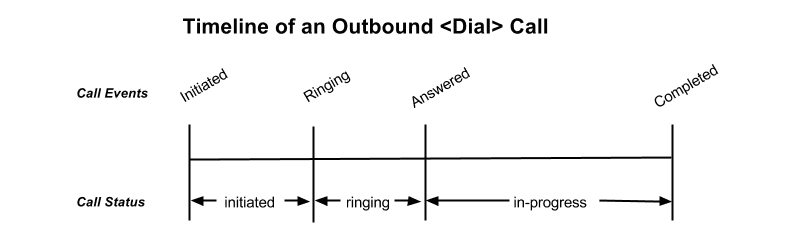
When dialing out to a Client using <Dial>, an outbound call is initiated. The
call transitions from the initiated state to the ringing state when the
phone starts ringing. It transitions to the answered state when the call is
picked up, and finally to the completed state when the call is over. With
statusCallbackEvent, you can subscribe to receive webhooks for the different
call progress events: initiated, ringing, answered, or completed for a
given call.
The statusCallbackEvent attribute allows you to specify which events Twilio
should call a webhook on. To specify multiple events separate them with a space:
initiated ringing answered completed. If a statusCallback is provided and no
status callback events are specified the completed event will be sent by default.
As opposed to creating an outbound call via the API, outbound calls created
using <Dial> are initiated right away and never queued. The following shows a
timeline of possible call events that can be returned and the different call
statuses that a <Dial> leg may experience:
| Event | Description |
|---|---|
initiated | This event is fired when Twilio starts dialing the call. |
ringing | This event is fired when the call starts ringing. |
answered | This event is fired when the call is answered. |
completed | This event is fired when the call is completed, regardless of the termination status: busy, canceled, completed, failed, or no-answer. If no StatusCallbackEvent is specified, completed will be fired by default. |
The statusCallback attribute allows you to specify a URL for Twilio to send
webhook requests to on each event specified in the statusCallbackEvent
attribute. Non-relative URLs must contain a valid hostname (underscores are not permitted).
The statusCallbackMethod attribute allows you to specify which HTTP method
Twilio should use when requesting the URL in the statusCallback attribute.
The default is POST.
The parameters Twilio passes to your application in its asynchronous request to
the StatusCallback URL include all parameters passed in a synchronous request
to retrieve TwiML when Twilio receives a call to one of your Twilio numbers.
The full list of parameters and descriptions of each are in the TwiML Voice
Request documentation.
When the call progress events are fired, the Status Callback request also passes these additional parameters:
| Parameter | Description |
|---|---|
| CallSid | Unique identifier for this call that Twilio generates. To modify the child call, make a POST request to Calls/{CallSid} with a new TwiML URL. |
ParentCallSid | A unique identifier for the parent call. |
CallStatus | A descriptive status for the call. The value is one of queued, initiated, ringing, in-progress, busy, failed, or no-answer. See the CallStatus section for more details. |
CallDuration | The duration in seconds of the just-completed call. Only present in the completed event. |
RecordingUrl | The URL of the phone call's recorded audio. This parameter is included only if record is set on the <Dial> and does not include recordings initiated in other ways. RecordingUrl is only present in the completed event. |
RecordingSid | The unique ID of the Recording from this call. RecordingSid is only present in the completed event. |
RecordingDuration | The duration of the recorded audio (in seconds). RecordingDuration is only present in the completed event. To get a final accurate recording duration after any trimming of silence, use recordingStatusCallback. |
Timestamp | The timestamp when the event was fired, given as UTC in RFC 2822 format. |
CallbackSource | A string that describes the source of the webhook. This is provided to help disambiguate why the webhook was made. On Status Callbacks, this value is always call-progress-events. |
SequenceNumber | The order in which the events were fired, starting from 0. Although events are fired in order, they are made as separate HTTP requests and there is no guarantee they will arrive in the same order. |
To notify your application of a call routing to a client user of the Voice SDK, call this URL. When handling your own push notifications to mobile client users, use this parameter. URLs must contain a valid hostname. This value can't include underscores. Parameter defaults to and only accepts POST.
It is possible to include additional key value pairs that will be passed to the Voice SDK device instance (Web or Mobile). You can do this by using the nested <Parameter> TwiML noun.
1const VoiceResponse = require('twilio').twiml.VoiceResponse;23const response = new VoiceResponse();4const dial = response.dial();5const client = dial.client();6client.identity('user_jane');7client.parameter({8name: 'FirstName',9value: 'Jane',10});11client.parameter({12name: 'LastName',13value: 'Doe',14});1516console.log(response.toString());
Output
1<?xml version="1.0" encoding="UTF-8"?>2<Response>3<Dial>4<Client>5<Identity>user_jane</Identity>6<Parameter name="FirstName" value ="Jane"/>7<Parameter name="LastName" value ="Doe" />8</Client>9</Dial>10</Response>
These custom parameters can retrieved using the SDKs. For the Voice JavaScript SDK, refer to Connection.customParameters, for iOS, refer to TVOConnectOption.params, and for Android, refer to ConnectOptions.getParams()
In this example, we want to connect the current call to a client named joey.
To connect the call to joey, use a <Dial> verb
with a <Client> noun nested inside.
1const VoiceResponse = require('twilio').twiml.VoiceResponse;23const response = new VoiceResponse();4const dial = response.dial();5dial.client('joey');67console.log(response.toString());
Output
1<?xml version="1.0" encoding="UTF-8"?>2<Response>3<Dial>4<Client>joey</Client>5</Dial>6</Response>
You can use up to ten total <Number> and <Client> nouns
within a <Dial> verb to dial multiple <Number>s and <Client>s at the same time. The first person to answer the call will
be connected to the caller, while the rest of the call attempts are hung up.
1const VoiceResponse = require('twilio').twiml.VoiceResponse;23const response = new VoiceResponse();4const dial = response.dial({5callerId: '+1888XXXXXXX',6});7dial.number('858-987-6543');8dial.client('joey');9dial.client('charlie');1011console.log(response.toString());
Output
1<?xml version="1.0" encoding="UTF-8"?>2<Response>3<Dial callerId="+1888XXXXXXX">4<Number>858-987-6543</Number>5<Client>joey</Client>6<Client>charlie</Client>7</Dial>8</Response>
In this case, we want to receive a webhook for each call-progress event when
dialing a Voice SDK device using <Dial>.
1const VoiceResponse = require('twilio').twiml.VoiceResponse;23const response = new VoiceResponse();4const dial = response.dial();5dial.client(6{7statusCallbackEvent: 'initiated ringing answered completed',8statusCallback: 'https://myapp.com/calls/events',9statusCallbackMethod: 'POST',10},11'joey'12);1314console.log(response.toString());
Output
1<?xml version="1.0" encoding="UTF-8"?>2<Response>3<Dial>4<Client5statusCallbackEvent='initiated ringing answered completed'6statusCallback='https://myapp.com/calls/events'7statusCallbackMethod='POST'>8joey9</Client>10</Dial>11</Response>