Guide

The Ultimate Guide to RCS ROI

Unlocking Revenue, Trust, and Engagement with Rich Communication Services

The Forces Redefining the Messaging Landscape

Messaging remains one of the most direct, high-converting channels available to businesses. Plain-text SMS and standard MMS have anchored customer communication for decades, offering unmatched open rates and instant reach. However, as digital habits evolve, these traditional formats are hitting natural limits:

  • Declining SMS value: With over 6 billion daily A2P texts clogging inboxes, declining trust and engagement have made reaching customers via SMS more expensive than ever.

  • Fraud and SMS spoofing: Rampant SMS fraud and spoofing have eroded consumer trust, making users hesitant to engage with unverified text threads.

Enter Rich Communication Services (RCS). 

RCS replaces plain-text SMS and standard MMS with branded, interactive, and secure messages delivered directly through a consumer’s phone’s native messaging app. Unlike SMS and MMS which are limited to plain text and basic, low-resolution media files, RCS supports rich media, interactive buttons, carousels, verified sender badges, and read receipts, all within a single message.

For businesses, RCS isn't just an upgrade: it's a game-changer, elevating text messaging from one-way broadcasts into branded, trust-building conversations.

Stylish person with glasses using a smartphone, surrounded by stars.

96% of business leaders plan to invest in or are already using RCS in 2026.

Why RCS Wins: A Quick Comparison

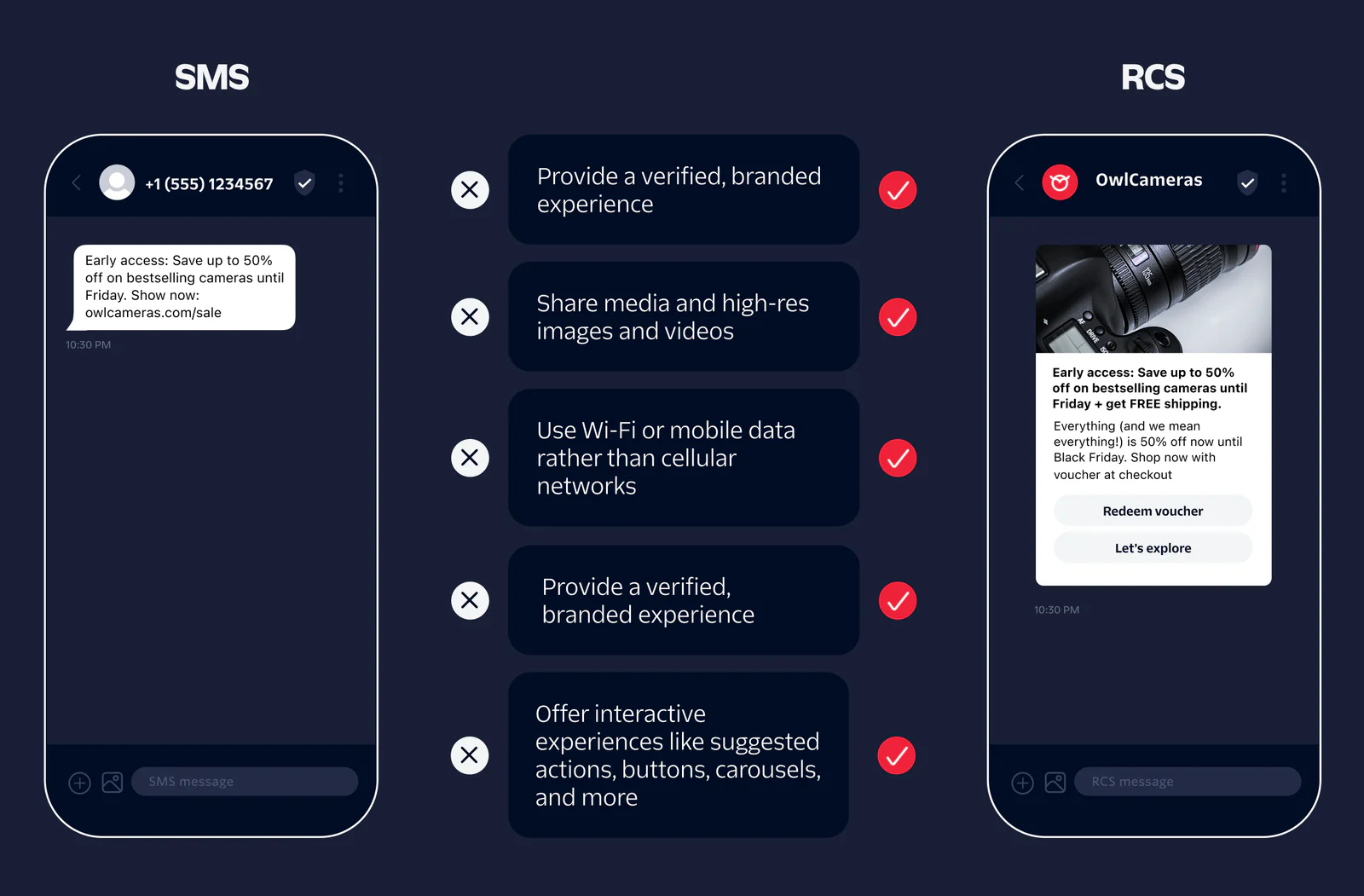
Metric/feature

SMS & MMS

Rich Communication Services (RCS)

Trust & Security

Anonymous long/shortcodes; vulnerable to spoofing

Verified sender badge with company name and logo

User Experience

Plain text or heavily compressed media files

High-res image/video carousels & quick-reply action buttons

Engagement

Dynamic links; limited visibility into opens

Direct actions, read receipts, & real-time typing indicators

Image comparing the features of SMS and RCS messaging, highlighting benefits like branding and interactive experiences.

Winning Over Your Team

Thinking about adding RCS to your communications strategy, but need to prove it’s actually worth the investment?

We get it, securing buy-in isn't easy. Executives want proof, marketing teams need hard benchmarks, and product leaders need realistic integration timelines. This guide delivers all three.

If you're ready to make the case for RCS, this playbook is your shortcut. Backed by original Twilio research, Twilio customer data, and Forrester Total Economic Impact™ analysis, this guide will show you how to model ROI, map out implementation, and build a rock-solid business case your leadership team can get behind.

Try Twilio's RCS ROI Calculator

Use our interactive calculator to compare SMS, RCS Rich, and RCS Rich Media and see which channel will bring you the highest ROI for your unique use case.

3D red and black dollar sign with a shadow effect.

Chapter 1

What RCS Delivers: Trust, Engagement, and Analytics

RCS is more than a new channel. It's a fundamentally different way to communicate with customers. Here's what it delivers.

The Three Pillars of RCS

1. Trust & Security Infrastructure

Features:

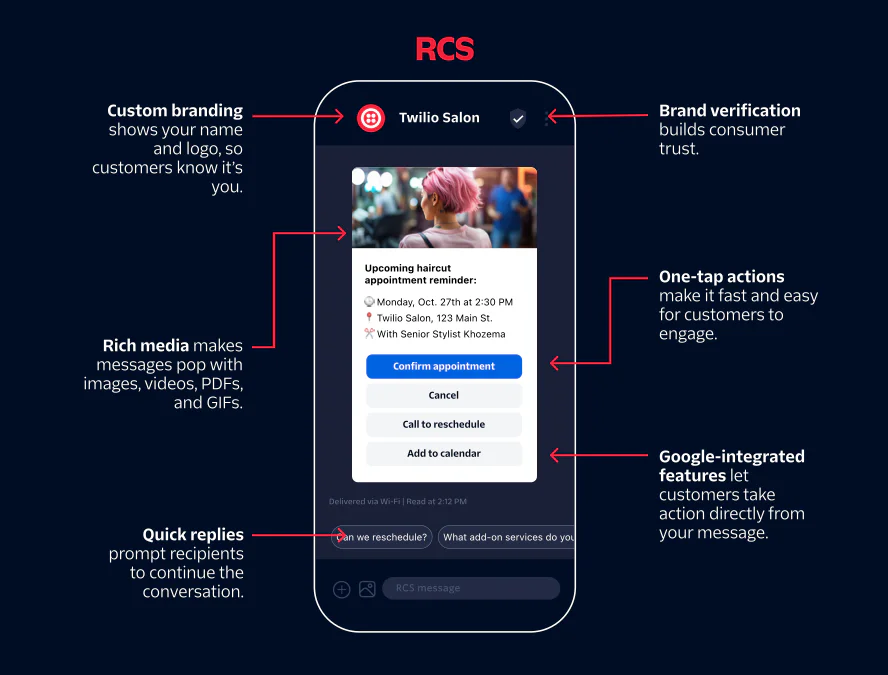
  • Branded identity: No anonymous or generic shortcodes or long codes. RCS displays your logo, business name, and custom brand colors at the top of every conversation.

  • Verified sender badges: Carrier-authenticated verification checkmarks let consumers know at a glance that your message is the real deal.


2. Engagement &
Interactivity

Features:

  • Rich media: Send recipients high-res images, HD video, audio, and documents up to 100MB.

  • Interactive carousels: Product image carousels provide more engagement than multiple SMS or MMS messages trying to do the same.

  • Suggested replies & action buttons: One-tap replies and actions keep the conversation going and drive immediate action. 

  • In-thread webviews: Users can open lightweight browser windows directly within the messaging app.

3. Advanced Analytics & Attribution

Features:

  • Read receipts: Know exactly when a customer reads your message

  • Button-tap CTR: Understand which elements drive clicks.

  • Two-way messaging: Goodbye one-sided blasts. RCS lets customers reply directly to your brand.

  • Active typing indicators: See when customers are composing replies.

  • A/B testing: Just like with email, you can test copy, visuals, and CTAs to optimize on the fly.


**RCS messaging benefits showing features like custom branding, rich media, and quick replies.**

The RCS Engagement Benchmark: What the Data Shows

While rich messaging continues its rapid global adoption, performance benchmarks are clear: RCS consistently outperforms standard SMS across key performance indicators (KPIs). Here’s some research to back that up. 

According to Twilio’s The Communications Blueprint, switching from SMS to RCS yields:

  • +29% higher conversion rates

  • +12%higher click rates (CTR)

  • +38% higher average order value (AOV)


And Forrester Consulting’s New Technology: The Projected Total Economic Impact™ Of RCS For Business (Feb 2026), commissioned by Google, found a composite customer to achieve:

  • +60–70% higher conversion rates for marketing campaigns
  • +0.5% -1.5% improvements in customer retention 
  • $1.3M - $2.2M in projected Net Present Value

Whether you start with basic brand verification or jump straight to interactive rich media, the outcome is clear: higher trust, faster responses, and significantly lower cost per action.

Customer RCS Success Stories

Here’s how three businesses upgraded to RCS for major ROI:

Logistics

The Lowe's logo in white with a house-shaped outline above the text.

By using RCS for delivery updates, Lowe’s slashed failed redeliveries by 20%, driving major cost savings.

Healthcare Tech

White Audibene logo with stylized wave on a transparent background.

RCS became audibene’s second most important channel and reduced cost-per-conversion up to 9x versus SMS.

Finance

Logo of Novagestões with the slogan Recuperação de Ativos

RCS’s branded verification helped Nova Gestões secure customer trust and achieve a 4x higher response rate than SMS.

Chapter 2

RCS Economics — Does it Cost More?

Does RCS cost more than SMS or MMS? The answer is nuanced.

We recommend using a fully loaded cost model to ensure that nothing is missed. Items for consideration can include: 

  • Usage fees: Per segment, per message, or per volume pricing 
  • Platform subscription fees: Recurring platform fees from your messaging provider
  • Carrier fees: Per-message surcharges that vary by wireless carrier and change often (e.g. quarterly)
  • One-time onboarding and compliance costs: One-time setup costs for brand registration, carrier authentication, and sender approval
  • Engineering integration time: Initial engineering hours for API configuration and workflow setups

Comparing message costs in isolation doesn’t give you the full picture. When you measure total cost against actual customer actions — conversions, purchases, or resolved inquiries — RCS consistently delivers a lower cost per acquisition. More on this when we discuss ROI. 

In the meantime, note that RCS does have pricing advantages over SMS in some instances:

Illustration of a hand holding a smartphone with a heart and button icons on the screen.

TIP:

SMS has a segment disadvantage.

Providers charge for messages in 160-character segments. Because RCS (UTF-8) handles emojis and special characters more efficiently than SMS (GSM-7), long messages often take fewer segments — and cost less — on RCS. 

How RCS Changes The Math

Here's what Twilio found after analyzing 500 million messages:

  • Average SMS message length: 1.9 segments

  • Average length if using RCS: 1.7 segments due to UTF-8 encoding.
     

This means that the average RCS message uses 10.5% less segments than SMS.  Here’s an example of how the math could work:

Cartoon woman smiling and waving, sitting by a laptop with an upward graph displayed on the screen.

Metric/feature

SMS & MMS

RCS

Segments per message

1.9

1.7

Usage cost/per segment*

$0.0083

$0.0083

Carrier fees per segment**

$0.0040

$0.0049

Cost Per Segment (Usage + Carrier Fees)

$0.0123

$0.0132

Avg. usage cost per message

$0.0234

$0.0224

* For illustrative purposes, Twilio charges the same price for RCS Rich that it does for SMS. 
** Fees vary by carrier. For estimating purposes, this analysis uses weighted average assuming 29% AT&T subscribers; 35% T-Mobile subscribers; 36% Verizon subscribers.

In this scenario, the average RCS is actually 4% less per message than SMS, even when accounting for carrier fees. Plus, you get branding, logos, verified checkmarks, and  quick-reply buttons, all at no additional cost. RCS with Rich Media (e.g. carousels, images, and interactive elements) is not charged by segment and will cost slightly more than MMS due to carrier fees.

Curious how switching from SMS to RCS impacts your message segment costs?

Try Google's RCS tool and Twilio's SMS segment calculator to compare segment lengths.

Chapter 3

Measuring RCS ROI

Ready to measure RCS success and ROI? Here are the formulas, real examples, and benchmarks you need to make a strong business case for the channel.

Real-World Example: How to Calculate RCS ROI for an Online Retailer

To keep things simple, we’ll focus on one clear metric: how RCS outperforms SMS in driving revenue from retail abandoned carts. Now, let's put this formula to work.

Imagine a mid-sized online retailer uses Twilio to send 600,000 cart abandonment messages every month. To measure the impact of upgrading to RCS from SMS, they split their audience into three equal groups.

  • Group 1: Using SMS

  • Group 2: Using RCS Rich to send trusted messages with their company name, logo, quick replies, buttons and a verified badge.

  • Group 3: Using RCS Rich Media to include interactive image carousels, location sharing, in-app web views and more.

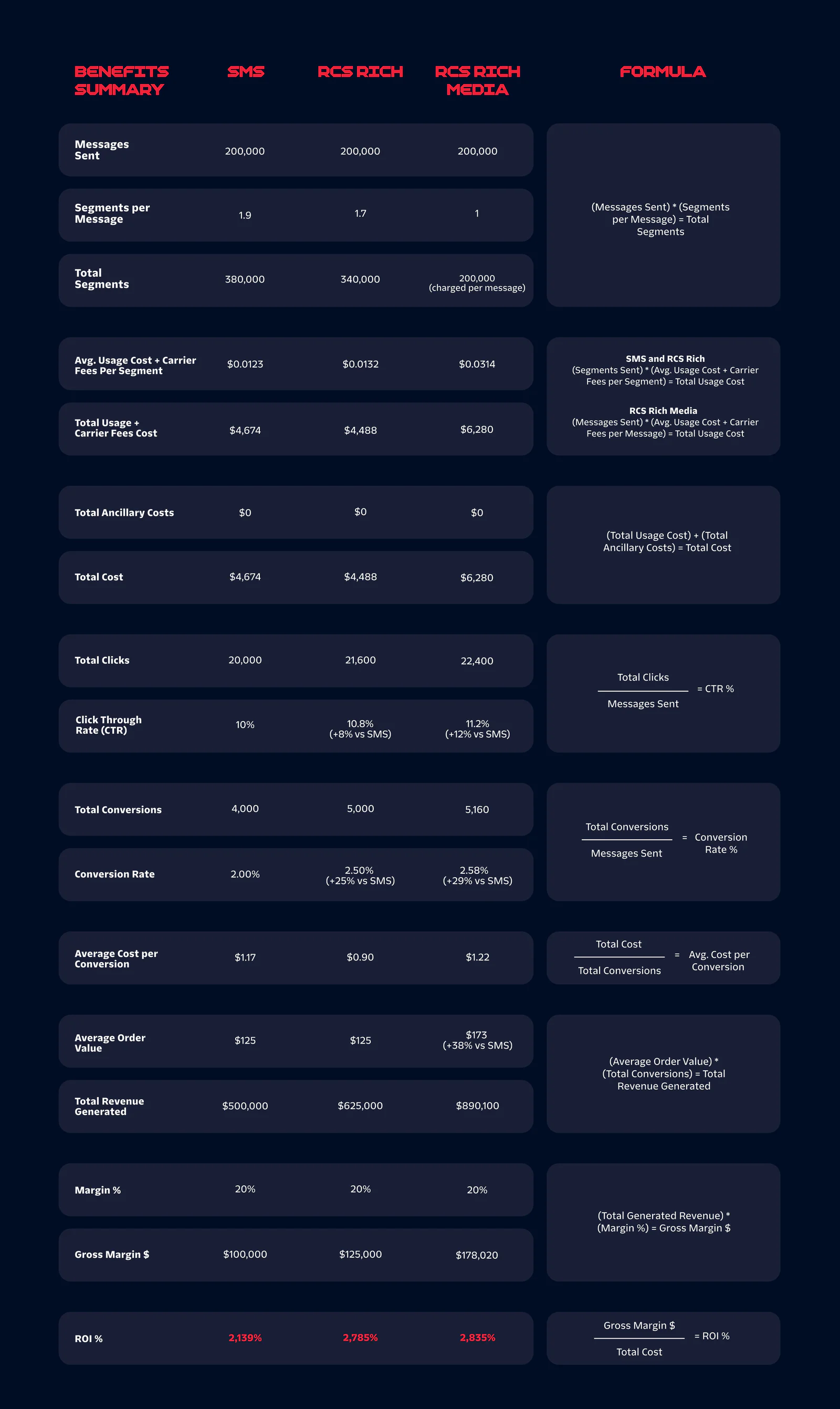
Here is what the data revealed at the end of the test using the Twilio benchmarks highlighted above:

By using RCS for abandoned cart campaigns, this retailer found the opportunity to:

  • Increase their conversion rate by 29% and CTR by 12% if choosing RCS Rich Media.

  • Drive an incremental 1,160 conversions and $190k in top line revenue if choosing RCS Rich Media.

  • Decrease their average cost per conversion by 27% if choosing RCS Rich.

The ROI clearly pays off for this retailer whether these choose to use RCS Rich or RCS Rich Media. Using a 20% margin, they have the opportunity for +646% or +696% in ROI over SMS respectively.

Graph and pie chart illustration on red background representing data analysis.

Want to calculate your RCS ROI?

Use our interactive calculator to model ROI based on your volume and business situation.

Chapter 4

Your RCS Deployment Roadmap

Ready to launch? Here's your phased roadmap.

Phase 1

Test Small, Learn Fast (Weeks 1–4)

Before rolling out RCS across your entire subscriber base, validate performance with a focused pilot program. 

Pick your highest-engagement use case (e.g., cart abandonment, appointment reminders, OTP delivery) and then dedicate a subset of traffic — say, 10% of your audience — to RCS while maintaining SMS as control. This will help you compare the performance and costs of these two channels before scaling. 

Pilot scope:

  • 10,000–50,000 test users

  • One use case

  • Duration: 2–4 weeks (enough for statistical significance)

  • Compare against SMS control group
     

Phase 2

Measure, Analyze, Optimize (Weeks 5–8)

Next, it’s time to analyze your data to determine if RCS outperformed SMS and, if so, by how much? Measure:

  • Open rates (read receipts)

  • Click-through rates

  • Conversion rates

  • Revenue per message

  • Cost per conversion

Based on your findings you have three options:

  1. If RCS outperforms the other channel, move to Phase 3. 

  2. If SMS still holds its own, keep things as they are and only shift traffic where RCS clearly earns its keep.

  3. If results are inconclusive, A/B test different creative or try a different use case.

Phase 3

Scale (Weeks 9–16)

With your proof in hand, it’s now time to scale. You can expand RCS to 30%–50% of your traffic for that use case or add a second use case to build an internal business case for leadership.

During this phase:

  • Set up automated dashboards and reporting

  • Run continuous A/B tests to optimize creative and send times

  • Present early wins to leadership and request increased budget

  • Optimize delivery by registering your brand with carriers, cleaning subscriber lists, monitoring complaint rates, and segmenting traffic by use case

Phase 4

Enterprise Deployment
(Month 5+)

Lastly, it’s time to roll out RCS across all use cases and traffic cohorts and fully integrate RCS into your messaging playbook. Be sure to measure ongoing ROI quarterly and continue to test and optimize your use of the channel.


Is RCS actually where your customers want to hear from you?

Check out the latest consumer preference data to see how your messaging strategy should shift by region, generation, and use case.

Conclusion

The RCS Future is Now

The shift from SMS to RCS isn't coming — it's already here.

Moving to rich messaging isn't just a win for your bottom line; it's what your customers actually want, with 81% of consumers preferring RCS over standard text messages.

While SMS is still a strong channel, it simply can't match the modern capabilities of RCS — namely, how it:

  • Restores trust: Verified Sender badges eliminate spam friction and build instant credibility.

  • Drives engagement: Interactive carousels and single-tap action buttons convert passive readers into buyers.

  • Improves efficiency: Higher conversion rates cut your cost per action while maximizing revenue per send.

Your next step is simple: start small. Pick a high-value use case, route 10% of your traffic to RCS, and run a 30-day control test. Once you measure the lift, you will have the hard proof needed to secure leadership buy-in and scale.

Want to calculate your RCS ROI?

Stop sending boring plain-text messages and start delivering verified, high-converting RCS experiences right to your customers' native messaging apps.

Cartoon cyclist in helmet and jacket checking smartphone next to a bike.