We’ve all been there—contacting customer experience teams, repeating your issue, and re-explaining past conversations because their systems aren’t connected. You’d think this wouldn’t happen in 2025, yet it still does.
Customer experience teams aim to provide seamless omnichannel experiences, but disconnected tools often get in the way. Instead of a costly rip-and-replace approach, augmenting your existing tech stack with open APIs and AI-powered solutions offers a smarter, more scalable path to improved customer experiences and business growth.
With an open API-first approach, your systems can integrate in near real-time across email, SMS, social media, and support portals—ensuring every interaction maintains context. AI-powered solutions like predictive routing, intelligent chatbots, and near real-time analytics further enhance engagement by automating responses, surfacing customer insights, and optimizing interactions across channels. Unlike closed systems with rigid constraints, open APIs let you enhance existing tools, scale dynamically, and avoid unnecessary licensing fees or call limits.
The benefits? Seamless experiences across all customer touchpoints, richer data insights, and more effective customer journey mapping. Implementation can be gradual—starting with key channels, unifying data, ensuring consistent messaging, and leveraging cross-channel analytics to refine engagement strategies.
Case study: How Universidad Uk optimizes student and employee omnichannel experiences with AI
Use case: Omnichannel
Industry: Education
Region: Global
Product: Flex
Universidad Uk leveraged Twilio Flex to achieve high ROI by transforming its student engagement through omnichannel communications. By integrating near real-time student data with Twilio Flex’s scalable contact center platform, the university personalized interactions and provided 24/7 customer experience support via WhatsApp, SMS, and voice. Twilio’s Unified Profiles and Agent Copilot streamlined operations, reducing agent handle time by 30% and improving conversion rates by 25%. The flexibility of Twilio’s APIs enabled Universidad Uk to customize its contact center, integrating seamlessly with CRM systems and third-party applications to optimize student interactions.
The university also enhanced lead generation and operational efficiency with Twilio-powered chatbots and automation. Chatbots pre-qualified prospective students, improving conversion rates by 2.5X and reducing enrollment time by 60%.
The ROI impacts speak for themselves
Companies leveraging AI-driven omnichannel solutions see:
• Higher sales through near real-time, personalized engagement across multiple channels
• Improved customer retention with proactive AI-powered support and predictive insights
• Significant cost savings by automating workflows, reducing manual effort, and optimizing agent efficiency
By following best practices—gradual implementation, ongoing staff training, performance monitoring, and customer feedback loops—businesses can transform disconnected channels into a unified, AI-driven system that delivers seamless, data-driven engagement across every touchpoint.
One company that has successfully implemented this approach is Universidad Uk, a digital-first university serving students across Latin America and the U.S. Faced with the challenge of delivering high-quality, personalized student experiences at scale, the university turned to Twilio Flex and AI-powered automation to transform its engagement strategy. By integrating omnichannel communications, real-time analytics, and intelligent automation, Universidad Uk not only improved student support but also achieved significant operational efficiencies and cost savings. Here’s how they did it.
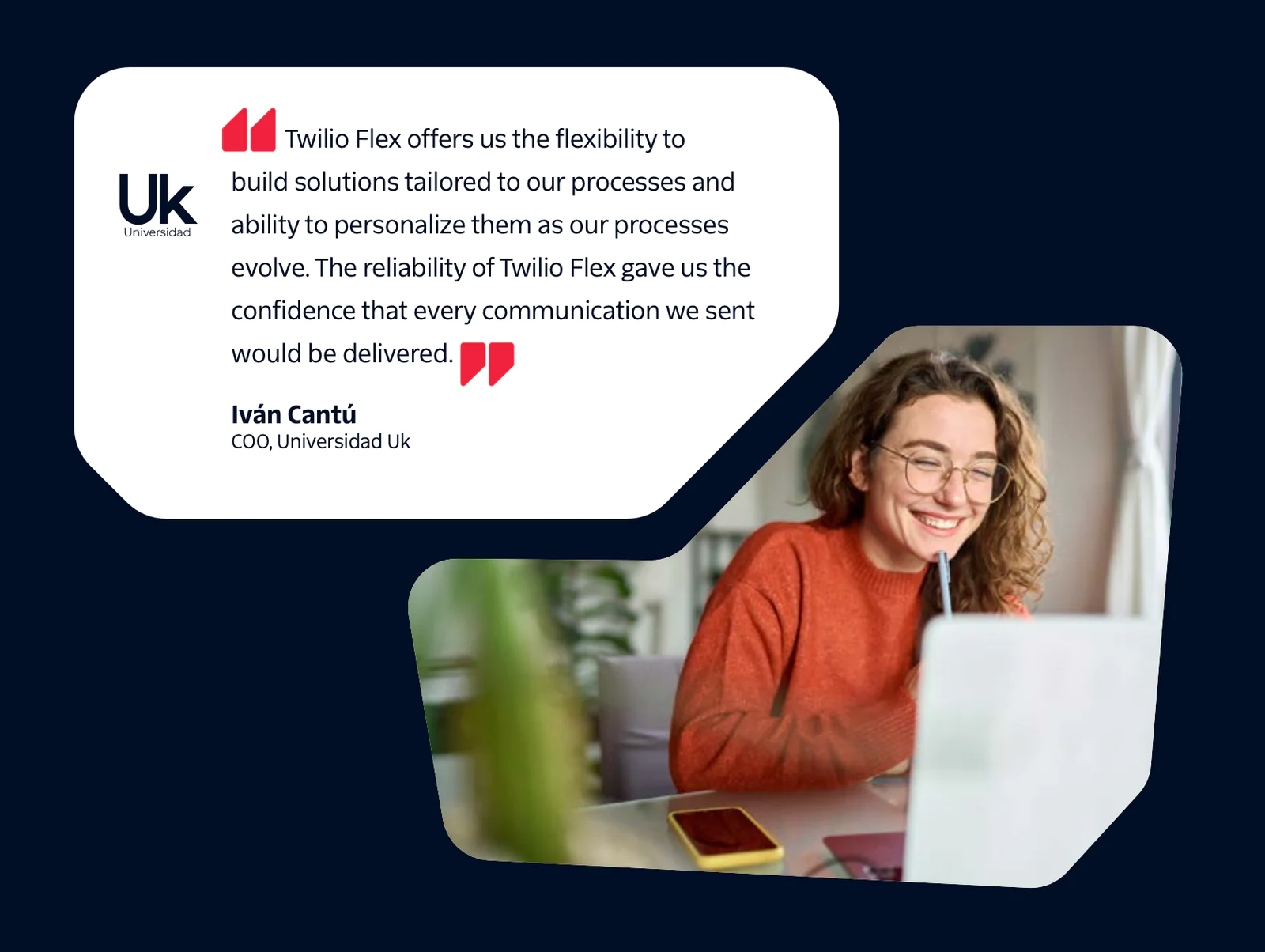
The implementation of a supervisor chatbot ensured accurate lead management, cutting manual data validation tasks significantly. Additionally, Universidad Uk consolidated all conversational data into a single portal, reducing audit-related work hours by 45%.
By leveraging Twilio’s advanced AI and omnichannel capabilities, Universidad Uk improved both student experience and operational efficiency, driving measurable business impact.