Choosing the right channel for your message
In modern communications, the phrase "the medium is the message" holds true. Choosing a channel shouldn't be a guessing game or a matter of convenience — it must be a deliberate, strategic decision. Every digital touchpoint carries a unique psychological weight, meaning that using the wrong channel can transform a helpful update into an intrusive annoyance.
To choose the right channel, you need to know what your options are. To help, here’s a brief overview of the main channels you have at your disposal and their top use cases:
Channel breakdown and top use cases
|
Channel |
Best for... |
Key use cases |
|---|---|---|
|
|
Long-form content and records |
Account signups, password resets, order confirmations, and newsletters |
|
SMS/MMS |
High-urgency and brevity |
One-time passwords (OTP), appointment reminders, fraud alerts, order and delivery notifications |
|
RCS |
High-urgency and rich media |
Marketing messages, OTP, appointment reminders, fraud alerts, order and delivery notifications |
|
|
Rich, global conversations |
Two-way customer support, international shipping updates, and branded chat experiences |
|
Push notifications |
Driving app engagement |
Order and delivery notifications, promotional alerts, and re-engagement prompts |
|
Voice calling |
Complexity and empathy |
High-value sales, sensitive security issues, and resolving nuanced support tickets |
Beyond the channel's basic function, your selection should also consider the timeliness and criticality of your message, regional and generational preferences, and the use case of your message. Let’s explore each of these in more depth:
1. Timeliness and business criticality
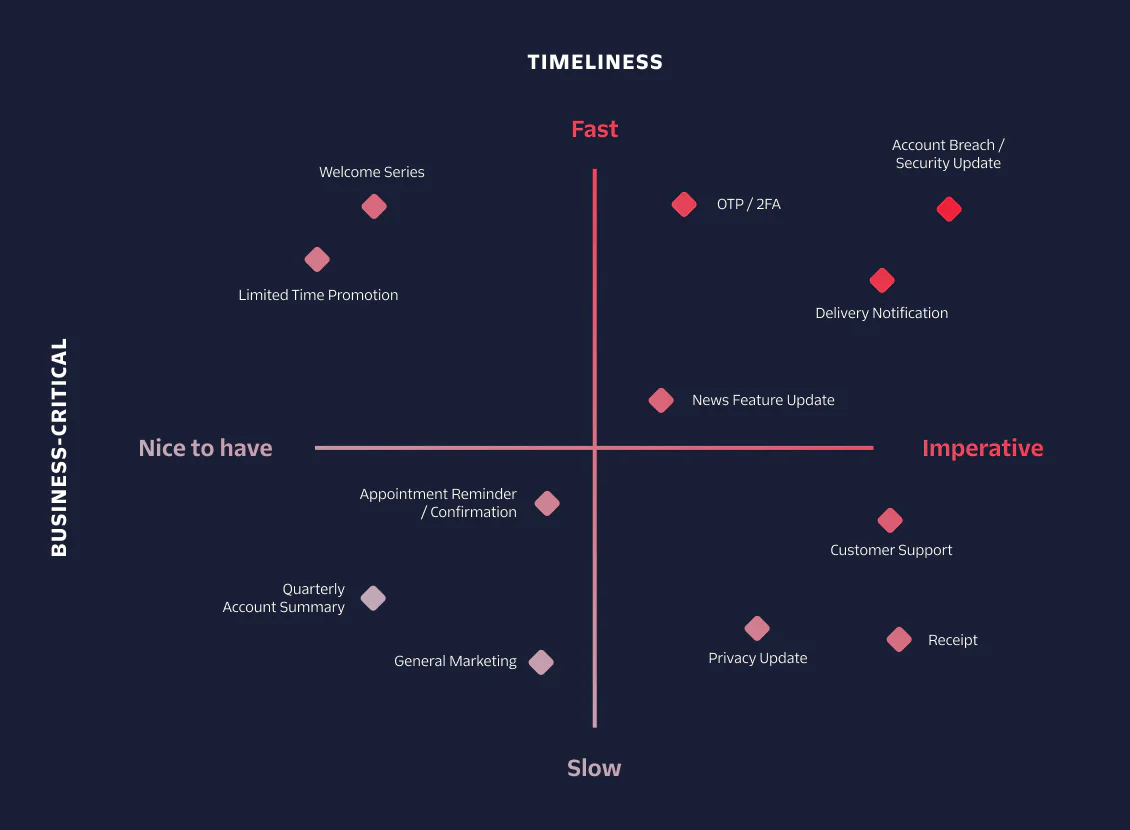
To ensure your message cuts through the noise without overstepping, you must evaluate every notification through the lens of two primary dimensions: timeliness and business-critical.
Fast urgency: Does the customer need this information to take immediate action? (e.g., a fraud alert or a ride-share driver arrival)
Slow urgency: Is the information evergreen or not time sensitive? (e.g., a monthly newsletter or a loyalty point update)
All notifications and alerts are urgent, but some are more appropriate for time-sensitive notifications than others. How quickly you need your message to be read by a customer plays a large role in selecting what channel to send it on.
- Imperative: Is this message essential to the customer’s safety, security, or the completion of a transaction? (e.g., a 2FA code or a flight cancellation)
Nice-to-have: Is this a nice-to-have update designed to build brand loyalty or drive incremental sales? (e.g., a back in stock alert or sale announcement)
Now, using your answers from above, map your notification onto the quadrant below to determine where your message falls on the spectrum.
First, plot your notification using the chart below. Then, use the "Channel breakdown and top use cases" table above to determine if your message is better suited for a persistent inbox (email), a real-time notification (SMS/MMS/RCS/Push/WhatsApp), or a direct intervention (voice).
The communication timeliness vs. business-critical matrix
2. Regional preferences
Next, you’ll want to think about where your audience is, as certain geographic preferences play into your messaging strategy. Across our research, we found a few key regional differences you should know about.
Remember, 87% of consumers are multi-channel so we are presenting the percent of time a consumer cited a channel in their top three preferred channels:
Global consumers top 3 ranked branded communications channels
|
Channel |
Total |
NAMER |
EMEA |
APAC |
LATAM |
|---|---|---|---|---|---|
|
|
75% |
77% |
79% |
70% |
72% |
|
Text Messaging (RCS/SMS/MMS) |
56% |
77% |
51% |
59% |
39% |
|
|
57% |
14% |
63% |
62% |
84% |
|
Phone Call |
50% |
60% |
50% |
49% |
41% |
|
Push notifications |
27% |
30% |
25% |
30% |
24% |
-
Email is still king
Across all regions, 75% of users rank email in their top three preferred channels. It may not be the most instant channel, but it is inescapable. In fact, 94% of consumers report checking their inbox within 24 hours, making email the "oldie but goody" channel that continues to deliver the most consistent reach.
-
NAMER runs on text messaging
While users often claim they want to reserve texting for friends and family, the data tells a different story. In North America, text messaging remains the undisputed champion for speed and visibility; it is the most effective way to ensure a message is not just delivered, but actually read.
-
WhatsApp is what’s up in LATAM
For this region, WhatsApp is the primary communication engine regardless of context. Across nearly every use case, LATAM consumers heavily cite WhatsApp as a top three preferred channel compared to traditional SMS. If you’re doing business in the region, WhatsApp isn't just an option — it’s an imperative.
-
Push notifications remain a secondary channel
Only 27% of consumers list push notifications as a top-three preference, clearly marking it as a secondary channel. While business leaders often desire to use push for real-time engagement, it works best as a "nudge" to complement your primary communication pillars rather than leading the charge.
"Hello, may I speak to LATAM?"
When we asked consumers which channels they want businesses to adopt, 68% of LATAM respondents said WhatsApp Business Calling. LATAM consumers see this OTT giant as a high-speed support hub, with customers craving the intimacy of a phone call with the convenience of their favorite app. It’s time to stop typing and start talking if you want to win over this market.
Of course, these findings aren’t meant to make you abandon your current channel strategy. They’re aimed at helping you fine-tune your orchestration, ensuring you meet customers exactly where they are — whether that’s a WhatsApp thread in Brazil or an email inbox in New York.
3. Generational preferences
How old your audience is might impact their channel preferences as well. When it comes to generational communications preferences, we found a few key differences:
Older generations are more likely to prefer email, SMS/MMS/RCS, and phone calls
Younger consumers are more likely to embrace WhatsApp and push notifications
That’s not to say younger generations are anti-email or anti-text messaging — far from it. However, as digital natives, Gen Z and Millennials are simply more open to brands meeting them where they already spend their time. For them, a WhatsApp message or a push notification feels like a natural part of their day — not an intrusion.

Consumers’ top 1-3 preferred channels, by generation
|
Channel |
Total |
Gen Z |
Millenial |
Gen X |
Boomer |
|---|---|---|---|---|---|
|
|
75% |
68% |
75% |
77% |
79% |
|
Text Messaging (RCS/SMS/MMS) |
56% |
50% |
51% |
59% |
70% |
|
|
57% |
63% |
64% |
56% |
43% |
|
Phone Call |
50% |
47% |
45% |
51% |
61% |
|
Push notifications |
27% |
31% |
28% |
26% |
23% |
If your customer base spans every age group, these differences can feel like a lot to juggle. But if you have a specific target audience, this data can help narrow down your channel selection. Instead of trying to be everywhere at once, use these generational cues to double down on the channels that actually move the needle for your specific demographic.
4. Use case preferences
A strong communication strategy requires understanding how preferences shift based on the message's purpose. Whether it’s a critical one-time password, a high-touch customer support interaction, or a personalized promotional message, consumers have clear boundaries around how they want brands to reach out to them.
In this section, we’ll break down these preferences by use case, giving you the insights needed to tailor your approach to the unique habits of your global audience.
Leading channels by use case (Top 3 weighted preferences)
|
Channel |
OTP/2FA |
Time-sensitive notifications |
Non-urgent notifications |
Support/customer service |
Marketing and promotions |
|---|---|---|---|---|---|
|
|
71% |
73% |
80% |
74% |
83% |
|
Text Messaging (RCS/SMS/MMS) |
76% |
80% |
64% |
54% |
61% |
|
|
46% |
12% |
44% |
48% |
41% |
|
Phone Call |
27% |
45% |
24% |
47% |
20% |
|
Push notifications |
31% |
34% |
36% |
23% |
38% |
|
Web/social media chatbot interactions* |
- |
- |
- |
13% |
- |
*Option only surveyed for support/customer service use case
Urgency makes allowances for channel intrusiveness such as voice
Consumers only tolerate highly intrusive channels (phone calls, SMS) when the information is urgent or security-related. For example, while 44% of consumers prefer phone calls for time-sensitive alerts and 47% for customer support, these numbers plummet to 20% for marketing and 24% for non-time-sensitive updates.
5. Industry preferences
Your business’ industry can also impact where and how customers want to hear from your brand. For example, consumers might be more forgiving of their bank sending them a text message about a fraud alert compared to a retailer texting them about a new promotion.
To find out, let’s dive into these industry-specific findings below:
Whether it’s banking, insurance, or investments, your customers need to know they can trust your communications, especially when their money is involved. Here’s how people prefer their financial providers reach out to them:
Top 1-3 channel preferences for financial services communications, by region
|
Channel |
Total |
NAMER |
EMEA |
APAC |
LATAM |
|---|---|---|---|---|---|
|
|
77% |
76% |
79% |
78% |
74% |
|
Text Messaging (RCS/SMS/MMS) |
64% |
73% |
62% |
67% |
51% |
|
|
37% |
9% |
31% |
42% |
66% |
|
Phone Call |
37% |
53% |
37% |
34% |
24% |
|
Push notifications |
30% |
29% |
29% |
34% |
27% |
Top 1-3 channel preferences for financial services communications, by generation
|
Channel |
Total |
Gen Z |
Millenial |
Gen X |
Boomer |
|---|---|---|---|---|---|
|
|
77% |
73% |
76% |
78% |
82% |
|
Text Messaging (RCS/SMS/MMS) |
64% |
59% |
62% |
66% |
69% |
|
|
37% |
38% |
39% |
38% |
29% |
|
Phone Call |
37% |
40% |
35% |
32% |
45% |
|
Push notifications |
30% |
31% |
34% |
29% |
24% |
As you might expect, email (77%) and text (64%) are the big winners globally, and we found that those preferences actually get stronger as customers get older. But when you look at LATAM, the story changes a bit — WhatsApp is still the favorite there, beating out text with 66% of consumers ranking it as a top channel compared to 51% for text messaging.
That said, people still value a human voice. It turns out Gen Z and Boomers are actually the two groups most likely to pick up the phone when they have a question for their financial institution.
Sending out new product announcements, promotions, and transactional messages? Here’s where your customers want to hear from you:
Regional channel preferences for retail communications (Top 3 weighted preferences)
|
Channel |
Total |
NAMER |
EMEA |
APAC |
LATAM |
|---|---|---|---|---|---|
|
|
79% |
82% |
84% |
72% |
76% |
|
Text Messaging (RCS/SMS/MMS) |
58% |
65% |
54% |
63% |
50% |
|
|
41% |
12% |
39% |
48% |
64% |
|
Phone Call |
21% |
34% |
19% |
21% |
13% |
|
Push notifications |
34% |
35% |
29% |
41% |
29% |
Generational channel preferences for retail communications (Top 3 weighted preferences)
|
Channel |
Total |
Gen Z |
Millenial |
Gen X |
Boomer |
|---|---|---|---|---|---|
|
|
79% |
75% |
78% |
80% |
82% |
|
Text Messaging (RCS/SMS/MMS) |
58% |
54% |
54% |
60% |
67% |
|
|
41% |
44% |
44% |
41% |
34% |
|
Phone Call |
21% |
18% |
21% |
20% |
27% |
|
Push notifications |
34% |
36% |
38% |
31% |
28% |
When it comes to retail, email is the undisputed leader — hitting a higher preference here than in any other industry we looked at. Globally, 79% of shoppers prefer it, and that number climbs as high as 84% in EMEA. We also saw push notifications perform better in retail than anywhere else. On the flip side, phone calls are consistently consumer’s least favorite option. Only 21% of people globally want a call from a retailer, and that preference really bottoms out in LATAM (13%).
Whether it’s sharing private health records, sending appointment reminders, or providing general medical updates, let’s right dive into how consumers prefer to hear from their healthcare providers:
Regional channel preferences for healthcare communications (Top 3 weighted preferences)
|
Channel |
Total |
NAMER |
EMEA |
APAC |
LATAM |
|---|---|---|---|---|---|
|
|
69% |
73% |
73% |
65% |
66% |
|
Text Messaging (RCS/SMS/MMS) |
62% |
75% |
64% |
63% |
45% |
|
|
45% |
9% |
41% |
52% |
77% |
|
Phone Call |
46% |
63% |
46% |
43% |
32% |
|
Push notifications |
23% |
24% |
19% |
28% |
21% |
Generational channel preferences for healthcare communications (Top 3 weighted preferences)
|
Channel |
Total |
Gen Z |
Millenial |
Gen X |
Boomer |
|---|---|---|---|---|---|
|
|
69% |
67% |
69% |
70% |
72% |
|
Text Messaging (RCS/SMS/MMS) |
62% |
58% |
60% |
64% |
69% |
|
|
45% |
48% |
49% |
46% |
34% |
|
Phone Call |
46% |
48% |
44% |
42% |
51% |
|
Push notifications |
23% |
24% |
26% |
22% |
20% |
Even though email and text are still big players, people are much more likely to want a real conversation when it comes to their health. In fact, phone calls are a major part of the healthcare experience, with 46% of people ranking them as a top three channel — and that number jumps to 63% in North America. This is especially true for Boomers, over half of whom (51%) still count on the phone to stay on top of their care.