Eliminating Agent Amnesia and Data Fragmentation
Instead of letting disparate AI initiatives compound data fragmentation, organizations require a single, governed foundation. We built Twilio Segment to serve as the deterministic infrastructure that powers the AI systems you build and connects to Twilio's overarching AI infrastructure—bringing context closer to conversations in a way that's model agnostic and tech stack friendly. You pick the model and the agent runtime; we provide the unified data pipelines to ensure every AI investment builds on the exact same truth, eliminating redundant compute, custom data pipelines, and agent amnesia.


Pre-Computed Intelligence
Segment settles the factual questions—who this customer is and what their intent is—before any model ever runs. With native AI Predictions and Recommendations (such as churn risk, purchase propensity, lifetime value, and next-best-item), Segment puts out-of-the-box machine learning directly into the hands of growth teams—no data science resources required. Segment pre-computes this intelligence and either syncs it with your warehouse or makes it highly available in its Profile API so agents and downstream systems have answers ready at interaction time.
Businesses are actively embedding our predictive intelligence into their broader operational strategies, most frequently syncing these insights with platforms like Google Ads, Meta (Facebook), BigQuery, Iterable, and Mixpanel to optimize targeted ad spend, centralized data warehousing, marketing automation, and product analytics.
API-First Agentic Infrastructure
As the enterprise transitions from scripted bots to true agentic AI—goal-oriented systems capable of making independent decisions—our API-first architecture provides exactly what agent builders need to treat customer data in Segment as a programmable, queryable infrastructure.
Our Profile API delivers near real-time customer context, and our Audiences API enables the configurability autonomous agents require to make intelligent decisions. While the Public API and Config APIs allow teams to programmatically adjust data pathways and tracking rules as business or agent needs change. And for engineering teams running CI/CD workflows, Segment's Terraform provider and Git Sync extension bring infrastructure-as-code control—workspace configuration managed in version control, reviewed in pull requests, and deployed like any other piece of software. Once initially set up, Segment can run effectively headless with these APIs.
These developer-centric tools enable engineering teams to treat their data pipelines as code, ensuring that AI agents always have safe, up-to-date, and compliant access to data.
Connecting Systems of Record with Working Memory
This demand for semantic, point-of-conversation access is rewriting the rules of customer data infrastructure. CDPs remain incredibly effective at activating that deep enterprise system of record—unifying identities, historical traits, and preferences gathered over years of interaction. But active conversational AI operates on a different rhythm, demanding split-second, turn-by-turn awareness that static profiles weren't built to provide.
In an era where optimizing the LLM context window is a strategic imperative, passing an exhaustive, life-to-date customer profile into a live prompt just isn't practical. It’s a heavy lift that slows down response times, drives up token costs, and often leaves AI agents struggling with "digital amnesia" the moment a customer switches from a web chat to a voice call.
Forward-thinking solutions connect the long-term customer record with a nimble, real-time "working memory" of an agent conversation. Think of the CDP as the system of record, anchoring exactly who the customer is and what they’ve done historically. The working memory, meanwhile, acts as the AI’s instant recall. It captures the immediate, live context of what is happening right now across voice and chat, abstracting those interactions into lean, token-friendly summaries. By combining the deep foundational truth of a CDP with the agility of working memory, brands eliminate agent cold-starts—equipping autonomous systems with both comprehensive history and total situational awareness.


Powering Every Agent Conversation with Complete Customer Context
For these autonomous systems to operate safely and effectively, they must be grounded in both what a customer does (behavioral data) and what they say (conversational data). Twilio Segment is the only CDP connected directly to conversations that are happening across channels within Twilio's CPaaS infrastructure.
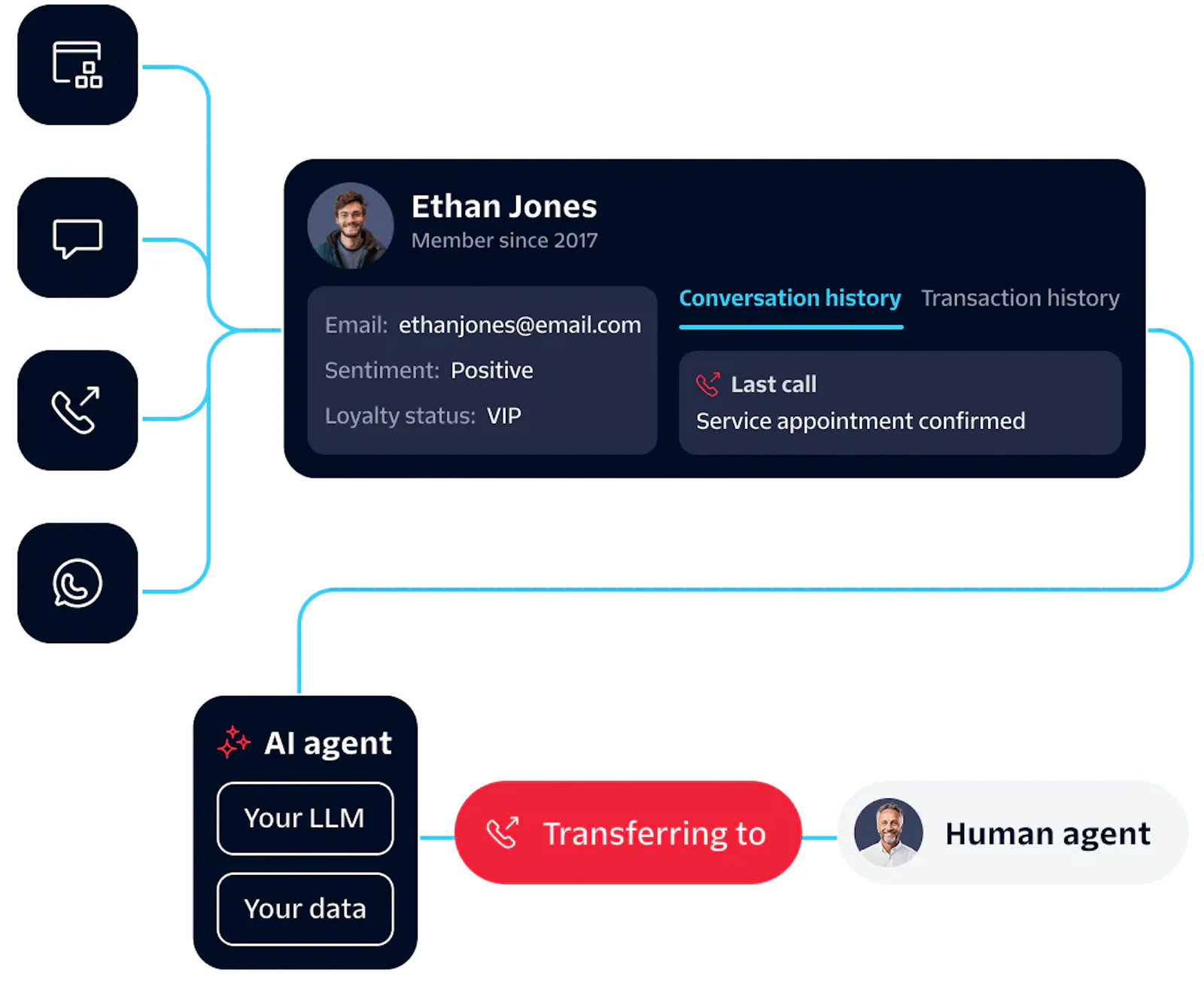
Twilio’s new Conversations layer turns fragmented interactions into continuous conversations with persistent memory (Conversation Memory), intelligent orchestration (Conversation Orchestrator), and real-time and post-interaction context for humans and AI agents (Conversation Intelligence). The Conversations layer works with any existing AI runtime and any LLM to provide the coordination, context, and intelligence required for AI and human agent powered-conversations.
Twilio Conversation Layer

Using our new integration (currently in private beta), unified customer data in Segment can flow directly into the Twilio Conversations ecosystem—effectively connecting the long-term system of record with the “working memory” of the live agent conversation.
By unifying behavioral data with conversational data, customer-facing agents finally get the complete picture that fragmentation makes impossible: who the customer is, what they've done, and what they've said across channels.
The result is full customer awareness that wasn't previously possible without months of custom data engineering. The agent knows the behavioral history, the predicted intent, the resolved identity, and the full conversation record.
Conversations never start from scratch, hallucinations are prevented by a constant stream of verified facts, and the customer always feels like the business knows them.