Human agent augmentation solution blueprint
Using AI for human augmentation lets you give every agent a "second brain" that listens, understands, and surfaces the right data at the right time. This allows your agents to focus on empathy, judgment, and complex problem‑solving rather than searching and note‑taking.
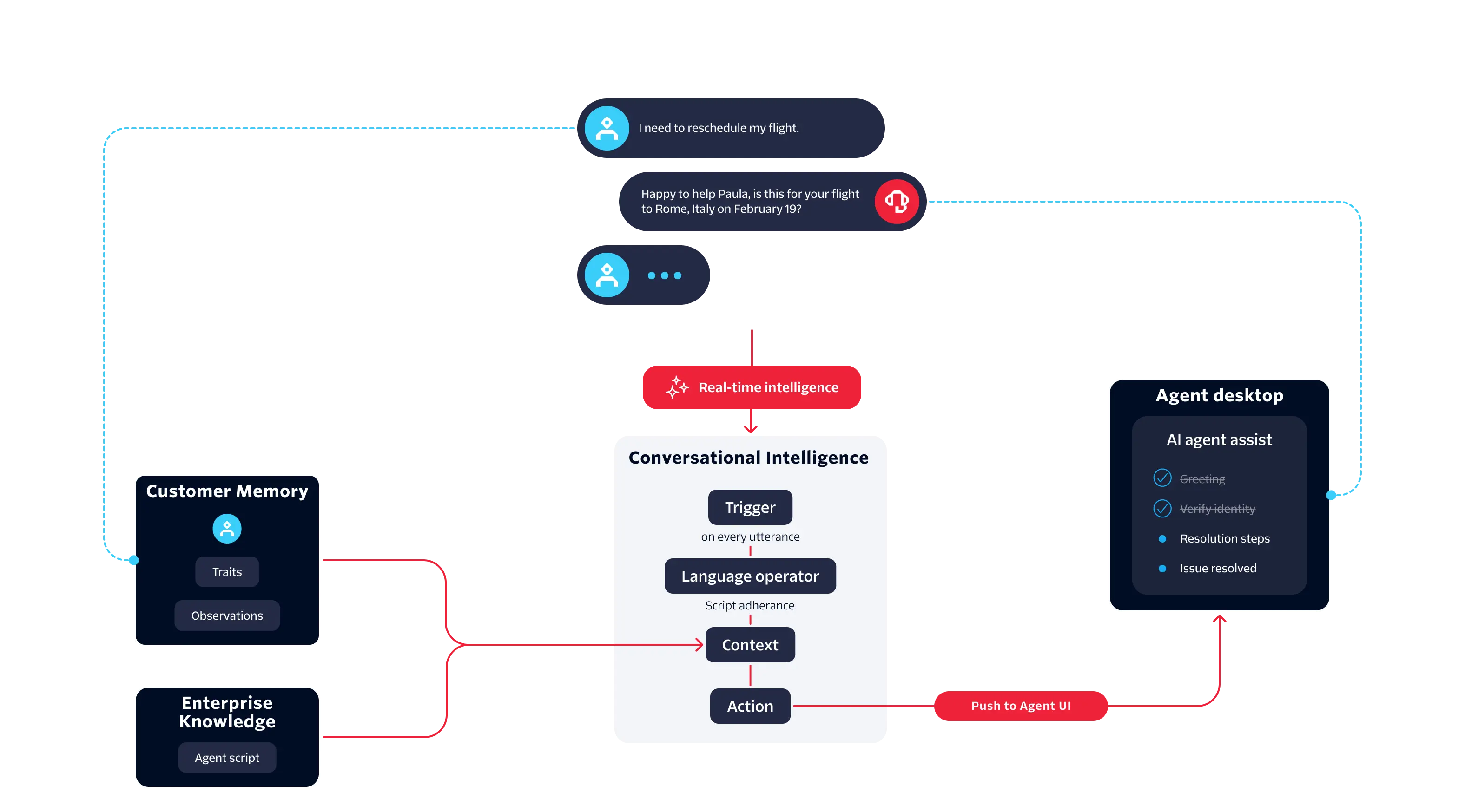
Twilio Conversations' agentic harness combines real-time conversational intelligence with orchestration, memory, and insight components. You can program human agent augmentation on Twilio so you can both:
- Implement conversational analysis to meet your business's unique needs.
- Integrate with existing systems and tools your agents use
As organizations adopt AI-driven customer engagement, many are exploring a spectrum of approaches from fully human-led interactions to autonomous AI agents. Human agent augmentation offers an accessible and flexible entry point on that journey, delivering meaningful gains in efficiency, personalization, and agent productivity while keeping experienced agents in the loop.
By pairing AI-powered intelligence with human judgment, teams can introduce AI assistance in increments. With each increment, teams observe how these insights perform in real customer interactions and refine workflows over time. This builds confidence while laying the foundation for more advanced automation in the future.
Human agent augmentation on Twilio implements a range of AI-powered capabilities in support of live agents before, during, and after customer interactions. These capabilities enhance agent effectiveness without removing human judgment from the loop. Consider the following use cases:
A low-friction entry point for augmenting live agents with AI occurs after an interaction has ended. Twilio analyzes completed conversations and generates structured outputs. In providing outputs like summaries, sentiment signals, and topic dispositions, the agents have less after-call work and can transition more quickly to their next interaction.
Agents remain fully in control of recorded or shared data. They can use AI-generated notes as a starting point then review, edit, or supplement them as needed. Wrap-up assistance improves efficiency and consistency while building familiarity and trust with AI-powered workflows in your teams.
Twilio can analyze conversations as they unfold and surface insights such as sentiment shifts, script adherence signals, or recommended next responses. These insights can be enriched with customer history and enterprise knowledge. With this data, agents can respond more confidently and consistently without searching across systems or interrupting the flow of the interaction.
Common examples include compliance guidance, objection handling suggestions, and knowledge-backed response recommendations delivered directly within the agent experience.
By combining real-time intelligence with orchestration, Twilio can start downstream workflows when it finds specific conditions met. These workflows could include escalating a conversation to a supervisor or triggering fraud-prevention activities. As these triggered workflows reduce human effort through the consistent and timely start of critical actions, the agents remain in control of customer-facing interactions.
Twilio can generate post-interaction summaries, sentiment scores, and compliance signals that feed quality-assurance, coaching, and analytics workflows.
AI-generated insights can help your teams identify trends, comply with policies, and flag conversation for review. Aggregated across interactions, these insights support training, performance management, and continuous optimization of agent experiences.
Conversation Intelligence provides the core capabilities that power human agent augmentation on Twilio. These features work together to deliver real-time understanding, contextual reasoning, and consistent analysis across channels.
Conversation Intelligence can process live streams of Twilio communications. Based on rule sets, these streams can trigger language operators during an active interaction. This integrates intelligence into the conversation. Human agents can benefit from real-time agent assist, proactive guidance, and actions during the conversation and get post-conversation analysis when interactions end.
Program GenAI-powered building blocks for conversational understanding. Language Operators transform raw conversation text into structured meaning, such as sentiment, summaries, intent, or domain-specific insights. These modular, reusable, and configurable operators help you control the analysis of conversations, the outputs returned, and when execution happens: in real time or after the conversation completes.
Unify Conversation Intelligence across voice, messaging, and chat. Conversation Intelligence integrates with Conversation Orchestrator to reason across multiple Twilio communication channels using a single Conversation object. This ensures consistent analysis and behavior regardless of whether an interaction occurs over Voice, SMS, WhatsApp, RCS, or Chat—without requiring channel-specific logic.
Context-aware intelligence grounded in your customer data and enterprise knowledge. Using Conversation Memory and Enterprise Knowledge, you can enrich your Conversation Intelligence. Leveraging stored knowledge, language operators can reason with historical customer context and business-specific information at runtime. This additional awareness improves accuracy, relevance, and consistency beyond what you can infer from conversation text alone.
Twilio augments the capabilities of human agents with a set of interoperable Conversations layer components. Together, these components analyze conversations in real time, apply context, and deliver actionable insights to agents and downstream systems. Each component plays a distinct role. You can adopt them incrementally based on your use case.
- Conversation Intelligence — Analyzes live conversations using AI-powered language operators that extract structured signals to guide agent actions and downstream workflows. Signals can include upsell opportunities, agent script adherence, compliance risks, and summaries. Includes a conversation insights capability that aggregates operator outputs across conversations for quality assurance and optimization.
- Conversation Orchestrator — Unifies agent and customer interactions across channels into a single conversational context and orchestrates when intelligence runs. Provides consistent delivery of real-time and post-interaction insights to human agents.
- Conversation Memory — Provides shared customer context that enriches conversational analysis and tailors insights to each customer's history and situation.
- Enterprise Knowledge — Provides business-specific information, policies, and procedures that ground language operator analysis in your domain.
Twilio built human agent augmentation around a conversation-centric, event-driven workflow. This method executes intelligence at specific moments during an interaction, while remaining tightly connected to conversation context across channels.
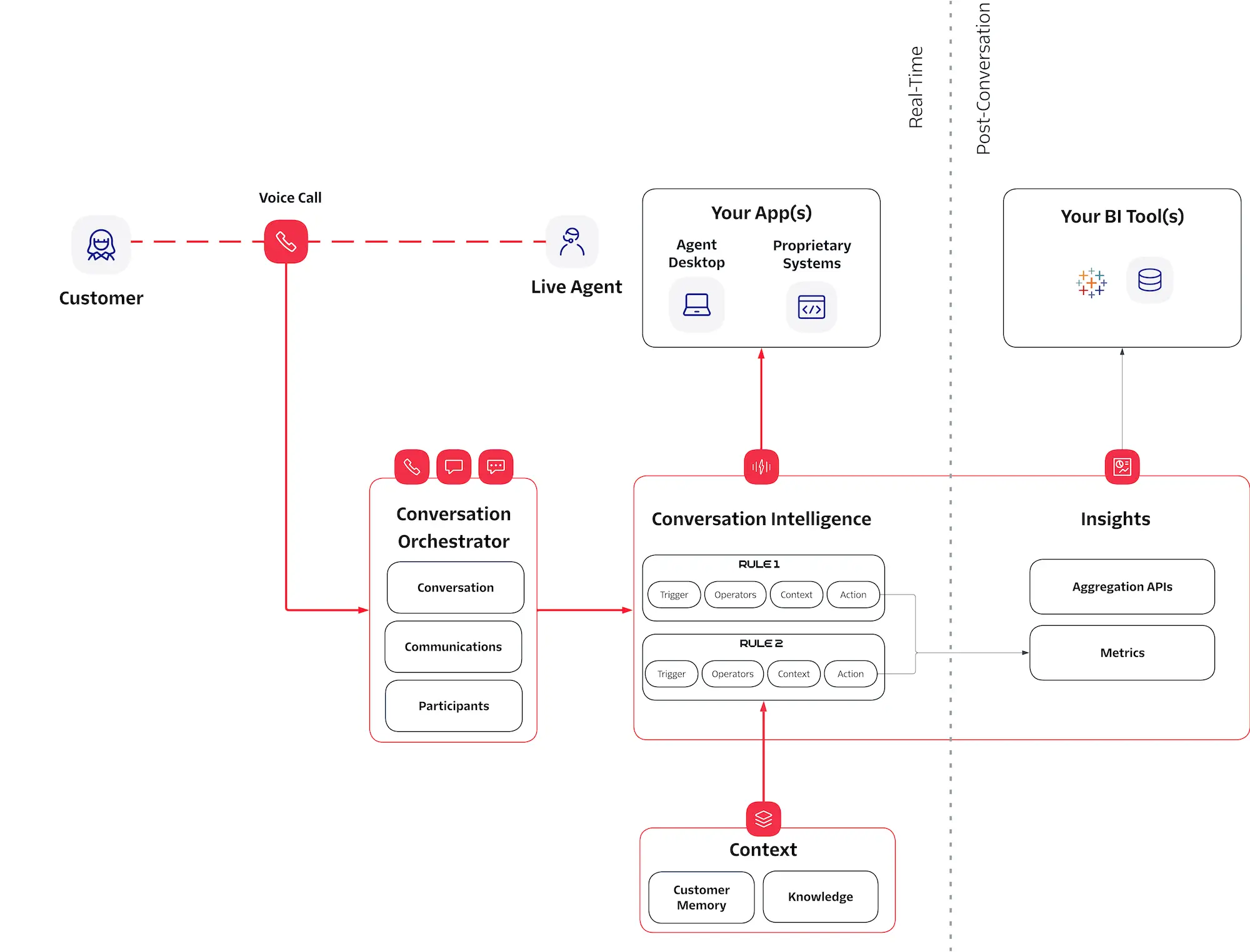
The following diagram illustrates how customer communications, orchestration, intelligence, memory, and downstream systems work together end to end:
-
A customer engages a live agent
A customer communicates with a human agent over a supported Twilio channel, such as a voice call or messaging interaction. These communications form the raw input for real-time and post-conversation analysis. -
Conversation Orchestrator groups communications into a conversation
Conversation Orchestrator ingests and normalizes channel events, grouping related communications into a durable conversation that includes:- The conversation itself
- Individual communications (messages or call segments)
- Participants, each with a typed role (customer, human agent, or AI agent)
This unified conversation becomes the system of record that downstream services reference, regardless of channel or modality.
-
Conversation events trigger Conversation Intelligence
As the conversation progresses, Conversation Orchestrator emits structured conversation events. Based on configured rules, these events can trigger Conversation Intelligence to execute language operators:- In real time (for example, on each utterance or message)
- At specific milestones
- When the conversation ends
This allows intelligence to run during the interaction, after the interaction, or both.
-
Language operators analyze the conversation
When triggered, Conversation Intelligence applies one or more AI-powered language operators to the conversation. Using the live conversation as the source of truth, operators extract structured meaning. Twilio provides four ready-to-use operators—Sentiment, Summary, Next Best Response, and Script Adherence—and you can create custom language operators tailored to your domain. Structured meaning comes from sources including:- script adherence
- next best response
- upsell opportunities
- summaries
- compliance signals
Operators can be enriched with additional awareness by drawing on Conversation Memory and Enterprise Knowledge, providing more accurate and business-aligned results.
-
Intelligence results get delivered to agent-facing systems
Language operators make structured outputs available to your applications in real time. You can display these results in one or more of the following outlets:- Agent desktops
- Internal tools
- Proprietary systems used during the interaction
This real-time display sets up use cases such as real-time agent assist, guided workflows, and assisted wrap-up without disrupting the live customer experience.
-
Memory and context inform future interactions
Conversation Memory and Enterprise Knowledge provide context during execution, and conversation outcomes can update them. Future interactions then benefit from prior insights, creating continuity across conversations without requiring agents to recall or re-enter information. -
Post-conversation insights get aggregated
After the interaction completes, Conversation Intelligence's conversation insights capability can aggregate operator results across conversations. These aggregated signals support downstream analytics, quality assurance, coaching, and reporting workflows through your business intelligence tools.
A key aspect of this architecture is that real-time and post-conversation intelligence use the same underlying conversation and execution model. This allows teams to start with low-friction use cases—such as post-call summaries—and progressively introduce real-time assistance and automation using the same components and configuration patterns.
Human agent augmentation on Twilio combines real-time conversational intelligence, orchestration, and contextual awareness to help teams deliver better customer experiences—without removing human judgment from the interaction. By grounding AI assistance in live conversations and business context, Twilio empowers human agents. While AI handles analysis and assistance behind the scenes, agents can focus on empathy, decision-making, and problem-solving.
Teams can adopt these programmable and modular capabilities over time. Many start with low-friction, post-interaction use cases then introduce real-time guidance and automation as confidence grows. The same underlying architecture supports this evolution. You can expand your AI use without rethinking how you model conversations or apply intelligence.
With these capabilities, Twilio helps you meet goals like reducing after-call work, improving agent consistency, or introducing real-time assistance at scale. Twilio provides a flexible foundation for building human-centered AI experiences and helps lay groundwork for more advanced automation over time.
To build human agent augmentation on Twilio, combine Conversation Intelligence with Conversation Orchestrator and Conversation Memory. To begin implementing the capabilities described in this guide, start with the following product documentation.
Learn how to define intelligence configurations, configure AI-powered language operators, and control when and how Conversation Intelligence executes in real time or after an interaction ends.
Use conversation insights to aggregate and analyze Conversation Intelligence outputs across interactions to support quality assurance, coaching, analytics, and continuous optimization.
For voice use cases, chained configuration automates the workflow from audio capture through transcription to intelligence analysis.
Together, these components provide the foundation for building human-centered AI experiences on Twilio. You can introduce conversational intelligence incrementally while keeping human agents in control of the customer experience.