Twilio Conversations
Building conversational AI and human-assisted customer engagement often requires custom development to manage cross-channel interactions and customer context across agents, teams, and backend systems. Twilio Conversations provides Twilio-native platform services, available as APIs or through a self-hosted SDK, for coordinating interactions across channels while maintaining conversation history and intelligence.
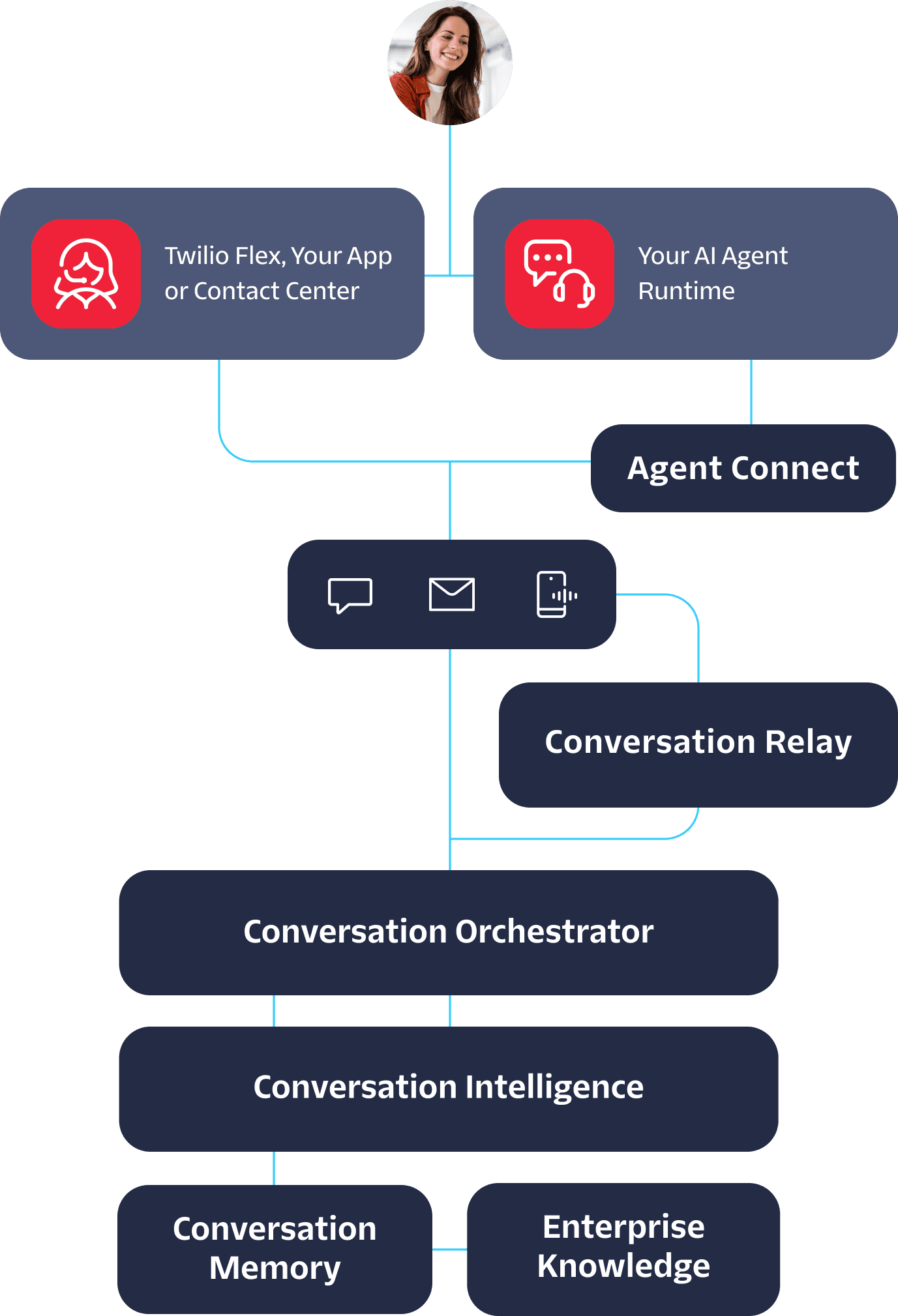
These capabilities work with your existing agent runtime or LLM of choice, reducing the custom API layers, middleware, and multi-vendor integration work typically required to connect every channel, agent, and backend system.
The Conversations layer supports two primary conversational patterns:
Apply real-time conversation intelligence to support human agents during live interactions. This includes understanding conversation context, surfacing insights, and enabling AI-assisted actions while keeping humans in control of final outcomes.
Build conversational agents that maintain context across channels, remember customer history, ground responses in business knowledge, and trigger actions based on conversation signals. These agents can operate independently or as part of larger conversational systems that include human participants, external tools, and downstream workflows.
Both patterns leverage the Conversations layer's shared foundation of platform components that manage conversation state, intelligence, and execution consistently.
Prerequisites
The Conversations layer is designed for developers with an active Twilio communications implementation. You should have at least one channel (Voice, SMS, WhatsApp, RCS, or Chat) deployed in production before adding Conversation Intelligence, Memory, or Orchestrator capabilities.
These components handle the infrastructure complexity of real-time communications and AI orchestration while giving you control over business logic and workflows. You can adopt them incrementally or combine them to support advanced use cases.
| Component | Role | Description |
|---|---|---|
| Conversation Intelligence | Analyze | Analyze conversations in real-time to extract key conversational signals, then trigger the right automated action. Supports both AI-led and human-handled conversations. |
| Conversation Relay | Integrate | Enable conversational AI agents to handle voice calls with real-time speech-to-text and text-to-speech over WebSockets. Use any LLM while Twilio manages voice infrastructure, latency, and interruption handling. |
| Conversation Orchestrator | Orchestrate | Track conversation state across channels and participants without changing existing Twilio CPaaS integrations. Coordinates Intelligence, Memory, and Knowledge to power contextual experiences. |
| Conversation Memory | Ground (customer) | Contextualize conversations with persistent customer knowledge so agents deliver continuity and personalization over time. |
| Enterprise Knowledge | Ground (business) | Ground agent responses in your enterprise policies, procedures, and product information. Provides a centralized repository that prevents hallucinations and ensures accurate answers. |
The following SDKs and helper libraries simplify development with Twilio Conversations primitives.
| Component | Type | Description |
|---|---|---|
| Agent Connect | Framework | Open-source framework that manages conversation lifecycle, session state, and integration between your conversational AI agent and Twilio Conversations primitives. Handles memory retrieval, profile lookups, and message routing across Relay and Intelligence. |
These blueprints demonstrate how to leverage the agentic harness to solve specific conversational use cases with end-to-end implementations.
Build systems that augment human agents with real-time intelligence, automated actions, and contextual awareness during customer interactions.
Integrate Twilio features into your AI agents that can handle customer conversations autonomously, with access to tools, memory, and intelligence across channels.
Build seamless escalation paths from AI agents to human agents, preserving conversation context and customer history for smooth transitions.