Send WhatsApp notification messages with templates
In this guide, you'll learn how to create message templates, submit them for approval, and send WhatsApp messages using approved templates.
For information on when message templates are required and whether they need WhatsApp approval, see Message templates.
Before you begin, ensure you have the following:
- An active Twilio account with WhatsApp access
- A WhatsApp Business Account (WABA) set up
- Access to Twilio Console messaging services
- Understanding of WhatsApp customer service window concept
Creating custom message templates allows you to send notifications outside the 24-hour customer service window.
Content Templates are omnichannel templates and offer access to WhatsApp templates. Content Templates are message templates that you can use on any channel, including WhatsApp. They offer flexibility and help ensure your implementation remains compatible with future updates at Twilio. For more detailed information about Content Templates and how to use them with WhatsApp, refer to this page.
| Feature | What is supported in content templates |
|---|---|
| Supported channels | WhatsApp, SMS, MMS, Facebook Messenger |
| Sending messages | Send messages with a ContentSid field |
| Messaging Service | Required |
| Rich feature support | Latest rich features supported by Twilio, such as catalog, carousels, media templates, and dynamic buttons |
| API to manage templates | Content API |
| UI to manage templates | Content Editor in the Twilio Console, go to Messaging > Content Editor |
To create a WhatsApp template in your Twilio account, follow these steps:
-
Go to Twilio Console > Messaging > Content Template Builder.
-
Click Create new.
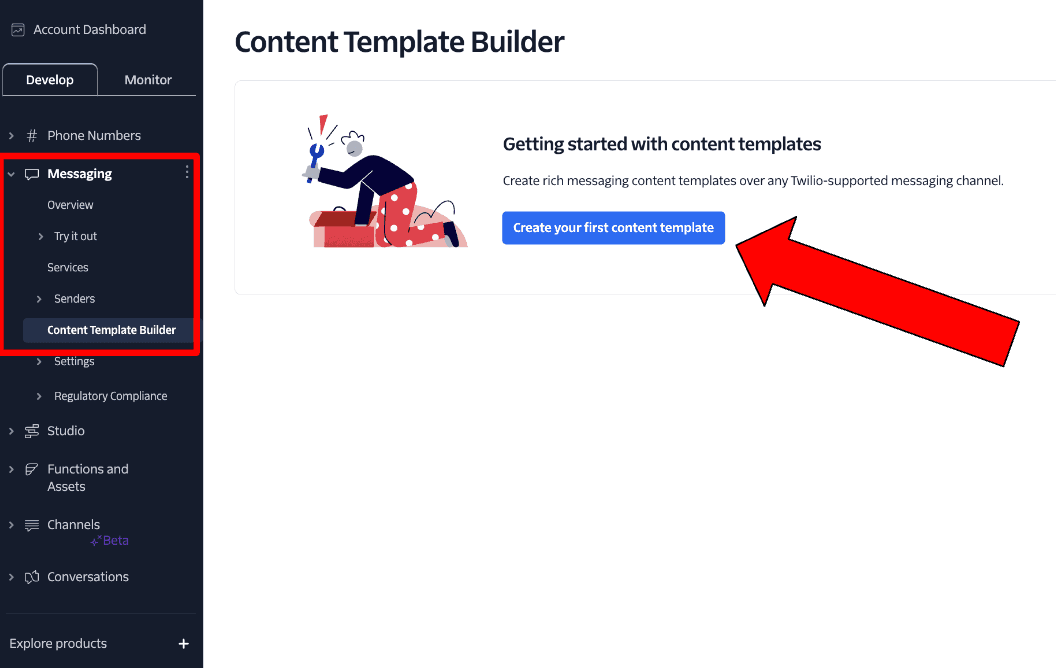 (information)
Info
If you are creating a template for the first time, you will see the Create your first content template button. Click it to create templates.
-
On the next screen, fill out the information to submit to WhatsApp. WhatsApp's team uses the information you submit to approve or reject your template submission.
For more information, refer to this page on creating Content Templates.
- Template name: The name can only contain lowercase alphanumeric characters and underscores. Tip: Use a name that helps WhatsApp reviewer understand the purpose of your message, for example,
"order_delivery"rather than"template_1". - Template category: You must select the category that matches WhatsApp definition. See Meta's docs for definitions and examples. Authentication templates have special constraints. See Authentication template requirements for more information.
- Message language: Select from the languages provided by WhatsApp.
- Message body: The text of the message that you want to send. WhatsApp doesn't allow multiple sequential line breaks.
- Buttons and other rich features: You can add a variety of button types and other rich features into a content template. To see a full list of supported template types, see our content type overview here.
- Template name: The name can only contain lowercase alphanumeric characters and underscores. Tip: Use a name that helps WhatsApp reviewer understand the purpose of your message, for example,
-
After you fill out the message template, click Save and submit for WhatsApp approval.
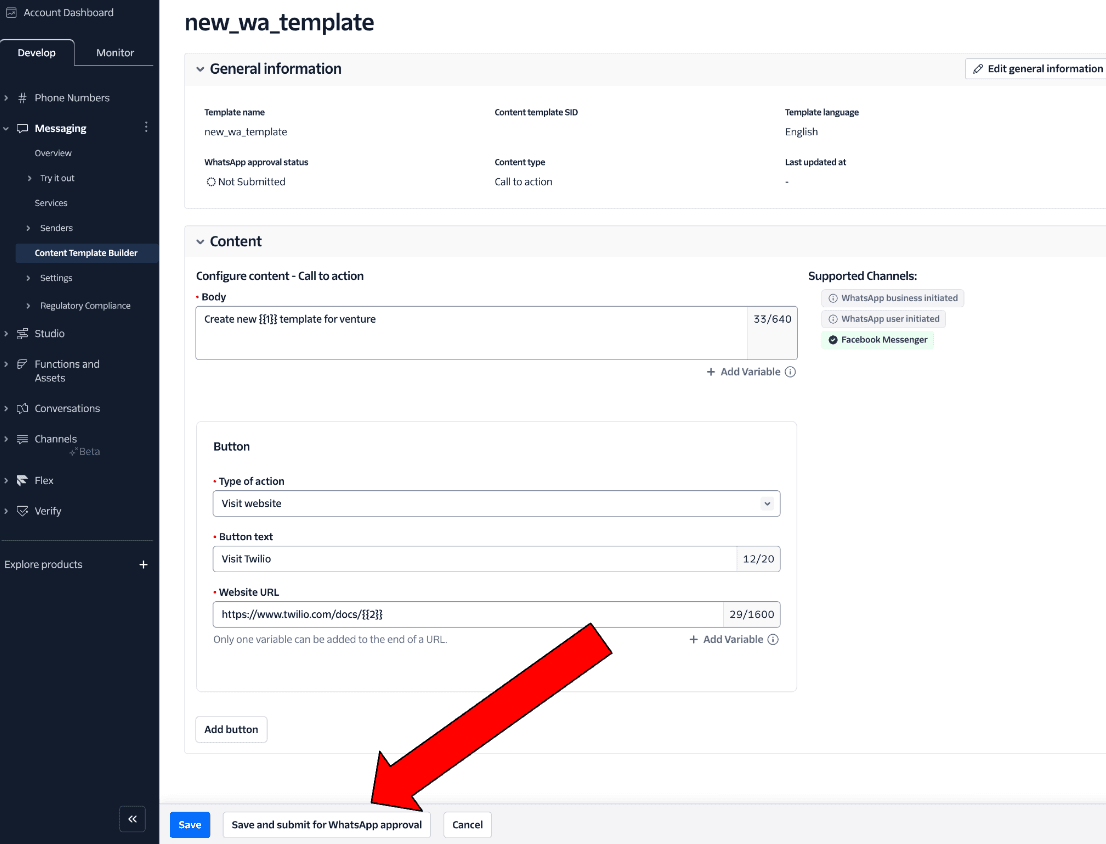
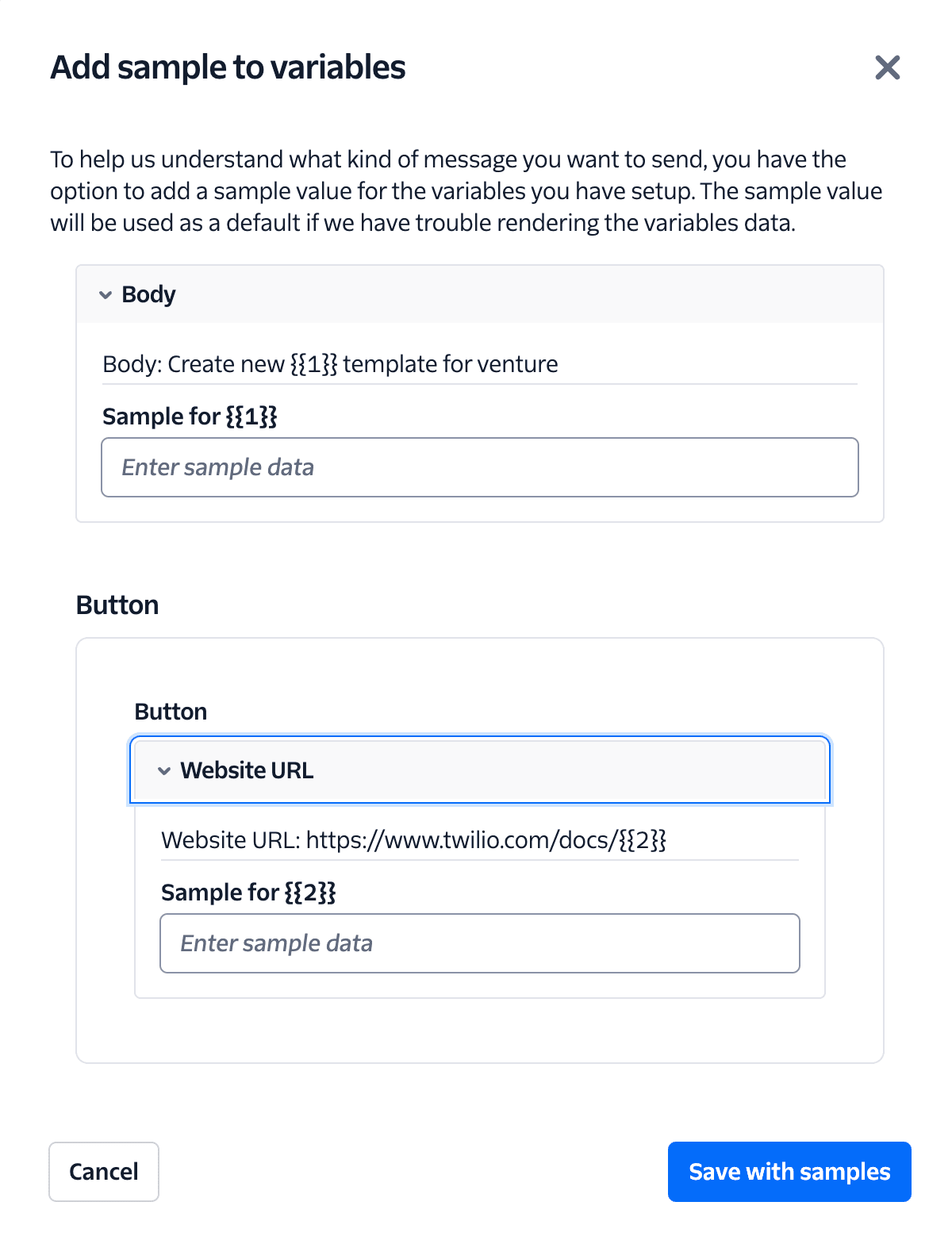
If your template includes placeholders (like "Hello {{1}}! We've received your request regarding {{2}}."), a modal will appear for you to add sample content for each placeholder. Enter sample text for each placeholder and then click Save and submit to submit your template to WhatsApp.
Note: Once you submit a template, it cannot be edited.
Refer to the WhatsApp documentation to learn more about message template formatting and supported languages.
Authentication templates have specific restrictions and pre-defined formatting set by WhatsApp for security compliance. When creating a template with the category of Authentication (i.e., Authentication Templates) using WhatsApp Templates, certain restrictions apply to comply with WhatsApp policies:
- WhatsApp sets the body text of the template for every language and you cannot edit it.
- You must include a Copy Code button, which users can use to copy the one-time passcode. You can edit the button label per language.
To learn more about the WhatsApp authentication content type, see WhatsApp authentication.
WhatsApp evaluates each template language translation on an individual basis. Content Templates offer searching and filtering tools to help manage your templates.
To delete a message template:
- Click on the template name on the WhatsApp Message Templates page.
- Click Delete at the bottom of the page.
- Alternatively, click on the 3-dot menu on the right-hand side of the template and select Delete.
Per WhatsApp guidelines, you may not reuse the name of a deleted template for 30 days after deletion.
Info
WhatsApp supports up to 6,000 template translations in total, across all templates, per account. Previous limits of 250 and 1,500 templates no longer apply.
WhatsApp reviews most templates submitted for approval within minutes. For detailed information about the approval process, refer to this article.
Sending templated WhatsApp messages requires using the ContentSid parameter along with any necessary ContentVariables for dynamic content. To send a templated message, include the ContentSid parameter in the call with the HX content SID of the template you would like to send. If your template includes variables, set them using the ContentVariables parameter. For more information, see Send templates created with the Content Template Builder.
The following example demonstrates how to structure template variables for a order confirmation message:
Hi {{1}}! Thanks for placing an order with us. We'll let you know once we process and deliver your order. Your order number is {{2}}. Thanks
In the ContentVariables parameter of the message resource, provide the end user's information as follows:
ContentVariables={ "1": "Joe", "2": "O12235234" }
1// Download the helper library from https://www.twilio.com/docs/node/install2const twilio = require("twilio"); // Or, for ESM: import twilio from "twilio";34// Find your Account SID and Auth Token at twilio.com/console5// and set the environment variables. See http://twil.io/secure6const accountSid = process.env.TWILIO_ACCOUNT_SID;7const authToken = process.env.TWILIO_AUTH_TOKEN;8const client = twilio(accountSid, authToken);910async function createMessage() {11const message = await client.messages.create({12contentSid: "HXXXXXXXXX",13contentVariables: JSON.stringify({ 1: "Name" }),14from: "whatsapp:+15005550006",15messagingServiceSid: "MGXXXXXXXX",16to: "whatsapp:+18551234567",17});1819console.log(message.body);20}2122createMessage();
Response
1{2"account_sid": "ACXXXXXXXXX",3"api_version": "2010-04-01",4"body": "Hello! 👍",5"date_created": "Thu, 24 Aug 2023 05:01:45 +0000",6"date_sent": "Thu, 24 Aug 2023 05:01:45 +0000",7"date_updated": "Thu, 24 Aug 2023 05:01:45 +0000",8"direction": "outbound-api",9"error_code": null,10"error_message": null,11"from": "whatsapp:+15005550006",12"num_media": "0",13"num_segments": "1",14"price": null,15"price_unit": null,16"messaging_service_sid": "MGXXXXXXXX",17"sid": "SMaaaaaaaaaaaaaaaaaaaaaaaaaaaaaaaa",18"status": "queued",19"subresource_uris": {20"media": "/2010-04-01/Accounts/ACaaaaaaaaaaaaaaaaaaaaaaaaaaaaaaaa/Messages/SMaaaaaaaaaaaaaaaaaaaaaaaaaaaaaaaa/Media.json"21},22"to": "whatsapp:+18551234567",23"uri": "/2010-04-01/Accounts/ACaaaaaaaaaaaaaaaaaaaaaaaaaaaaaaaa/Messages/SMaaaaaaaaaaaaaaaaaaaaaaaaaaaaaaaa.json"24}
If you are rendering line breaks or other escaped characters, encode the line breaks properly based on the language you are using. The Twilio Console may show line breaks and other escaped characters in their raw form, such as \n.
You may want to send different types of notifications and messages to your users. However, it is difficult and inefficient to go through the template approval process for every type of message you want to send to your end users.
For example, you might want to send a time-sensitive message such as "We are having a company-wide announcement at 11 AM." WhatsApp is unlikely to approve this template, making it challenging to build a real notification flow.
To work around this, you can create a generic template that asks your end users to respond. An example of a generic notification template you can submit for approval is:
"Hello {{1}}, we have a new update regarding your account. Respond to this message to receive it. Have a nice day!"
Once an end user replies to this templated message, it initiates the 24-hour customer service window, during which your business can send free-form messages.
Once you start using your templates, monitor them for excessive negative user feedback.
WhatsApp may pause templates that receive excessive negative feedback to protect sender quality ratings. If end users repeatedly block or report spam in association with a message template, WhatsApp will pause the template for a period of time. Pausing durations are as follows:
- First instance: Paused for 3 hours
- Second instance: Paused for 6 hours
- Third instance: Deactivated
When WhatsApp pauses a template a third time, WhatsApp will permanently deactivate it. Messages using paused or deactivated templates will fail. Paused and deactivated message templates that you attempt to send do not count against the daily messaging limit.
Twilio can send a notification using Twilio Alerts when a template status changes to paused, disabled, or rejected. To get notified, create an alert for error 63041 (paused), 63042 (disabled), or 63040 (rejected). We also offer alarms for approved templates with code 63046.
You may send URLs in a template. For example: "Thanks for registering with Example Business. To continue, click on https://app.example.com."
WhatsApp does not support URL previews in templated messages. In-session messages support URL previews.
WhatsApp reviews and approves most templates within minutes, though complex templates may take longer.
No, submitted templates cannot be edited. You must create another template with the desired changes.
WhatsApp supports up to 6,000 template translations total across all templates per account.
WhatsApp may pause your template for 3-6 hours, and permanently deactivate it after the third pause.
After understanding WhatsApp message templates, explore these related resources:
- Set up WhatsApp Sandbox to test templates in your development environment.
- Create templates with the Content Template Builder using Twilio Console.
- Explore the WhatsApp API documentation.
- Learn about Message template approval process.
- Learn about WhatsApp pricing.