ActiveCampaign Source
Source Info
- The ActiveCampaign Source is an Event Cloud source. This means that it sends data as events, which are behaviors or occurrences tied to a user and a point in time. Data from these sources can be loaded into your Segment warehouses, and also sent to Segment streaming destinations. Learn more about cloud sources.
This Source is supported in US data processing regions.
This Source is only supported in workspaces configured to process data in the US region. Workspaces configured with data processing regions outside of the US cannot connect to this source. For more information, see Regional Segment.
Active Campaign is an email marketing & marketing automation solution for small businesses.
When you add ActiveCampaign as a source to Segment, Segment automatically collects email events like Email Delivered and Email Opened, forwards them to your destinations, and loads them into your data warehouse.
In the BI or analytics tool of your choice, you can analyze your email campaigns in SQL or through drag-and-drop reports. You can also join your ActiveCampaign data with the event data you're already sending through Segment to analyze the down-funnel effects of your emails.
To connect ActiveCampaign as a Segment source, follow these steps. If you previously enabled sending email events using the ActiveCampaign destination during beta (using a project write key), you don't need to create a new ActiveCampaign source. Your email data continues to flow as normal.
-
From your workspace' Sources tab, click
Add source. -
Choose ActiveCampaign.
-
Give the source a nickname and a schema name. The nickname is a label used in the Segment interface, and the schema name is the namespace you query against in your warehouse. You can name them whatever you like, but we recommend something that reflects the source itself, like
ActiveCampaignfor nickname andactivecampaignfor the schema name. -
The next page (Overview) will surface your Segment write key for ActiveCampaign. Copy this write key.
-
In your ActiveCampaign account, navigate to Segment.
-
Scroll to the bottom of the page to where it says "Send email events data from ActiveCampaign to Segment." and click the "OFF" toggle.

-
This will open a modal for you to enter your Segment.com write key. Enter your write key and click "Connect".
-
The toggle will now say "ON".

-
Once the first event occurs, you'll always see the last event that occurred in this box.
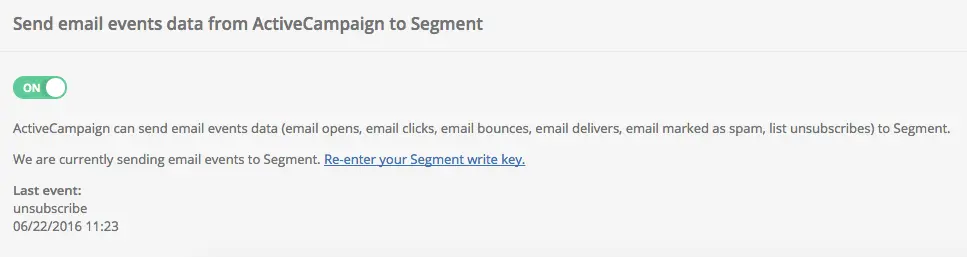
-
If you ever need to re-enter your Segment write key, just click "Re-enter your Segment write key."
-
In Segment, click into your ActiveCampaign source in your workspace. From there you'll be able to add Destinations where you want to see email events.
As you send emails, events will now be sent to your destinations and automatically loaded into any warehouses you have enabled.
Stream
ActiveCampaign uses Segment's stream source component to send Segment email events. It uses a server-side track method to send data to Segment. These events are then available in any destination that accepts server-side events, and available in a schema in your data warehouse, so you can query using SQL.
The default behavior is for ActiveCampaign to pass the userId associated with the email recipient as the userId. There are cases in which ActiveCampaign does not have an associated userId, in which case the email address will be passed in as the anonymousId.
Collections are the groupings of data pulled from your source. In your warehouse, each collection gets its own table, as well as a tracks table that aggregates all the events into a single table.
| Collection | Type | Description |
|---|---|---|
| Email Delivered | Event | Message has been successfully delivered to the receiving server |
| Email Opened | Event | Recipient has opened the HTML message. You need to enable Open Tracking for getting this type of event |
| Email Link Clicked | Event | Recipient clicked on a link within the message. You need to enable Click Tracking for getting this type of event |
| Email Unsubscribed | Event | Recipient clicked on message's subscription management link |
| Email Bounced | Event | Receiving server could not or would not accept message |
| Email Marked as Spam | Event | Recipient marked message as spam |
The ActiveCampaign Source works better when you also connect ActiveCampaign as a destination. With the ActiveCampaign Destination, you can use Segment to send ActiveCampaign user and event data from which you trigger email campaigns. To start sending website or mobile data TO ActiveCampaign, see the ActiveCampaign destination docs.