Guide
B2B customer segmentation: methods, examples & how to do it
Learn B2B customer segmentation methods, find real examples, and see how to segment business customers based on firmographics, needs, and more.
Time to read:
AI generated summary
- B2B customer segmentation tailors company strategies to specific market needs
- Unique attributes include multiple decision-makers and longer, non-linear buying cycles
- Major segmentation methods: firmographics, technographics, tiering, needs-based, sophistication-based
- Twilio Segment enables scalable, personalized marketing by unifying customer data
This summary was generated by AI.
B2B customer segmentation: methods, examples & how to do it
B2B customer segmentation is the practice of grouping your target market into segments based on shared characteristics, pain points, or behavioral patterns. Once you've defined these segments, you can personalize sales tactics, marketing campaigns, and product messaging based on what each group cares about.
You know, instead of blasting everyone with the same generic pitch and hoping something sticks.
Not all businesses are the same, even if they're shopping for the same product.
A 10-person startup has different needs than a 5,000-person enterprise. A company still using spreadsheets for everything requires different messaging than one already running your competitor's cloud solution. A price-focused buyer won't respond to the same pitch as someone who wants premium features and dedicated support.
Without segmentation, you're playing a guessing game. Your marketing is generic. Your sales team wastes time on deals that don't fit. Your product team builds features for an imaginary typical customerI who doesn't exist.
And your conversion rates reflect all of that confusion.
B2B customer segmentation solves this by helping you understand who you're selling to, what they need, and how to reach them. The payoff is more relevant campaigns, smarter resource allocation, and higher conversion rates because you're finally speaking to specific groups instead of shouting into the void.
This guide covers what B2B customer segmentation means, how it differs from B2C segmentation, and the five most effective B2B segmentation methods.
What is B2B customer segmentation?
B2B customer segmentation is the practice of dividing your target market into distinct groups based on shared characteristics, pain points, or behavioral patterns. The goal is to start personalizing how you sell, market, and support based on what each segment cares about.
Once you've defined your segments, you can:
- Personalize marketing campaigns based on industry-specific pain points or company maturity.
- Tailor sales approaches based on buying sophistication and how many stakeholders are involved.
- Optimize resource allocation by focusing on high-value segments and right-sizing support for everyone else.
- Predict behavior for new prospects based on which segment they fall into.
- Build better products by understanding what different customer types need (not just what they say they need).
Done right, B2B customer segmentation transforms how your entire organization operates. Marketing qualifies better leads. Sales prioritizes the right deals. Product builds features people actually want.
And everybody stops wasting time on customers who were never going to be a good fit anyway.
How B2B customer segmentation differs from B2C
There are a few ways that B2B customer segmentation differs from B2C, including the amount of stakeholders involved in a purchase decision, the length of the customer buying cycle, and more.
Dealing with multiple decision-makers
When you sell to a business, you talk to different decision-makers. One study found that six to ten team members are usually involved in a B2B purchase decision – and everyone has their own goals and challenges that they’re trying to solve for. (With B2C, you’re often dealing with a single customer.)
Let’s say you’re in the business of selling productivity software to companies. You would need to appeal to the end-user’s desire for an intuitive interface, their managers’ reporting requirements, and a CFO’s need to justify spending.
Toggl, a time-tracking and productivity app, launched a campaign to attract creative teams in New York City, featuring different posters and billboards for their various personas.
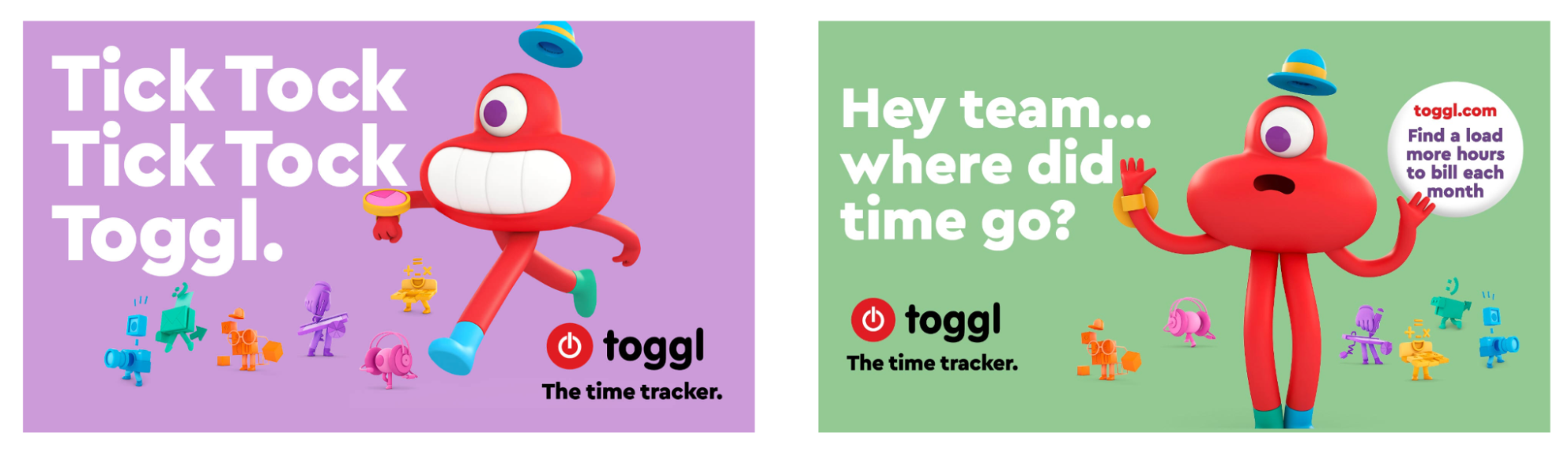
The visual on the left acknowledges just how busy creative workers can get with the tasks they juggle in a day. The one on the right speaks to team managers, and how it can be difficult to account for all the hours spent on a project. For both pain points, Toggl’s time tracker is the simple solution.
Multi-step buying process
We’re all familiar with the general outline of the buyer’s journey: a prospect becomes aware of your business, evaluates your offer versus a competitor’s, decides to purchase, and hopefully remains loyal.
While B2C companies tend to stick to this funnel, B2B sales come with a few more caveats. For one, these types of B2B deals require internal buy-in and budget approval – it’s not as simple as one person deciding to add an item to their cart. There’s also a lot of back and forth. As Gartner found in a recent report, B2B buying journeys are often non-linear.
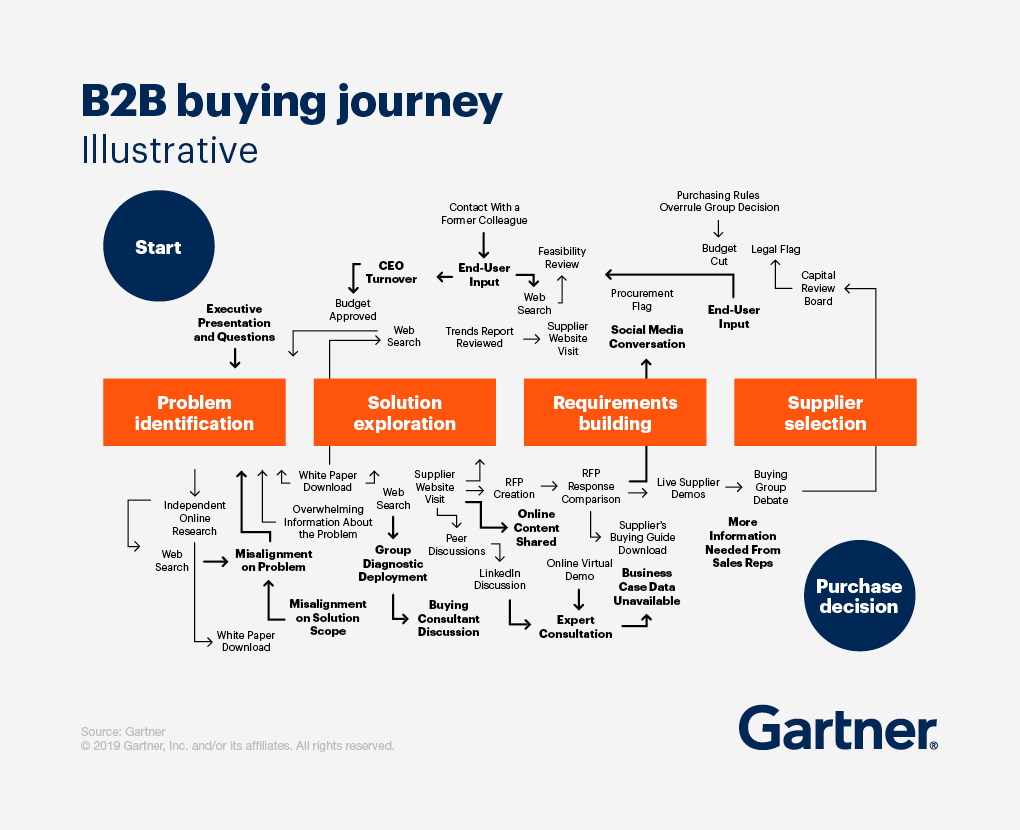
As a result, businesses may offer free trials to help secure a B2B conversion. If the free trial goes well, then a business might decide to upgrade to a premium plan, add more end-users to their account, or even sign a long-term contract – making this a multi-step buying process.
B2B customer segmentation helps businesses better tailor their sales tactics and marketing campaigns to different accounts. For instance, certain deals might have the potential for a bigger contract than others, requiring more time and bandwidth. Or perhaps different deals are geared toward different teams within an organization (e.g. an engineering team versus a marketing team), which would be interested in different product features or capabilities.
Longer buying cycle
As mentioned above, thanks to the number of decision-makers involved in B2B deals, the buying cycle is longer than what you would see in B2C. For B2B companies, securing a new customer can play out over the course of a few months.
However, a long sales cycle also lets you deepen your relationship with a prospect and learn more about their unique needs. As you gain a deeper knowledge of your customers, you can enrich their buyer persona profiles, refine your customer segmentation criteria, and hone your marketing strategy.
5 B2B customer segmentation methods
Different B2B customer segmentation methods serve different purposes, and come with their own limitations. We highlight five of these methods below.
1. Firmographics
Think of firmographics as the B2B equivalent to demographic data – but instead of focusing on a single person, it looks at the entire business. Firmographic data includes a company’s location, number of employees, its industry, annual revenue, and so forth.
You can get firmographic data from a company’s website, public records, online directories, or by asking the company directly. It’s quantitative, which means there’s no ambiguity in the information. It can also help create mutually exclusive segments – for instance, a company could either be an SMB or Enterprise, but not both.
2. Technographics
With technographic segmentation, you group together customers based on the technology they use. To do this, you can create a survey or ask them directly about their software and hardware.
By analyzing customers’ tech stacks, you get an indication of what capabilities they currently have, and the types of systems they prefer. Going back to our productivity app example, if the business already uses a time tracker, you’d create campaigns to show why your app is better. If the business is still stuck with on-premise, legacy software, you’d emphasize the benefits of SaaS. If the company uses a cloud-based collaboration suite, you’d talk about how your app integrates with others to boost team productivity.
Hardware matters, too. Companies that allow employees to use their personal devices for work are more likely to be interested in your mobile app and cross-device synching. Those that use PCs would likely prefer to know how well your software works on desktop, and whether or not you have browser plug-ins.
3. Tiering
Tiering involves grouping customers based on how suitable they are for your product and how much value they can bring to your business. By tiering customers, you identify those whose needs, budget, and characteristics match the solution you offer. You can then spend more marketing resources on those relevant groups.
For example, your product might be more suitable for a growth-stage startup than for one that’s just coming out of stealth mode. You may want to pursue businesses that have achieved a certain level of technological maturity or ones that are still largely using manual processes.
4. Needs-based
With needs-based segmentation, you group customers based on their most significant pain points. B2B International, a market research firm, lists four of the most common needs-based segments in B2B marketing and suggests how to sell to each group:
Price-focused segment: Sell the core product and don’t dwell on nice-to-have features that come with additional fees.
Quality- and brand-focused segment: Offer the best option, even if it’s at a premium price.
Service-focused segment: Emphasize the customer service you provide even after a sale.
Partnership-focused: Establish your company as a reliable partner that will help the customer grow their business and achieve their goals.
You’ll usually learn which of these four types of needs matter most to a customer through sales conversations. As you gather enough data about your customer segments, you’ll find traits and behaviors that companies in each segment share, allowing you to predict the needs-based category of future prospects. Once you know what problems keep your customers up at night, you can create marketing materials that clearly present your product as the solution.
5. Sophistication-based
In sophistication-based segmentation, you try to discern how well the business understands its problem and what it has done so far to solve it.
Say you’re offering a cloud-based CRM that can automate tons of sales and marketing workflows. You’d market differently to a business that still uses spreadsheets versus one that’s using your competitor’s cloud-based CRM.
For the business that’s still using legacy software, you need to focus on education – demonstrating the benefits of automation, guiding them in transitioning to a new system, and assuring them of the security of cloud-based tools. For the business that uses your competitor, you’ll need to show how you can serve them better.
Make B2B segmentation work at scale (with more personality)
B2B customer segmentation sounds great in theory. The challenge is making it work in practice, especially as your business grows and your customer base gets more complicated.
The manual approach doesn't scale, though.
You can't rely on sales reps to remember which segment each prospect belongs to. You can't manually tag thousands of accounts in your CRM and expect the data to stay current. And you definitely can't personalize campaigns across segments if your customer data is scattered across a dozen tools that don't talk to each other.
That's where a customer data platform like Twilio Segment can help. Segment automatically collects behavioral, firmographic, and technographic data from every customer touchpoint (your website, product, CRM, support system, wherever) then unifies it into a single profile.
From there, you can build dynamic segments that update in real time based on real behavior. New accounts get automatically categorized. Prospects move between segments as they progress through the buying journey. And your marketing, sales, and product teams all work from the same segmentation logic.
B2B customer segmentation is how you stop treating every business like they're the same. And making it work at scale starts with getting your data right.
See how Twilio Segment powers account-based personalization with unified customer data (or sign up for free to get started.)
Frequently asked questions
B2B segmentation involves grouping customers based on shared traits and behaviors. You then create marketing campaigns tailored to each segment’s needs and preferences.
Needs-based segmentation is one of several B2B customer segmentation methods: it helps marketers identify groups of customers that share similar pain points.
To segment their customers, B2B companies need to gather data on their behaviors, interests, and preferences. This can be through capturing events and interactions that take place between their business and a prospect, as well as through marketing surveys, interviews, and sales conversations.
Twilio Engage is a growth platform that lets marketers automate personalized marketing campaigns across multiple channels. You can orchestrate these channels through a single interface without ever leaving Engage. Engage links to Twilio Segment, a customer data platform, so that marketers can adjust marketing messages and channels based on up-to-date customer data.