Introducing the Twilio MCP Server and Skills: Give Your Coding Agents Native Access to 1,800+ Twilio APIs
Time to read:
May 07, 2026
Written by
Reviewed by
AI generated summary
- Twilio MCP server and Skills give coding agents native access to 1,800+ Twilio APIs.
- The MCP server helps agents search and retrieve API specs for accurate code generation.
- Twilio Skills guide agents in selecting the right products and best practices for optimal integration.
This summary was generated by AI.
AI coding agents are changing how developers build, but they can only work with what they can see. And now, we’re going to help them see more Twilio – today, we're launching the Twilio MCP server and Twilio Skills in Public Beta.
Together, our new MCP server and Skills package will help your coding agent better discover, plan with, and use Twilio Products and APIs, including our latest Conversations products. In this post, you'll learn why we built the new MCP server and Skills, what they do, and – most importantly – how to connect your coding agent.
The problem: your coding agent doesn't know Twilio well enough
If you've used an agent like Claude Code, Cursor, or Codex to build a Twilio integration, you probably recognize this scenario: your agent generates code that looks right but uses the wrong endpoint, skips pre-requisite steps, or misses entire products that would solve your problem more elegantly.
This isn't your agent's fault. Twilio has over 1,800 API endpoints and more than 30 products.
Compounding the issue, some of our most powerful products – Conversation Memory, Conversation Orchestrator, Twilio Agent Connect, and Conversation Intelligence – are new enough that your agent's training data likely doesn't cover them yet. And even for our older, well-established APIs, there's often a gap between "code that works in a demo" and "code that's ready for production" – the kind of knowledge that comes from building at scale, handling edge cases, and knowing which patterns to adopt upfront… knowledge that helps you avoid the shortcuts that will cost you later.
The result? You sometimes spend more time debugging agent-generated code and cross-referencing docs than you would have spent writing the code yourself.
Enter Twilio’s MCP server and Skills: purpose-built context that helps your coding agent stop guessing and start building with Twilio.
What the Twilio MCP server does
Model Context Protocol (MCP) is an open standard that lets AI agents connect to external tools and data sources. Our MCP server, hosted at mcp.twilio.com/docs, exposes two tools:
twilio__search – Search Twilio's APIs and documentation using natural language. Ask "how do I send an SMS?" or "real-time sentiment analysis on voice calls?" and the MCP server will return ranked results with the exact operations you need.
twilio__retrieve – Get the full specification for any operation: every parameter, every response field, every version. Your agent gets the complete picture before writing a single line of code.
The result is a coding agent that can reason about the right Twilio approach first, then use the right APIs to build it.
What are Twilio Skills?
With Twilio, you get access to a wide range of channels and tools for building customer engagement. But it’s not always clear which endpoint to use – and a lot of the best practices are only evident after the aforementioned experience from building with Twilio at scale.
Skills can help your coding agent get to the right endpoint the first time. Our new Twilio Skills are engagement domain experts for discovery and planning that teach your coding agent which Twilio products to use… and in what combination.
When you ask "help me verify users," the right answer isn't to roll-your-own OTPs and send them over SMS, it's to choose the right out-of-the-box solution with Verify. Or, it’s choosing SMS vs. WhatsApp vs. Voice based on your use case. Skills are the difference between broadly understanding you need to protect your app and knowing you’ll add Lookup for fraud scoring before verification and configure Verify Fraud Guard to prevent SMS pumping.
And MCPs and Skills work well together: think of MCP as the toolbox and Skills as the architect: MCP answers "what parameters does messages.create() take?" while Skills answer " should you even use messages.create() here, or do you need a Messaging Service with compliance toolkit and fallback routing?".
Together, they’ll give you an AI assistant that knows the right approach and can look up the precise implementation details.
Let the results speak for themselves
Ask a plain coding agent " How do I set up a marketing text campaign with welcome coupons using Twilio? " and it assumes you meant SMS, then jumps to giving a generic setup guide. Technically correct, but it often neglects the details that can vary the implementation plan.
A coding agent like Claude, with Twilio’s new MCP server and Skills, opens by asking three qualifying questions to determine the right architecture for you: which messaging channel (and it is ok if you are not sure), audience size, and geography. Only then does it design a suitable architecture, offer starter code, and recommend which Skills to install next.
The MCP server and Skills both work well independently, but here’s what they can do together:
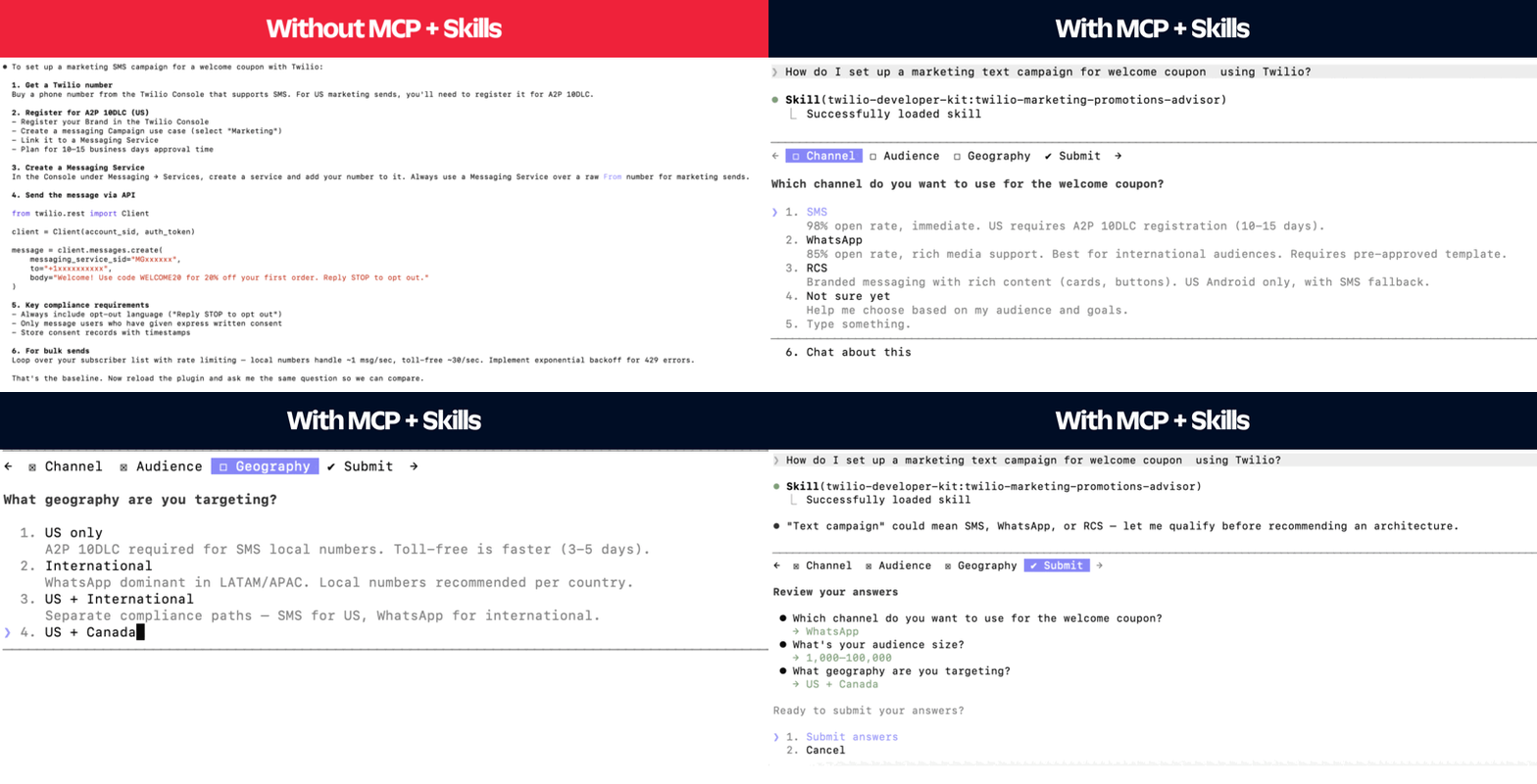
| Plain Claude | MCP + Skills Claude | |
| Response | To set up a marketing SMS campaign for a welcome coupon with Twilio: 1. Get a Twilio number 2. Register for A2P 10DLC (US) … 3. Create a Messaging Service … 4. Send Messages via the API … 5. Key compliance requirements … 6. For bulk sends … |
Qualifying questions: - Messaging channel - Audience size - Geography Recommended Architecture: WhatsApp Template Campaign via Messaging Service Why WhatsApp for this use case Welcome coupons are outbound-initiated, which means you need a pre-approved WhatsApp template — you cannot send free-form messages to users who haven't messaged you first. Plan 24–48 hours for Meta template approval. Step 1: Register a WhatsApp sender Step 2: Create a pre-approved template Step 3: Create a Messaging Service Step 4: Send the campaign Compliance (US + Canada) … |
Get connected
The Twilio MCP server and Skills are available today across the most popular AI coding platforms. No Twilio account required, no authentication1 – install from the tool you already use.
Claude Code (MCP + Skills)
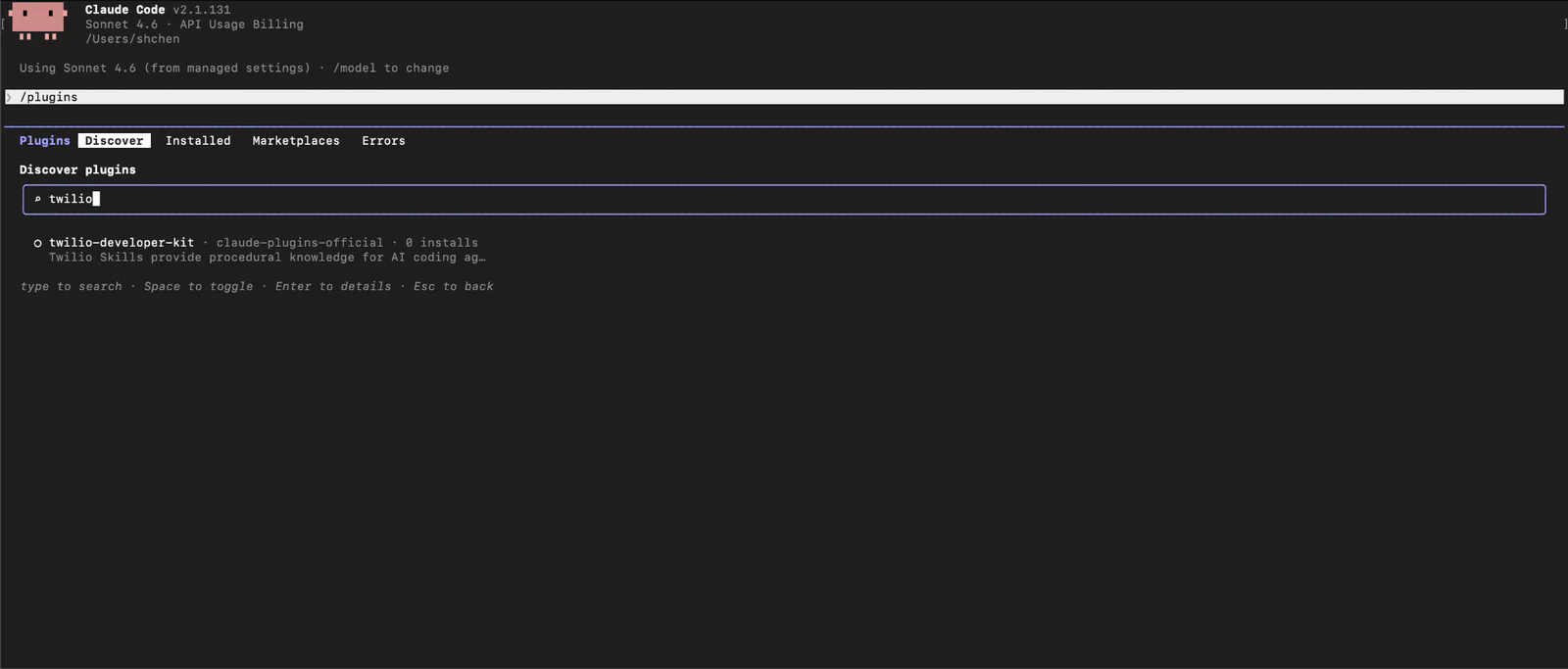
Type /plugins in Claude Code and search for “ twilio-developer-kit” to install the Twilio MCP and Skills in one step. Or, install the twilio-developer-kit plugin from the web. For MCP access alone, add the Twilio Connector.
Cursor (MCP + Skills)
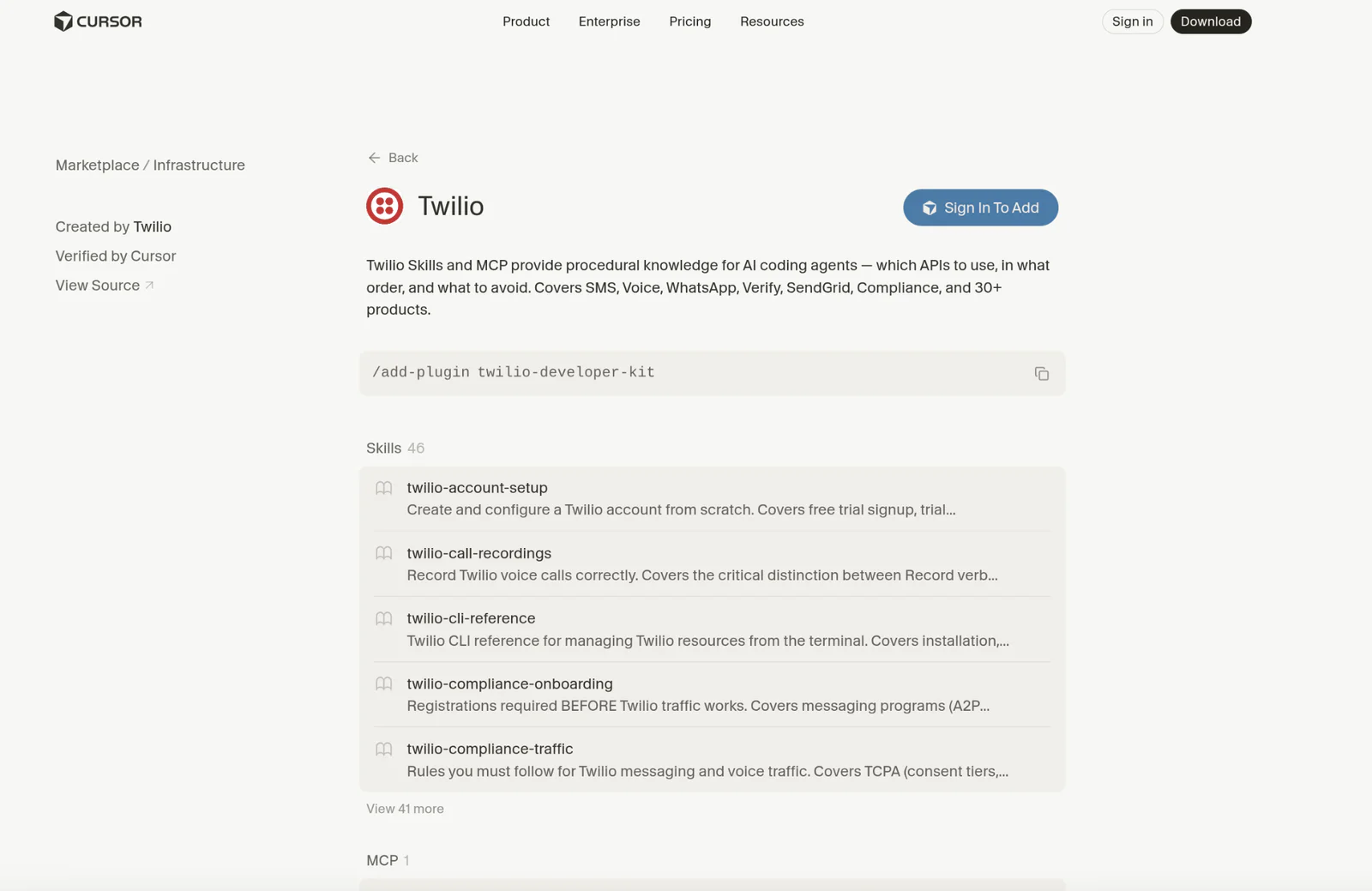
Find Twilio in the Cursor Marketplace - the plugin gives you both the MCP server and Skills. Or, run /add-plugin twilio-developer-kit from the Cursor command bar.
Codex (Skills)
Add Twilio Skills as a Codex plugin to give Codex expert guidance on which Twilio APIs to use and in what order.
Figma Make (MCP)
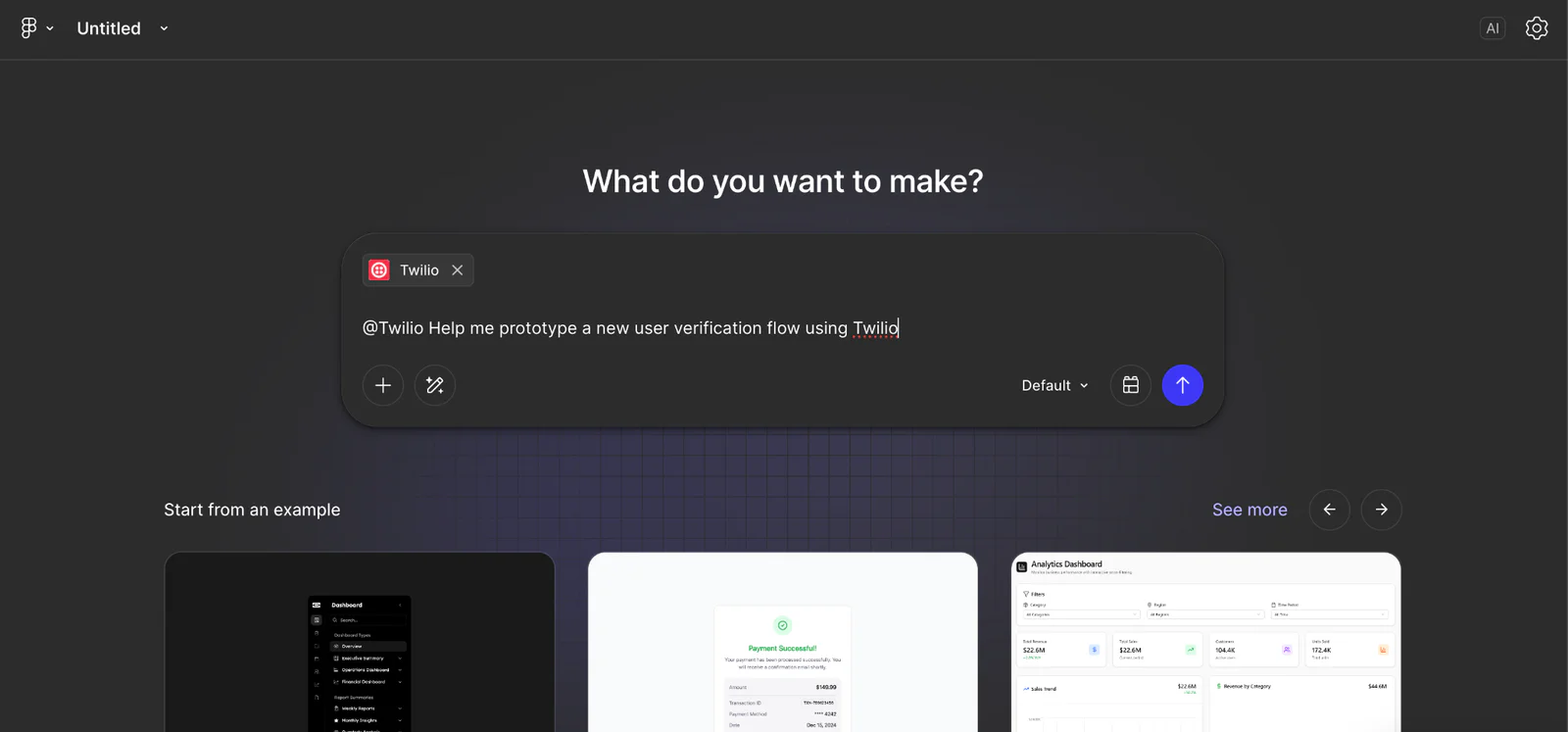
Connect the Twilio MCP server in Figma Make to go from design to working Twilio integration without leaving your canvas.
OpenCode CLI
Add to ~/.config/opencode/opencode.json:
Try it: building with Twilio's newest APIs
Once connected, your coding agent has access to every Twilio API – including our Conversations products. Here's what it looks like in practice.
Example: find the right API for a new product
Once you have the Twilio MCP server connected, prompt your agent: "I want to build a voice AI agent that remembers past conversations with each customer."
Without the MCP server, your agent would likely suggest a custom solution, or worse… hallucinate. But with the MCP? It searches for Conversation Memory and Conversation Relay, retrieves their exact parameter schemas, and generates code against the real API surface.
Example: discover cross-product workflows
Or, prompt your agent for a cross-product flow: "Set up real-time sentiment analysis on customer support calls with automatic escalation."
The MCP server surfaces Conversation Intelligence for sentiment analysis, Conversation Relay for the voice connection, and Twilio Agent Connect for human escalation – three products that work together but live in different parts of the API.
What's next
The MCP server is a piece of our larger vision. We want to learn your adoption patterns, and we want to hear where we missed – you can help us better design additional tools tailored to what you need most. We’ll share the iteration of this through adoption and feedback.
Conclusion
The Twilio MCP server is live at mcp.twilio.com/docs and our Skills are now available here. One command connects your coding agent to more than 1,800 Twilio API endpoints – including experience with our newest products that your agent's training data doesn't cover yet. And all that with no account required, no authentication1, and no setup friction.
Connect your agent, ask it to build something with Twilio, and see the difference – because we can’t wait to see what you – and your agents – build.
For full documentation, setup instructions across all supported platforms, and the complete tools reference, visit our MCP Server Docs.
We'd love your feedback at questions-mcp@twilio.com and questions-skills@twilio.com.
Team:
Thank you to the Engagement Experience Team for bringing this to life, including: Wen Zhu, Vinnie Giarrusso, Ankit Khani, Ryan Ferguson, Pranav Nutalapati, Gabriel Meyer, Peter Janovsky, Sam Grosby. We also want to thank the domain experts across product management as well as solution engineering including Michael Carpenter, Mark Shavers, Brent Bailey, Arnab Basu, Sharad Lahoti, Otavio Dalarossa, Dave Westbrook, Sandy Sage, Mark Brazinski, Ruma Nair, Troy Bolus, Chris Feehan, Rachel Baskin, Ryan Krueger, Aymen Naim, George Bochenek, and Kyle Kern.
About the authors:
Andrew Hitti, based in NYC, is a Director of Engineering at Twilio focused on enabling AI Agents to seamlessly connect and consume the Twilio platform
Christopher Lintz is an architect based in Denver, Colorado. At Twilio, he focuses on the platform foundations that power customer AI agents
Seline Chen is a product manager based in Bay Area, California. At Twilio, she leads Horizon 2 initiatives with a focus on AI-driven developer experience.
1 - The Twilio MCP Server is subject to rate limits.
Related Resources
Twilio Docs
From APIs to SDKs to sample apps
API reference documentation, SDKs, helper libraries, quickstarts, and tutorials for your language and platform.
Resource Center
The latest ebooks, industry reports, and webinars
Learn from customer engagement experts to improve your own communication.
Ahoy
Twilio's developer community hub
Best practices, code samples, and inspiration to build communications and digital engagement experiences.