The Power of the Grey Bubble: Why Apple Messages for Business is a game changer
Time to read:
May 21, 2026
Written by
AI generated summary
- Apple Messages for Business (AMB) offers verified and branded communication within the Apple ecosystem.
- AMB converts support queries into high-conversion sales, leveraging features like Apple Pay and scheduling.
- AMB ensures user privacy with anonymized identifiers and enables rich, two-way engagement tools.
This summary was generated by AI.
If you want to reach your customers where they spend the most time, you go to the Messages app. But for a business, just "being there" isn’t enough. You need to be trusted, branded, and actionable.
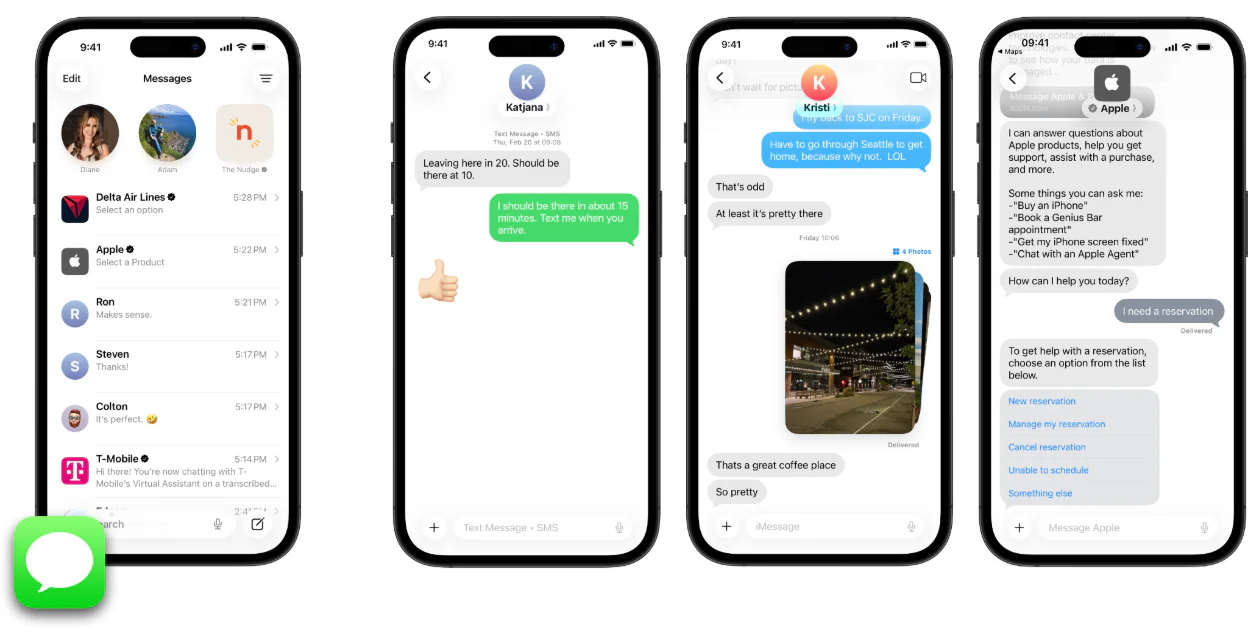
Apple Messages for Business (AMB) isn’t just another way to send a text; it’s a verified, high-conversion entry point into the Apple ecosystem. Unlike standard messaging, AMB allows your customers to seamlessly discover your brand and start conversations through a massive variety of native entry points, including buttons on websites, buttons in apps, QR codes, NFC tags, built-in tap-to-call IVR deflection (Message Suggest), and the new Business Invitations feature. Once started, the conversation continues seamlessly across their iPhone, Mac, and iPad.
From a business perspective, AMB transforms a standard support query into a high-conversion sales channel. By integrating native features like Apple Pay and scheduling, you remove the friction of app-switching, allowing customers to move from a 'Where is my order?' question to their next purchase within a single, branded interface.
The Bubble Breakdown: Know Your Channels
To understand why AMB is the "gold standard" for the Apple ecosystem, you have to look at the three distinct experiences happening inside the Messages app:
The Green Bubble (SMS/MMS/RCS): This is universal but basic. While the evolution to RCS introduces Rich Business Messaging (RBM) with branding, it still fundamentally relies on carrier networks. Because there’s no clear distinction between a personal text and a business alert, building deep brand trust remains a challenge.
The Blue Bubble (iMessage): This is strictly Peer-to-Peer (P2P). It’s built for friends and family, not for scale. Crucial note: There is no official API for iMessage. Any vendor offering "business iMessage" is likely using non-compliant hacks that Apple can shut down at any moment since they are violating Apple’s ToS. For a serious brand, this is high-risk and offers zero reliability.
The Grey Bubble (Apple Messages for Business): This is the official business channel. It is an Over-the-Top (OTT) service (much like WhatsApp) where your brand is verified and your logo is visible.
Secure: Encrypted end-to-end between the user and Apple.
Seamless: Tied to the user’s Apple Account, not just a phone number.
Interactive: Supports "Rich Features" like List Pickers, Time Pickers, Forms, in-line authentication with oAuth and Apple Pay and app extensions that simple "bubbles" just can't match.
Our SIGNAL Chat with Apple
When we sat down with the Apple team at SIGNAL, the conversation centered on one core idea: AMB isn't about monetization, it’s about the user experience. They want to ensure that interacting with a brand on an iPhone is so seamless it becomes a reason to stay an iPhone user forever.
The Strategy: Quality Over Quantity
We often hear businesses ask if they should prioritize AMB in regions where iOS isn't the majority. Apple’s answer? Look at your most valuable customers. Major airlines and banks shared that while general market share might be 60%, their highest-value, highest-spending segments are often 80%+. The math is simple: go where your best customers live.
Privacy as the Foundation
Apple’s "Privacy First" philosophy is baked into the code. Unlike SMS, AMB doesn't use phone numbers. Instead, it uses an anonymized identifier. A customer can chat with you without ever revealing their personal details unless they choose to. Customers feel safe because they are always in control of the conversation.
The "Tap, Not Type" Experience
AMB turns conversations into premium app experiences using native tools like Apple Pay and list pickers. Because the focus is on two-way engagement, you can't use AMB for cold, outbound blast notifications. You can send notifications, but only after a user messages your brand first. That initial user interaction opens a 365-day window to send updates (which trusted brands can kickstart using Apple's Invitations feature).
However, if the user chooses the “leave conversation” option, your access is revoked, at least until the customer chooses to engage with you again. And since Apple limits your brand to a single official presence, you should use "Intents" in your entry URLs to automatically route these incoming queries to the right department.
Related Posts

Related Resources
Twilio Docs
From APIs to SDKs to sample apps
API reference documentation, SDKs, helper libraries, quickstarts, and tutorials for your language and platform.
Resource Center
The latest ebooks, industry reports, and webinars
Learn from customer engagement experts to improve your own communication.
Ahoy
Twilio's developer community hub
Best practices, code samples, and inspiration to build communications and digital engagement experiences.