Guide
Data governance framework: examples and models in 2026
A data governance framework defines how organizations collect, store, and use data. Learn the components, models, and real-world examples.
Time to read:
Data governance framework: examples and models in 2026
Data governance frameworks are falling apart at most companies. Teams use different definitions for the same metrics. Customer data lives in dozens of disconnected tools. And nobody knows who's responsible for data quality or compliance.
You're left with fragmented systems, contradictory reports, and regulatory risks. A data governance framework fixes this by establishing clear rules, processes, and ownership for how your organization collects, stores, and uses data. It defines the structure, components, and standards that turn chaotic data into a trustworthy asset.
This guide covers what a data governance framework is, why you need one, the core components and structure that make frameworks work, common models like top-down and center-out, and real framework examples from McKinsey, DGI, and PwC.
What is a data governance framework?
A data governance framework is a structured set of rules, processes, and responsibilities that defines how an organization collects, stores, manages, and uses its data. It establishes:
- Who owns which data
- How data should be labeled and categorized
- Where data is stored
- Who can access data
- What quality standards the data must mee
- How data should be used across the organization
Ultimately, the framework creates accountability and consistency so every team works from the same playbook.
Without a governance framework, each department operates independently with its own standards, definitions, and processes. Marketing tracks active users differently than product. Sales stores customer data in their CRM while support uses a separate ticketing system.
This creates data siloes that can't communicate with each other, and when systems don't talk, you get:
- Contradictory reporting: Marketing says you have 50,000 active users. Product says 47,000. Finance says 52,000. Nobody knows which number is right, so nobody trusts any of them.
- Compliance risk: Privacy regulations like GDPR require you to know exactly where customer data lives and how it's used. Without governance, you can't respond to data deletion requests or prove you're storing data correctly.
- Wasted resources: Teams spend hours reconciling conflicting data instead of analyzing it. Engineers build custom integrations to move data between siloed tools. Decisions get delayed because nobody can agree on what the numbers mean.
- Security vulnerabilities: When you don't know who can access what, sensitive data ends up in the wrong hands. Former employees retain access. Customer PII gets shared with third-party tools without proper vetting.
A data governance framework solves these problems by creating a single source of truth. Everyone follows the same definitions, uses the same processes, and knows who's accountable for data quality.
Dive deeper into Data Governance with these articles:
What is Data Governance? Types, Examples & Best Practices
Understand what data governance entails, and best practices, to ensure data remains secure, private, accurate, and useful.
What is a Data Governance Policy? Examples + Templates
Discover how to create a robust data governance policy for your organization along with best practices, examples, and templates for success.
The importance of data governance frameworks
Without a data governance framework in place, companies can’t guarantee data quality or compliance with privacy regulations. This opens the door to mismanaging customer data, which could land you in hot water legally (resulting in hefty fines and reputational damage).
In the absence of a data governance framework, individual departments follow their own standards and processes, creating data silos that quickly snowball into inefficiencies. Instead of consulting a single source of truth within an organization, employees only have insight into the data collected in their owned tools. This creates blindspots in understanding, and sometimes mismatched reporting between databases – resulting in a distrust of data altogether.
The benefits of a data governance framework
Data democratization
A data governance framework allows you to establish data democratization, giving employees of all technical skill sets the ability to access and act on data. This autonomy and confidence in data allows teams to accurately set goals, measure performance, strategize, and discover new opportunities.
Data democratization has been notoriously difficult for businesses to achieve in the past few years. (83% of companies admit they’re unable to turn fragmented data points into comprehensive user records.) It’s one of the reasons behind the growing adoption of customer data platforms (CDP) to help manage and centralize customer data so everyone can benefit from it.
Take Landbot as a prime example. The no-code chatbot platform experienced rapid growth and was struggling to govern its data amid an evolving tech stack. The business implemented Twilio Segment’s CDP to help unify and standardize data at scale, quickly integrate new tools, and give every team access to real-time insights. The result was:
Eliminating the 8 hours of engineering time spent each day on product integration
Increasing the accessibility of their data by 80% across all teams.
Easily integrating 12 new tools in a 6-month time span.
Standardized and trustworthy data
An important aspect of good data governance is clear guidelines on how to label and categorize data. Guidelines allow you to standardize data that the entire organization can trust. Efforts to standardize data may include creating a shared data dictionary to ensure consistency across teams in what is being tracked, and their naming conventions.
A tracking plan is a living document that creates internal alignment on what is being tracked to avoid inconsistencies or duplicate entries.
Compliance with regulatory requirements
The global rise of customer data privacy regulations, such as the European Union’s General Data Protection Regulation (GDPR), has made it necessary for organizations to know exactly how they collect, store, and use data. Now, certain privacy regulations dictate that a user has a right to request their personal data be deleted by an organization, or that data needs to be stored and processed locally (i.e., data sovereignty laws).
A data governance framework ensures that a business is adhering to these larger privacy and security regulations. One example of ensuring compliance at scale is with the media publisher Quartz. They used Twilio Segment to consolidate their customer data and prioritize first-party data to get ahead of the deprecation of third-party cookies which signals a massive shift in how digital advertising will be done. With Segment, Quartz was able to automate consent management, enforce privacy policies, and streamline regulatory compliance, while also honing their personalization strategies. Learn more about Quartz’s strategy here.
Improved business performance
Data governance sets clear processes for the collection, storage, and use of data. When employees know how to collect and where to find important data, the results are improved efficiency and data accuracy.
The cumulative effect of these practices is better decision-making and performance. With precise customer data, for instance, the marketing team can optimize their campaigns to result in a higher ROI. The leadership team is also able to make better strategic decisions on which products or use cases to prioritize.
Data governance framework structure and components
Every data governance framework needs the same basic building blocks. The details change depending on your company size and industry, but the core components stay consistent.
Here's what makes a framework work:
Governance structure and roles
Someone needs to own this. Not the tea or leadership, but actual people with names who are accountable when things go wrong.
Most frameworks assign these roles:
- Data governance office (DGO): The central team that writes policies, maintains documentation, and keeps the whole thing running. Could be three people or thirty, depending on company size.
- Data stewards: Domain owners responsible for data quality in their area. The customer data steward owns customer information. The product data steward owns usage metrics.
- Data council: A cross-functional group that resolves conflicts and approves big decisions. When marketing and sales disagree on how to define qualified lead, the council settles it.
- Executive sponsor: A senior leader who allocates budget, breaks through bureaucracy, and reminds everyone this actually matters. Without executive backing, governance initiatives die.
Policies and standards
These are the actual rules everyone follows. No vague principles here. You need specific, measurable standards.
- Data quality standards: What counts as accurate? Complete? Current? If your customer records are missing email addresses 30% of the time, is that acceptable? (Probably not.) Set the threshold.
- Data classification policies: How you label sensitive versus public data. Customer PII gets classified one way. Marketing analytics another. This determines who can access what.
- Access control policies: Who can view data? Who can edit it? Who can delete it? Lock this down or you'll have support reps accidentally wiping production databases.
- Retention and deletion policies: How long you keep data and when you purge it. Regulations often mandate maximum retention periods. Your policy needs to enforce them.
Processes and workflows
Policies mean nothing without processes to enforce them. You need repeatable procedures that happen (each time, every time).
- Data collection processes: How does data enter your systems? What validation happens at the point of entry? If someone can dump junk data into your database with no checks, your governance framework is theater.
- Data validation workflows: How do you verify data quality before it gets used? Automated checks catch formatting errors. Manual reviews catch logic problems. Both matter.
- Issue resolution processes: What happens when data quality tanks or someone reports a problem? Who gets notified? How fast do you respond? What's the escalation path?
- Change management: How do policies get updated when business needs change? You can't require three months of committee meetings every time someone needs to adjust a definition.
Technology and tools
Governance doesn't run on good intentions. You need systems that enforce the rules automatically.
- Data catalogs: An inventory of what data exists, where it lives, and what it means. Without this, people can't find the data they need and end up creating duplicate datasets.
- Master data management (MDM) systems: Tools that maintain a single source of truth for critical entities like customers, products, or accounts. When the same customer exists in five systems with five different spellings, MDM reconciles them into one golden record.
- Access management tools: Systems that control who can see what. Role-based permissions, authentication requirements, audit logs of who accessed sensitive data.
- Customer data platforms (CDPs): Purpose-built systems for governing customer data specifically. They unify customer information from every source, enforce quality standards, and manage consent and compliance.
Metrics and monitoring
If you're not measuring it, it's not happening. Track whether governance is working or just creating paperwork.
- Data quality metrics: Error rates, completeness scores, timeliness measurements. If 15% of your records have invalid email addresses, you have a problem.
- Compliance metrics: How fast do you respond to data deletion requests? How many audit findings did you get? How many policy violations happened this quarter?
- Adoption metrics: Are teams actually following governance standards or ignoring them? Measure adoption rates across departments.
- Business impact metrics: Did governance reduce costs? Improve decision speed? Prevent regulatory fines? Governance costs money—prove it's worth it.
How do data governance frameworks work?
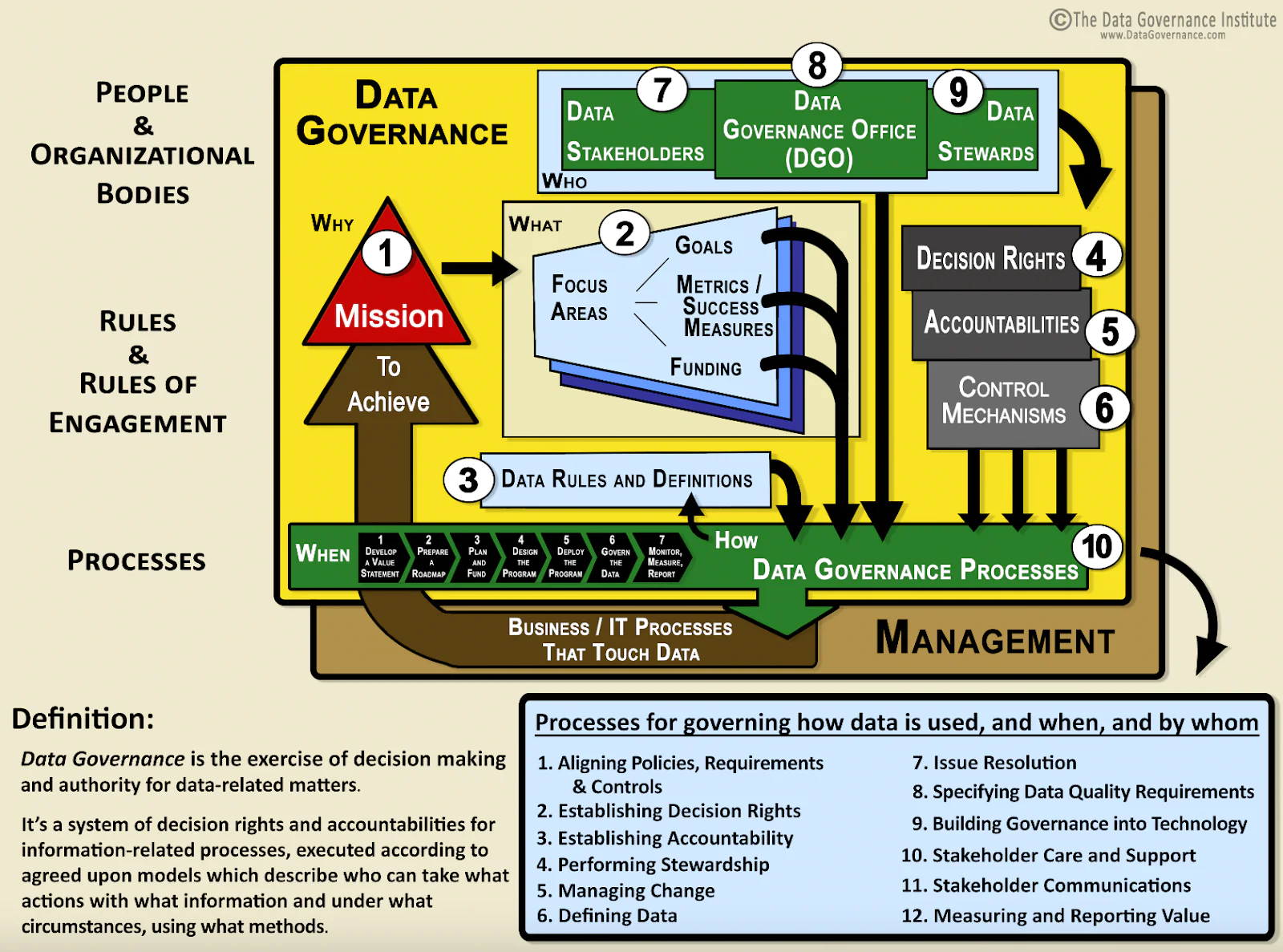
Data governance frameworks will vary depending on the business. However, the Data Governance Institute (DGI), which listed 10 essential components that you’ll often find some combination of in any framework. We cover a few of the overarching themes below.
Ownership
First order of business is to understand who will be responsible for establishing the rules and processes within your data governance framework. (When we say “rules,” we’re referring to all policies, definitions, and standards that you use for your data.)
Who is controlling this data decision-making process? Who is responding to issues that stem from non-compliance within that framework?
Some businesses may create a Data Governance Office (DGO) to lead this initiative, maintain documentation, communicate policies, track metrics, and more. This DGO could be a team of people or stakeholders, or an individual person (usually a data architect).
Data stewards may then be assigned throughout the organization to ensure internal alignment on standards and make recommendations. Larger organizations might have multiple councils to address different data issues, such as data storage, quality, and securing sensitive data.
Goal-Setting
Along with establishing a data governance framework, you’ll want to define the specific goals and metrics that will be used to measure the success of your initiative. The Data Governance Institute recommends considered the impact to the “4 Ps”:
Programs
Projects
Professional disciplines
People
For example, you should evaluate how your data governance initiative impacted revenue, costs, or the risk of regulatory violations.
Performance Monitoring
Accountabilities refer to all of the tasks that must be done in order to comply with your data governance framework. These processes should be repeatable, documented, and target different aspects of data governance, such as:
Assigning decision rights
Managing change
Resolving issues
Defining data quality
Approved Tech
In a data governance framework, stakeholders should approve the tech that’s being used to process, store, and use data, along with ensuring specific controls are in place to prevent data breaches.
Collaboration Standards
Data stakeholders are all the employees who create, use, and regulate data across the organization. Leaders of the data governance initiative must decide which stakeholders to include or consult with during the decision-making process and which ones should just be informed of the final decisions.
Data governance framework models and examples
Before we dive into specific examples of data governance frameworks, we should first touch on the five main data governance models. The models are based on how data governance decisions will flow through your organization.
Top-down: Company leadership implements data governance policies that are then passed down to individual business units and shared with the rest of the company.
Bottom-up: Employees at the lower levels implement data governance practices, such as standardizing naming conventions, which spread to the higher levels of the organization.
Center-out: The team or individual responsible for data governance sets data standards that the entire organization follows.
Silo-in: Various departments come together to align on data governance while keeping in mind the needs of each group.
Hybrid: Data governance decisions involve different levels of the organization. For example, a company uses a center-out model to suggest a course of action but employs a top-down model to make the final decision.
DGI data governance framework
The DGI framework is most appropriate for larger organizations and enterprises with complex data systems. It addresses rules, processes, and the people and organizational bodies that are needed for effective data governance.
McKinsey’s data governance model
McKinsey sees an effective data governance framework as consisting of a central data management office (DMO), a data council, and data leadership by domain.

The data management office (DMO) consists of leaders who set data governance standards, while the data council resolves issues and ensures compliance with previously set standards. Domain data leadership is responsible for data quality in their domain (such as transactional or product data) and takes part in the data council.
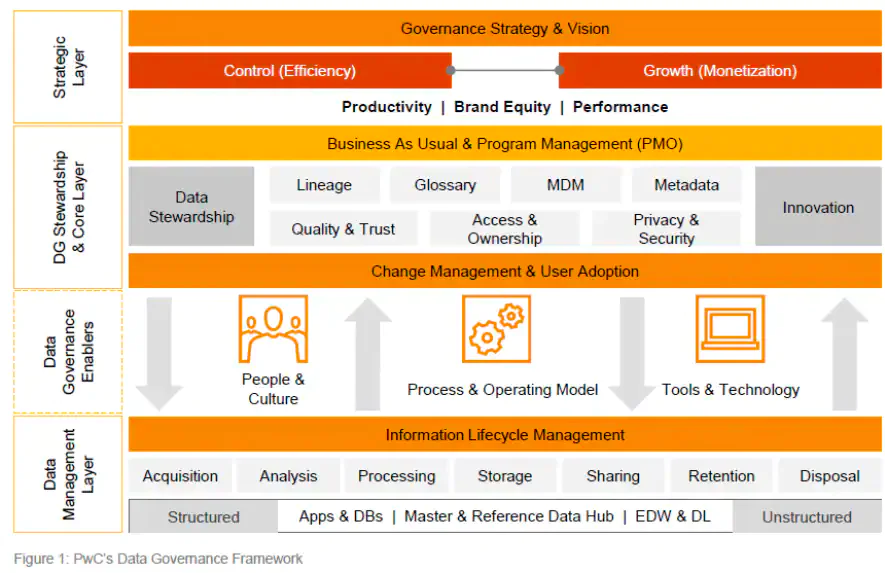
PwC’s enterprise data governance framework
PwC’s framework consists of four components that span strategy, data governance stewardship, data governance enablers, and data management.
Ready to get started with Twilio Segment?
Frequently asked questions
Data governance frameworks will vary between businesses, but a few overarching components include:
Establishing ownership: perhaps through a data governance council or appointing data stewards across cross-functional teams.
Goal-Setting: setting measurable goals and metrics for your data governance framework. The Data Governance Institute recommends thinking about the impact your framework will have on the “Four P’s,” which are Programs, Projects, Professional Disciplines, and People.
Approved tech & security: Identifying the proper tools and technology to be used throughout the data lifecycle, and ensuring controls are in place to protect against security threats and data breaches.
Collaboration: Choosing stakeholders across teams to consult with during the decision-making process and provide feedback.
To create a data governance framework, an organization needs to:
Use a data maturity model to evaluate its current state of data.
Set up a dedicated data governance team.
Align on the issue(s) that the framework must address, such as data security or data integrity.
Decide on data rules and processes you must implement.
Set key performance indicators (KPIs) to measure the impact of the data governance program.
There are five data governance framework models:
Top-down
Bottom-up
Center-out
Silo-in
Hybrid.
The models are organized around how data governance decisions will flow through the organization.
Data governance refers to all of the rules, responsibilities, and procedures that govern data collection, storage, and usage. Data management includes all of the business processes and software tools an organization implements to achieve data governance.