Voice Disaster Recovery Starts Before the Implementation
Time to read:
June 15, 2026
Written by
Reviewed by
AI generated summary
- Voice disaster recovery (DR) involves both technical setups and predefined business protocols.
- Effective Voice DR starts with questions customers will ask, establishing a trusted failover plan.
- Regional traffic isolation is essential, containing failures and setting up cross-regional recovery foundations.
This summary was generated by AI.
A major regional cloud infrastructure outage in late 2025 reminded our industry that regional failures are not theoretical. It exposed readiness gaps across providers and customers alike: many critical voice workloads had no tested cross-regional recovery path. Some gaps were technical – missing standby configuration, untested failover scripts – but others ran deeper: no clear decision authority for failover, no agreed success criteria, and untested assumptions about what would actually happen during a regional disruption.
This article looks at Voice application disaster recovery (or DR) at the strategy level, focused on your infrastructure buildout with Twilio Voice. Your resiliency doesn’t start with APIs, scripts, or a runbook. It starts with the questions your customers will ask, and you’ll need to answer together before a failover plan can be trusted.
Cross-regional Voice Disaster Recovery is a business and technical continuity program: it defines which voice flows matter, who can decide to move them, what has to be ready before a disruption, and how execution, validation, and recovery will work.
Key Takeaways
- Voice DR is a business and technical continuity program, not just a regional infrastructure feature. Start with your single most critical voice flow, not your entire voice platform.
- Voice DR is a shared responsibility model: Twilio as the provider and you as the customer need a clear framework for deciding what to protect, how to prepare, how to execute, and how to recover.
- Regional traffic isolation is often the first major business continuity improvement a team can make: it contains regional failures to a single market and builds the region-aware foundation that cross-regional DR depends on.
Why Voice DR Is different
Most digital services recover once users can reach the application again: the user retries, the request completes, and the work continues. Voice does not work that way – a voice call is a live, continuous, synchronous interaction.
In a support flow, for example, a caller needs help, an agent needs context, and your business needs a usable record of the interaction. The same pattern appears across other critical voice flows: a call is a live business process, not a single request. The goal of DR is not only to restart software — it is to keep the critical communication path usable.
Recovery targets reflect this. A web application can retry a failed request in two seconds and the user barely notices. But a caller who hears silence or a fast busy for ten seconds will hang up – and may not call back. The practical question is how quickly new calls can land in the standby path, and whether the records, recordings, transcripts, and analytics around those calls remain usable.
Voice disaster recovery layers and coordinations
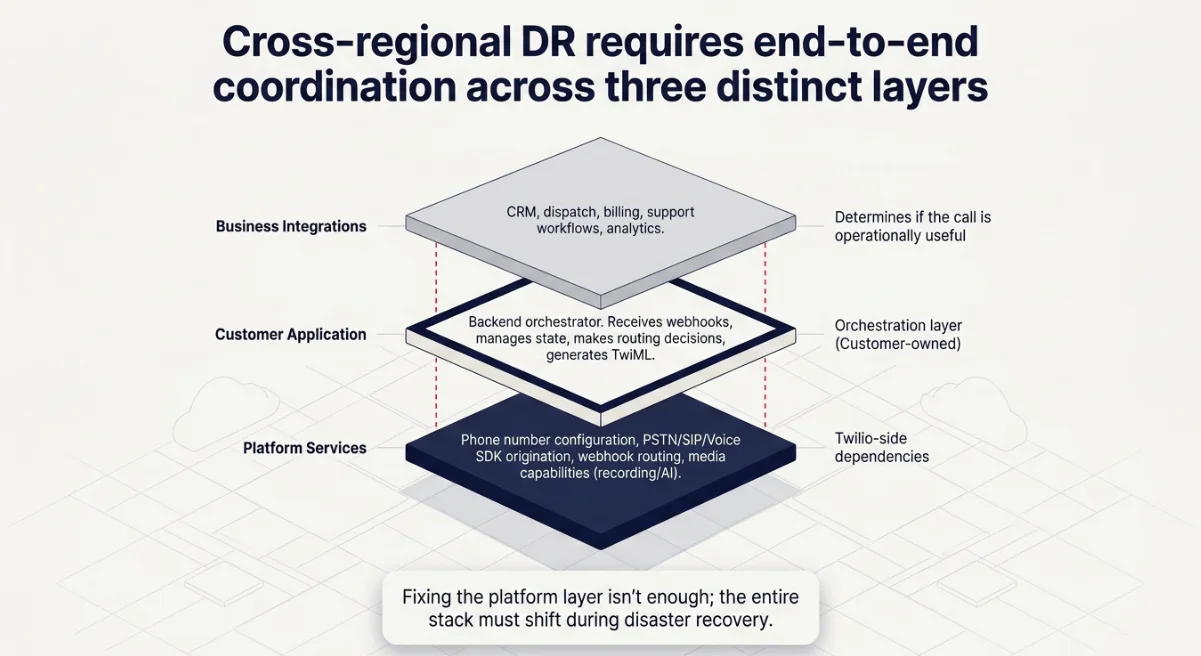
To see how this plays out in practice, consider the layers a voice call depends on. A voice flow depends on platform services, customer application logic, and surrounding business systems all working together in real time:
- Platform services: phone number configuration, PSTN/SIP/Voice SDK origination paths, webhook and TwiML routing, regional handling, compliance settings, and media capabilities such as recording, transcription, conferencing, and AI services. These are the Twilio-side dependencies that the call flow relies on.
- Customer application: your backend acts as the orchestrator of the call flow — receiving webhooks, making routing decisions, generating TwiML or API calls, managing state, and coordinating the real-time logic that turns platform primitives into a business conversation. Because many Twilio products are API-driven, this orchestration layer often lives on the customer side.
- Observability and business integrations: the systems that surround the call before, during, and after – CRM, dispatch, billing, support workflows, monitoring, analytics, and downstream reporting. These integrations determine whether the call is not just connected but operationally useful.
This means Voice DR cannot be solved at any single layer – it requires end-to-end coordination, and the team has to prove the protected voice flow still works end to end.
That does not mean every voice flow needs the same level of protection. Some flows justify full cross-regional DR. For others, in-region resilience or regional traffic isolation may be the better fit. Customers need to factor in the criticality and cost to implement and maintain the DR flows and frequency of region wide outage before making the decision of DR solution (cross-region vs in-region, etc).
Three stages of voice resilience
In this section, I’ll explain the different stages of voice resilience you can plan for, in-region resilience, regional traffic isolation, and cross-region disaster recovery.
Don’t worry if your team can’t implement – or can’t justify implementing – every stage on Day 1. Most teams move through stages, and each has real value and a clear boundary. The right stage for you to target depends on business impact, regional exposure, compliance needs, and the cost of maintaining a standby path.
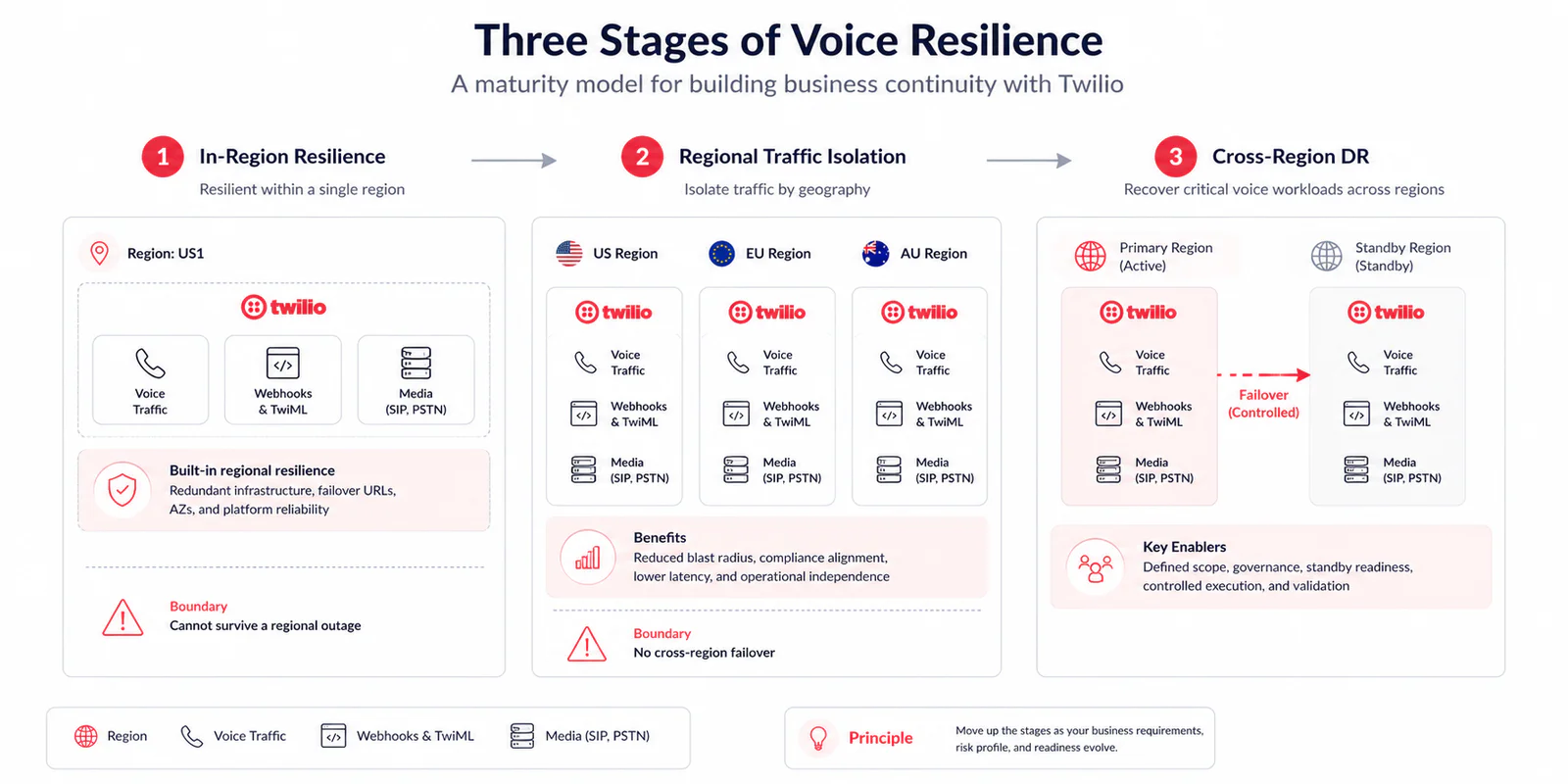
1. In-Region Resilience
Most Twilio Voice customers start here: a single primary region (often US1), with resilience built into the regional infrastructure.
Twilio provides platform-level redundancy across availability zones, network monitoring, and automatic recovery mechanisms. You can further strengthen your side of the path with primitives such as fallback URLs, resilient SIP patterns, and edge selection (see Twilio's availability and reliability guidance, Voice failover best practices, and global infrastructure overview).
For businesses that operate mainly in one market, or for voice flows with limited business impact, in-region resilience may be the right level of protection. But it has a clear boundary: it can improve how well one region absorbs disruption, but it cannot protect a workload when that region can no longer support the critical voice flow.
2. Regional Traffic Isolation
The second stage is regional traffic isolation: each market is served by its natural Twilio region – US traffic through US1, European traffic through IE1, Australian traffic through AU1.
Many organizations already have reasons to run traffic regionally – international customer bases, data residency or compliance requirements, or latency-sensitive voice workflows such as contact centers or telehealth. For these teams, regional traffic isolation is not an extra step. It aligns the voice architecture with where the users already are. Yet many teams have not taken it: their entire global traffic still flows through a single region, creating unnecessary blast radius.
Because Twilio regions operate independently, a problem in one region is less likely to affect others. That turns a regional disruption from a global failure into a contained one. The organization can keep serving unaffected markets while focusing response on the degraded region.
Running traffic regionally has a second benefit: it forces the application to become region-aware. Region-specific endpoints, credentials, webhooks, and observability paths have to be configured correctly as part of daily operations, not discovered during a crisis. That makes regional traffic isolation a practical foundation for cross-regional failover later.
Regional traffic isolation is not cross-regional failover. If US1 fails, IE1 does not automatically become its standby. But it is often the first major business continuity improvement a team can make, and a prerequisite for the operational muscle that Stage 3, cross-regional DR, demands.
3. Cross-Regional DR
The third stage is cross-regional DR. Where regional traffic isolation limits the impact of a regional event, cross-regional DR goes further: it asks whether a specific critical workload can move from its primary region to a standby region in a controlled way.
This stage is relevant for organizations where certain voice flows carry outsized business risk – for example, a regulated support line that must remain reachable, or a revenue-critical transaction flow where even a few hours of downtime creates material business damage.
Cross-regional DR raises several questions that the framework in this article is designed to answer:
- Which voice flow is important enough to protect, and what is the smallest useful scope? (This is about ruthless prioritization, not full-platform portability.)
- Who can approve a move to the standby region? (The decision authority must be defined before the disruption, not during it.)
- What has to be ready before the incident starts? (Standby readiness is where most DR programs succeed or fail.)
- Which actions remain during failover, and how small can that action set be? (If the action list is long, the readiness work is incomplete.)
- How will the team validate success, and what happens if validation fails? (Rollback must be designed alongside failover, not invented after it.)
- What can be standardized, what must be customer-defined, and how will both sides validate the boundary? (This is the shared responsibility question.)
The next section unpacks each of these questions into a practical six-step framework.
A practical framework for Cross-Regional voice DR
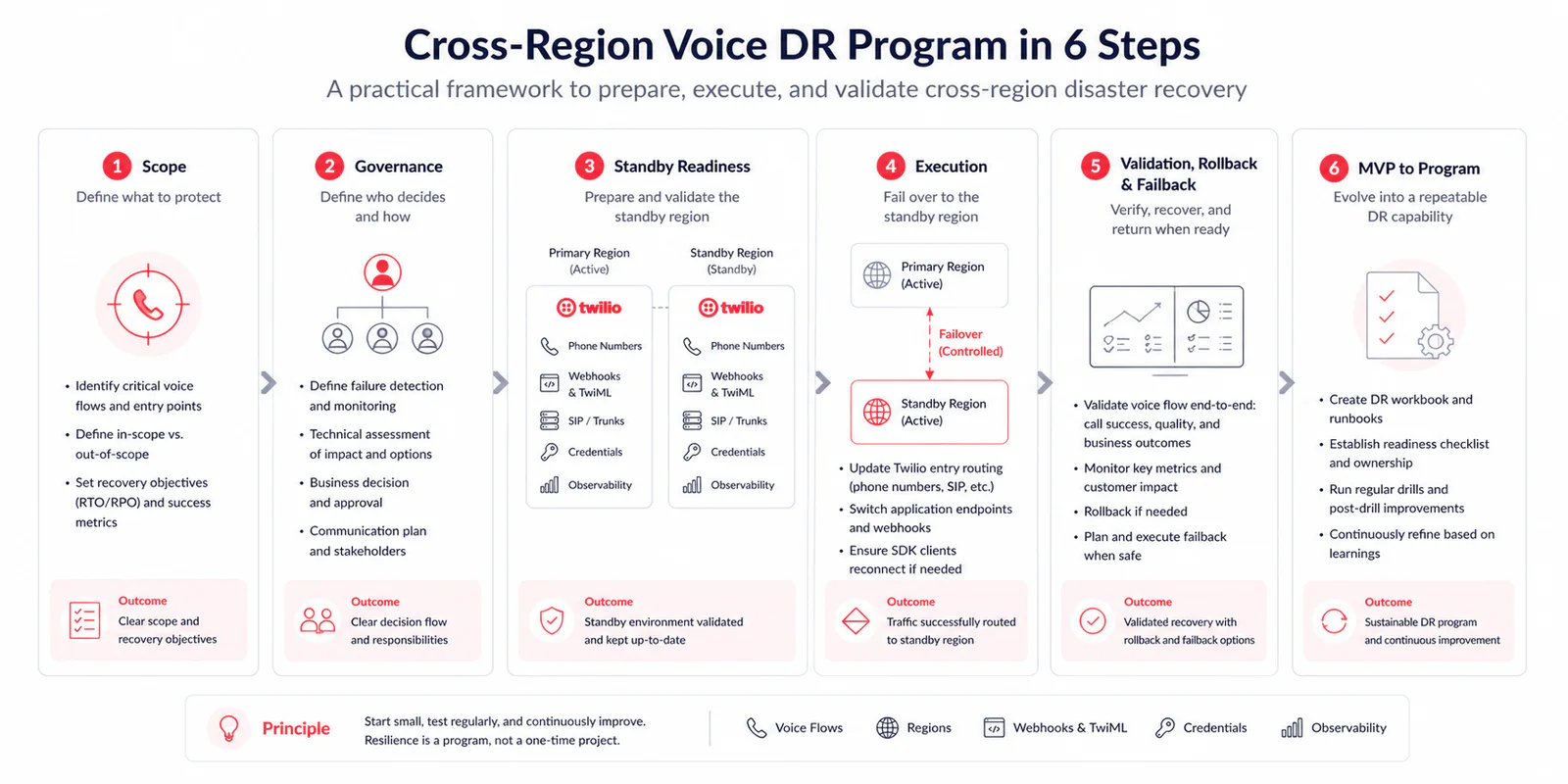
1. Define The DR scope
The first question is not "can we fail over?" It is "which voice flow is worth protecting first?"
The scope has to follow business impact, not generic best practices. For many organizations that means inbound support – customers call when something is already urgent, and losing that path during a disruption means losing one of the main ways to recover trust. For others it may be outbound notifications, regulated calls, dispatch workflows, or revenue-critical sales calls. What they have in common is that these are conversations the business cannot afford to lose for long: revenue-critical, safety-sensitive, regulated, or customer-facing paths where a regional disruption creates material damage.
A good first scope defines what must survive, what can degrade, what can wait, and what is explicitly out of scope along with the success metrics that will prove the DR worked. Without those choices, scope expands quickly: teams add adjacent flows, reporting paths, and edge cases until the plan looks complete but no single flow is clearly prepared and tested.
2. Failover governance
Once the protected voice flow is defined, the next question is who can authorize the move – and under what conditions.
In a shared responsibility model, the failover decision draws on signals from both sides. Twilio provides platform-level visibility – status page updates, incident communications, Voice Insights metrics, and support escalation paths. You as the customer provide application-level and business-level signals – customer impact, call failure rate, webhook reachability, and expected recovery time. Together, they form the picture that drives the decision. But regional failover also changes the business operating state – it may affect customer experience, compliance posture, support workflows, and cost – so the decision path has to be defined before the disruption.
A useful governance model usually separates four functions:
- Detection: identifying that the protected voice flow is degraded and collecting the first signals – drawing on both Twilio platform signals and customer-side monitoring.
- Technical assessment: confirming whether the technical preconditions for failover are satisfied and whether the failover action is executable.
- Business impact assessment: deciding whether the current degraded state is worse than the proposed standby operating state.
- Approval and execution: approving and performing the move according to the customer's internal authority model.
The exact roles, approval levels, and automation boundaries will vary by organization. The important point is that the decision chain is explicit before the disruption – captured in a failover decision runbook that defines the signals, authority model, trigger conditions, and the point where the team is allowed to execute the move.
3. Standby readiness
This is where many DR efforts break down. A standby region is not ready because it exists – it is ready when the required configuration, credentials, capacity, and observability are already in place. Teams that skip this step rehearse the final switch only to discover the standby path was never fully prepared.
The readiness review should follow the protected voice flow end to end, proving the standby path can run the flow – not just copy resources:
- Phone number configuration: target-region webhooks, TwiML Apps, status callbacks, fallback handling, and regulatory attachments where applicable.
- SIP and trunking configuration: regional SIP endpoints, trunk settings, credentials, ACLs, and related call-routing logic where used.
- Credential and SDK readiness: region-specific credentials, Access Token generation, SDK connection behavior, and push credentials if mobile SDKs are in scope.
- Customer application readiness: backend configuration, regional awareness, secret management, webhook handlers, and the ability to switch region context without code changes.
- Capacity and permission readiness: geo permissions, verified caller IDs where used, CPS behavior, API limits, concurrency limits, and SIP or trunk capacity.
- Twilio-side observability: call logs, recordings, transcriptions, and Voice Insights data accessible through the standby region's endpoints and credentials.
- Customer-side observability: dashboards, alerts, APM, support tooling, analytics, and business metrics configured to reflect the standby region's data paths.
If the standby region is not credible before the incident, the failover plan exists only on paper. The incident should trigger a small number of controlled actions — not the discovery of missing configuration, missing credentials, or unclear ownership.
Standby preparation should also be repeatable, not a one-time setup. In a mature operating model, changes to the primary region are reflected in the standby region through the same deployment or release process, and the secondary path is tested periodically so the team can trust that it remains ready for failover.
The output of this step is a standby readiness package: a checklist, a regional resource map, a gap list, and evidence for each required item.
4. Controlled execution
If the standby readiness work is done well, execution should be small – a short, rehearsed sequence, not a long build process. Both moves are customer-driven; Twilio provides the APIs and platform capabilities, but you own and execute the failover actions:
- Twilio platform configuration: activate the standby voice path. The customer uses Twilio's management APIs (for example,
IncomingPhoneNumberand Trunk APIs) to point the protected phone numbers to the standby region – updating the target-region webhooks, TwiML App, status callbacks, and SIP or trunking configuration. These settings can be pre-configured in the standby region and activated at failover time, or configured programmatically as part of the failover script. Either way, the actions should be scripted, rehearsed, and version-controlled rather than performed manually through the console during an incident. - Customer application: switch the runtime context. Your backend switches to the standby region's API endpoints and credentials for all Twilio API calls. If Voice SDK clients are involved, your token service needs to issue Access Tokens against the standby region; depending on the token TTL, active clients may need to re-authenticate and reconnect within the remaining validity window.
At its simplest, controlled execution is a series of API calls. But at scale – thousands of phone numbers, multiple trunks, or a large SDK client base – your teams should consider how to control the rollout: moving numbers in batches, using a canary approach to shift a small percentage of traffic first, and expanding only after the validation signals from Step 5 confirm the standby path is healthy.
The output is a runbook and the accompanying scripts – both the execution scripts that perform the failover actions and the validation scripts that verify each step completed correctly. Together with the action sequence, ownership, and rollback procedures, they form a rehearsable, version-controlled package.
5. Validation, rollback, and failback
After execution, the program has to prove that the move worked.
That proof depends on metrics defined before the disruption, not invented after it – and observable through the readiness work done in Step 3. The signals should cover both sides of the picture. Technical signals can stay simple: success rate, latency, voice quality, and so on. Business signals answer a different question: can priority customers reach support, can agents handle the recovered flow, and is the degraded experience acceptable to the business?
As the batched rollout from Step 4 progresses, each cohort should have a go/no-go decision – owned by the same governance roles defined in Step 2 – based on these pre-defined signals.
If the validation signals are bad after a cohort is moved, the team needs a clear recovery path: pause the expansion, correct the configuration issue, keep that cohort in a limited degraded mode, or move that cohort back if the primary path is viable. Here, a cohort means a planned batch of traffic – such as test numbers, lower-risk numbers, higher-priority numbers, or the remaining population – not the individual Twilio-side and customer-side actions that must be coordinated within a single failover unit.
Rollback should not be an emergency idea invented after the move. It should be designed alongside failover, with clear ownership, decision authority, and rehearsal for the same activation unit used during cutover.
The output of this step is a validation, rollback, and failback plan: success metrics, observable signals, go/no-go criteria per stage, rollback triggers and procedures, and failback decision criteria.
6. From strategy to MVP to program
The first five steps are strategy. The minimal viable product is where those decisions and assumptions are tested against a real customer environment – small enough to validate, concrete enough to expose gaps, and durable enough to become the foundation for regular drills.
A useful MVP should produce reusable assets in four areas:
- The protected scope: a jointly defined DR workbook that names the voice flow, acceptable degraded state, success metrics, and decision rules.
- The regional readiness baseline: a readiness checklist showing which Twilio and customer-side resources exist in the standby region, what was synchronized, and what remains manual.
- The execution path: runbooks and migration scripts defining which actions are required to move the flow, who owns each action, and how completion is verified.
- The validation and recovery plan: a documented plan for proving the flow worked, handling rollback or failback, and assigning owners to remaining solution gaps.
After the MVP, those assets should become part of a regular DR operating rhythm. Industry practice ranges from quarterly tabletop exercises to annual live drills; the right cadence depends on the application's rate of change, business priorities, and regional dependencies. Teams can revisit them through regular checkpoints, drills, and post-drill improvements, adjusting frequency as the environment evolves.
Closing
Voice DR is not a button or a single API call – it is a business continuity program that provider and customer build together under a shared responsibility model. Not every workload needs cross-regional failover: for many teams, regional traffic isolation is the first and highest-leverage improvement, containing regional failures to a single market and building the operational foundation that cross-regional DR depends on. For the voice flows that do justify full DR, the six-step framework gives teams a practical path from strategy to MVP to an ongoing program.
For customers who want to explore this further, your Twilio account team and solutions architects can help identify protected voice flows, assess current regional posture, and define a realistic MVP scope.
The evaluation can start with a single question: which voice flow would hurt your business most if it went silent during a regional disruption? If the answer is clear but the recovery path is not, that is where the work begins.
Additional resources
Hao Wang is a Solution Architect at Twilio, dedicated to empowering customers to maximize the potential of Twilio’s products. With a strong passion for emerging technologies and Voice AI, Hao is always exploring innovative ways to drive impactful solutions.

Related Resources
Twilio Docs
From APIs to SDKs to sample apps
API reference documentation, SDKs, helper libraries, quickstarts, and tutorials for your language and platform.
Resource Center
The latest ebooks, industry reports, and webinars
Learn from customer engagement experts to improve your own communication.
Ahoy
Twilio's developer community hub
Best practices, code samples, and inspiration to build communications and digital engagement experiences.