How to collect first-party data (the right way) in 2026
Time to read:
January 17, 2026
Written by
How to collect first-party data (the right way) in 2026
Third-party cookies are on their way out. Privacy regulations keep tightening. And customers expect personalized experiences without feeling like they're being tracked by strangers.
The answer to all of these changes: first-party data.
First-party data is information you collect directly from your customers through your website, app, email campaigns, point-of-sale systems, and other owned channels. It's more accurate than third-party data, more compliant with privacy regulations, and more trusted by the customers who provided it.
However, first-party data collection is easier said than done.
Systematically collecting first-party data, consolidating it in one place, and using it to drive better customer experiences takes work.
Fortunately, we've got you covered.
This guide covers what first-party data is, how to collect it across every major channel, best practices for keeping it secure and compliant, and how to put it to work for personalization, marketing, and smarter business decisions.
What is first-party data?
First-party data is information collected directly from your customers through interactions with your owned channels: your website, mobile app, email campaigns, point-of-sale systems, and anywhere else you have a direct relationship with your audience.
First-party data includes:
- Behavioral data (pages viewed, products browsed, features used)
- Transactional data (purchases, subscriptions, returns)
- Engagement data (email opens, SMS responses, app activity)
- Declared data (survey responses, preferences, account information)
First-party data is valuable because it's accurate and trustworthy. You're not buying it from a broker or inferring it from third-party cookies—you're collecting it straight from the source.
That means it's more reliable, more compliant with privacy regulations like GDPR and CCPA, and more aligned with customer expectations about how their information is used.
It's also yours.
Unlike third-party data that can disappear when browsers block cookies or vendors change policies, first-party data is an asset you control. As privacy regulations tighten and third-party tracking becomes less viable, first-party data is the foundation of any sustainable customer data strategy.
How to collect first-party data
Every interaction a person has with your brand presents an opportunity to learn more about their behavior and interests. Everything from their propensity to buy to their predicted lifetime value can be gleaned from first-party data.
Common opportunities for collecting first-party data include:
Website behavior (e.g., browsing your website, feature use, searches, transactional data)
Open, click, and engagement rates from email campaigns
SMS and text message open and response rates
Offline survey and feedback forms
Point-of-sale customer interactions, such as signups for loyalty clubs or demographic data
Mobile app engagement, including downloads, opens, time spent in-app, and purchase history
1. Website behavior
Your website is one of the richest sources of first-party data. Every page view, search query, product click, and feature interaction tells you something about what your visitors care about and where they are in their journey.
- Track browsing patterns to understand which content resonates.
- Monitor search behavior to see what customers are looking for (and whether they're finding it).
- Capture transactional data (purchases, cart additions, abandoned checkouts) to identify buying intent and friction points.
The key is implementing consistent tracking across your site so you're not just collecting pageviews, but building a coherent picture of each visitor's behavior over time. Tools like analytics platforms and customer data platforms (CDPs) help consolidate this activity into unified profiles.
2. Email campaign engagement
Email is a direct line to your customers, and every interaction generates valuable first-party data:
- Open rates tell you which subject lines and send times resonate.
- Click-through rates reveal which content and offers drive action.
- Engagement patterns over time help you identify your most active subscribers versus those at risk of churning.
Beyond basic metrics, you can track which links people click, how they move through email-driven journeys, and whether email engagement correlates with downstream conversions. This data feeds directly into segmentation, which helps you tailor future campaigns based on demonstrated interests.
3. SMS and text message engagement
SMS delivers some of the highest engagement rates of any channel, and every response or click is a first-party data point. Track open rates, response rates, link clicks, and opt-out behavior to understand how customers prefer to interact via text.
Pay attention to response content, too. If you're running two-way SMS campaigns, the replies themselves contain valuable signal about customer needs and sentiment.
This data can inform everything from campaign timing to message tone to which customers prefer SMS over other channels.
4. Offline surveys and feedback forms
Sometimes the best way to learn about your customers is to ask them directly. Surveys and feedback forms capture declared data—information customers explicitly share about their preferences, satisfaction levels, and needs.
- Post-purchase surveys reveal what's working (and what isn't) in your customer experience.
- NPS and satisfaction surveys track sentiment over time.
- Preference forms let customers tell you exactly what they want to hear about.
This declared data is incredibly valuable because it reflects conscious intent, and not just inferred behavior. Just keep surveys short and purposeful—response rates drop fast when you ask for too much.
5. Point-of-sale interactions
In-store and point-of-sale interactions generate first-party data that many businesses underutilize.
Loyalty program signups capture contact information and preferences. Transaction data reveals purchase history, frequency, and average order value. Even simple demographic data collected at checkout can enrich your customer profiles.
The challenge is connecting offline data to your digital customer profiles. When a loyalty member makes an in-store purchase, that transaction should update their unified profile alongside their website behavior and email engagement.
Without this connection, you're left with a fragmented view that misses how customers interact across channels.
6. Mobile app engagement
Mobile apps offer deep insight into customer behavior—often richer than what you can capture on the web.
- Track downloads and activations to understand acquisition.
- Monitor session frequency, time spent in-app, and feature usage to gauge engagement.
- Capture in-app purchases, subscription events, and cart activity to measure conversion.
Push notification engagement is another valuable data source—who's opting in, which messages drive opens, and how push interactions correlate with app activity.
The combination of behavioral, transactional, and engagement data from mobile apps can power highly personalized experiences, as long as you're consolidating it alongside your other first-party data sources.
Tools for data collection
Commonly used tools for data collection include:
Advertising: Facebook Ads, Google Adwords, LinkedIn Ads, etc.
Analytics: Google Analytics 4, Mixpanel, etc.
Email Marketing: SendGrid, Marketo, etc.
Surveys: Jebbit, Qualtrics, etc.
And more!
With Twilio Segment Connections, you can easily integrate all these tools into your tech stack, to consolidate data in a central repository, and then send data to downstream destinations for activation or analysis.
First-party data collection best practices
There are a few best practices to follow when collecting first-party data: only collect what you need, always have user consent, and make sure there are proper protections in place to keep data secure and compliant.
1. Obtain user consent to collect data
There are both legal and ethical considerations to take when collecting customer data, like obtaining user consent.
Consent management is the process of informing users how your business will collect and use their data, providing the opportunity for anyone to accept or decline. Many regulations now require users to opt in to being tracked or having their data collected, whereas in the past it was an opt out setup. (Apple’s App Tracking Transparency is an example of this trend.)
At Twilio Segment, we also recommend only collecting data that is necessary for your business to stay compliant and maintain user trust.
2. Use a universal tracking plan
Organizations need to have internal alignment about what data they plan to track, the reason for collecting this data, and where they’re tracking it. In other words, they need to have a well-defined data tracking plan.
These tracking plans are essential for having complete clarity on everything from naming conventions to how you’re maintaining compliance.
What you plan to track will vary depending on your business. At Twilio Segment, we recommend thinking of how different events will tie into key performance metrics (KPIs) to help drill down to what should be tracked. A simple example of this can be tracking churn rates as a way to understand what’s driving or hindering customer retention.
At Twilio Segment, we also offer several tracking specs to help get teams started, for industries like B2B SaaS, e-commerce, and more.
3. Implement proper security controls
Organizations have to ensure that they’re properly protecting customer data – not only to avoid legal hot water, but to maintain trust in their organization. There are several ways to protect first-party data, ranging from:
Encrypting data at rest and in transit
Implementing role-based access controls
Single Sign-On (SSO) and Multi-Factor Authentication
How to use first-party data
There are almost unlimited ways to put your first-party data to work in your organization. Before using it to make informed business decisions, consider your priorities.
Aggregate data into a unified customer profile
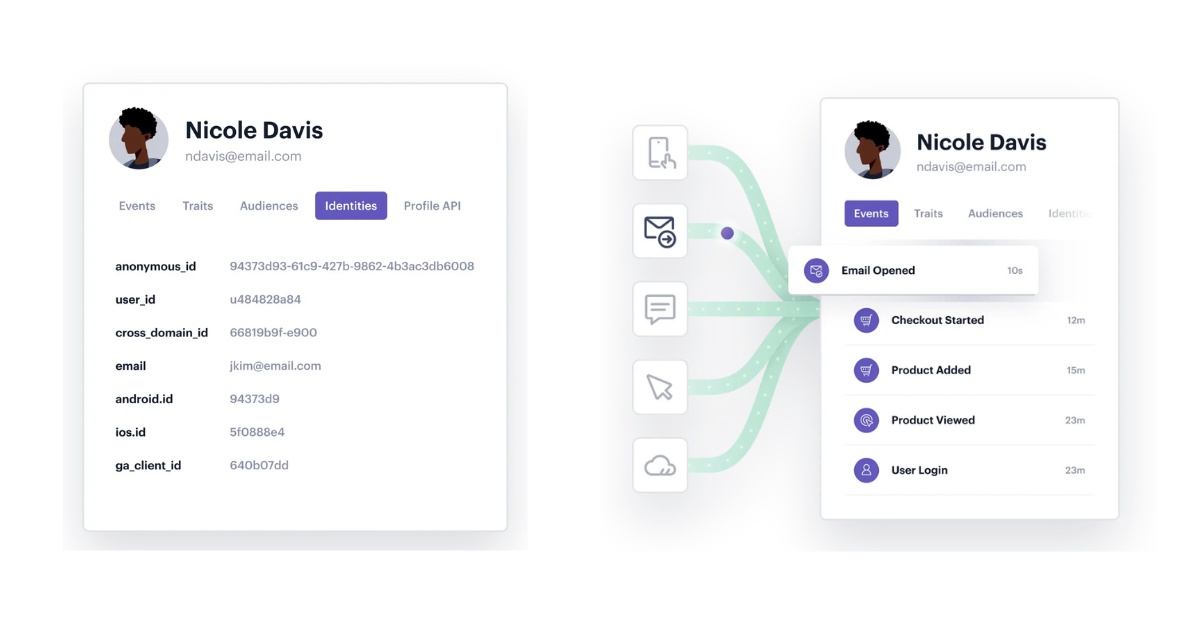
Collecting customer data is the first step. Attributing data points to each individual is another matter entirely – and it can quickly get complex. How do you track users as they switch between devices and channels? How do you stitch together anonymous user behavior with a known profile, once that person enters your database?
Identity-resolved customer profiles are at the heart of personalized marketing. But building these profiles can sometimes take years due to their complexity. With Twilio Segment, businesses can leverage deterministic identity resolution to merge complete customer histories into a single profile. This profile can then be synced with the data warehouse for further enrichment, and activated in any downstream destination.
Personalize customer experiences in real time
It’s not enough to use someone’s first name to create a personalized experience. Customers are looking for experiences that feel intuitive and seamless, and one of the largest challenges that businesses face is meeting these expectations at scale and in real time.
Examples of this can range from recommending the relevant products for a cross-sell, or a customer support representative having the context of a customer’s previous conversation with chatbot to discern their issue at a faster rate.
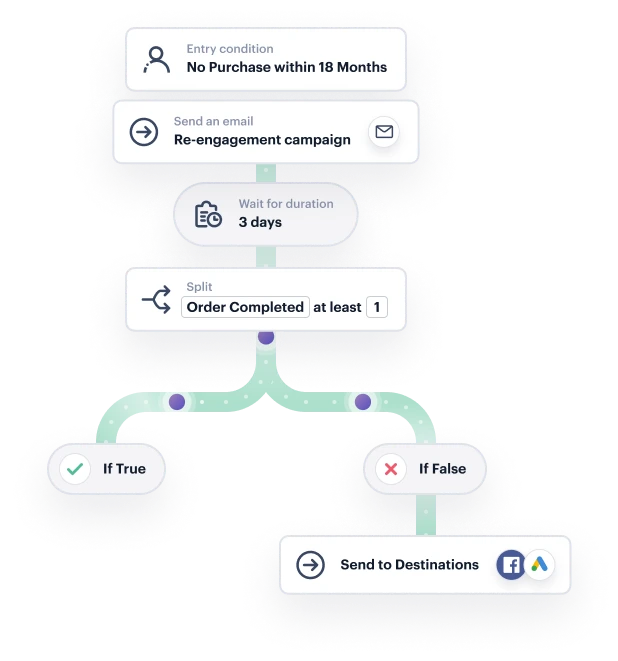
Using real-time customer data, businesses can even orchestrate multi-step, multichannel experiences that adapt based on a person’s behavior in the moment. For example, with Journeys, a marketer can first segment their audience based on people with the lowest engagement rates (e.g., people who haven’t made a purchase in over a year). From there, they can send a re-engagement campaign via email. If a user doesn’t interact with the email, they can then be included in ads on social media channels.
Leverage your first-party data with Twilio Segment
Twilio Segment is a single platform that can be used to collect, clean, consolidate, and activate first-party data. It offers over 400 pre-built integrations with different platforms and tools, along with the ability to create custom Sources and Destinations.
Twilio Segment also comes with features to protect the quality and compliance of data, like:
Automating data governance by enforcing a single tracking plan, standardizing naming conventions, and blocking bad data at the source.
A Privacy Portal that can automatically detect and classify personally identifiable information, and honor user suppression or deletion requests at scale.
The ability to orchestrate multi-channel, personalized customer experiences that adapt based on real-time data.
AI and machine learning models that allow you to predict the likelihood of a user performing a certain action.
As privacy expectations rise and third-party data continues to decline, first-party data collection is no longer just an advantage—it’s a necessity. By leveraging a CDP like Twilio Segment, businesses can unify, activate, and trust their data while ensuring compliance with evolving regulations. Investing in first-party data strategies today sets the foundation for long-term customer relationships, better personalization, and sustainable growth.
Now is the time to take control of your data and future-proof your business.
Frequently asked questions
First-party data is collected directly from your customers when they interact on your website, app, or other owned channels. Second-party data is the trusted first-party data of another site or business, made available to a second party through a use agreement (e.g., sharing leads from a joint webinar). Third-party data is collected by an unrelated third-party entity and may have been aggregated, sold, or shared many times before it gets to the final user.
Businesses can collect first-party data by leveraging real-time event streaming, APIs, website analytics, mobile app interactions, surveys, and more
Twilio Segment is able to collect and consolidate data from across an organization’s tech stack, and ensure that data is clean and compliant. It’s also able to create unified customer profiles that update in real-time, for a 360-degree view of customer behavior, which can then inform highly personalized campaigns.
Ready to see what Twilio Segment can do for you?

The Customer Data Platform Report 2025
Drawing on anonymized insights from thousands of Twilio customers, the Customer Data Platform report explores how companies are using CDPs to unlock the power of their data.
Related Resources
Twilio Docs
From APIs to SDKs to sample apps
API reference documentation, SDKs, helper libraries, quickstarts, and tutorials for your language and platform.
Resource Center
The latest ebooks, industry reports, and webinars
Learn from customer engagement experts to improve your own communication.
Ahoy
Twilio's developer community hub
Best practices, code samples, and inspiration to build communications and digital engagement experiences.