What is Reverse ETL (and how does it work)?
Time to read:
January 25, 2026
Written by
What is Reverse ETL (and how does it work)?
Most enterprises only use about one-third of their data. The rest is locked inside a warehouse, inaccessible to the teams who could actually do something with it.
That's a problem. Data should fuel decisions, personalize customer experiences, and streamline operations...not collect dust in a repository. But when marketing can't access customer insights without filing a ticket with engineering, or sales is working off stale CRM data, all that carefully collected information becomes dead weight.
Reverse ETL fixes this by moving enriched data out of your warehouse and into the tools your teams use every day: CRMs, marketing platforms, analytics dashboards, and support systems.
It's how you turn stored data into activated data.
This guide breaks down what reverse ETL is, how it differs from traditional ETL, the mechanics behind it, and how companies are using it to unlock real business value.
What is Reverse ETL?
Reverse ETL is the process of moving data from a central repository to the downstream tools and applications your teams use. We're talking CRMs, marketing automation platforms, analytics dashboards, support systems, ad networks, and pretty much any other business tool that benefits from better data.
The goal is activation. Your warehouse is full of enriched, cleaned, consolidated customer data. Reverse ETL gets that data out of storage and into the hands of people who can do something with it, whether that's a sales rep working a deal in Salesforce, a marketer building segments in HubSpot, or a support agent prioritizing tickets in Zendesk.
It also solves a consistency problem. Without reverse ETL, teams end up working from different versions of the truth. Marketing sees one set of customer attributes, sales sees another, and support is working off something else entirely.
Reverse ETL keeps data synchronized across your entire tool ecosystem, so everyone's operating from the same playbook.
Traditional ETL vs. Reverse ETL: What's the difference?
If you've worked with data pipelines before, you probably recognize the acronym ETL: Extract, Transform, Load. It's the process of pulling data from various sources, cleaning and structuring it, and loading it into a central repository like a data warehouse.
(There's also ELT, where you load raw data first and transform it inside the warehouse, but that's a different conversation.)
ETL and reverse ETL are essentially mirror images of each other. ETL moves data into the warehouse. Reverse ETL moves data out of it.
Traditional ETL consolidates information from across your business into one place where it can be cleaned, enriched, and modeled. The warehouse becomes your single source of truth.
The problem is that truth doesn't do much good if it stays locked in the warehouse. Your marketing team can't build campaigns from SQL queries. Your sales reps aren't running reports in Snowflake between calls.
They need that data in the tools they're already using.
That's where reverse ETL picks up. It takes the enriched, consolidated data you've built in your warehouse and pushes it back out to business applications.
| ETL | Reverse ETL | |
|---|---|---|
| Direction | Into the warehouse | Out of the warehouse |
| Purpose | Consolidate and enrich data from multiple sources | Activate enriched data in business tools |
| Data sources | Websites, apps, CRMs, payment platforms, APIs | Data warehouse or data lake |
| Destinations | Data warehouse, data lake | CRMs, marketing tools, ad platforms, support systems |
| Primary users | Data engineers, analysts | Marketing, sales, support, product teams |
| Core function | Create a single source of truth | Make that truth accessible and actionable |
Understanding the mechanics of Reverse ETL
Now that we’ve given an overview of Reverse ETL, let’s get into the mechanics of how it works.
Extraction. This involves querying your data warehouse (e.g., via SQL) to extract the specific data that you need.
Transformation. The data that you extract will be in a specific format (data warehouses typically store structured data). So, you may need to transform data so that it matches its target destination. This is where data mapping is pivotal, to trace the movement of data between storage systems and tools into specific fields.
Loading. This is when data is loaded into its target destinations. This can be done via an API integration, manual upload, batch processing, or in real time.
Activation. Once data is loaded into downstream tools and applications, it can be leveraged by internal teams and even trigger specific actions (e.g., launching a personalized customer interaction based on their recent online and offline behavior).
Ongoing Monitoring. As with any process, it’s important to continuously check for quality. Many Reverse ETL tools are able to automatically flag failed syncs or errors to help investigate issues.
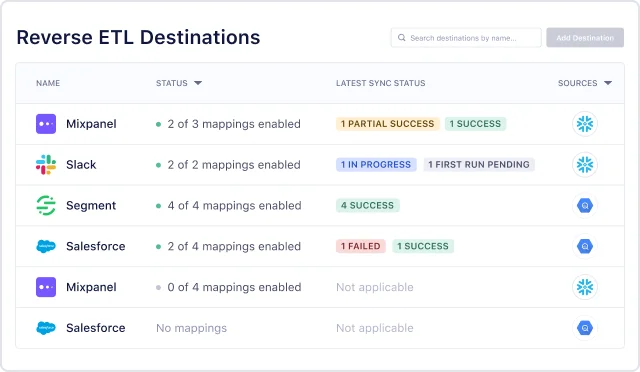
When we talk about Reverse ETL, we tend to focus on four components:
Source: This is where data originated from, which could be a website, cloud application, mobile SDK, etc.
Models: This refers to SQL queries that define and specify which data sets you want to synchronize with downstream tools.
Destinations: These are the tools and applications you want to deliver data to from the data warehouse.
Mapping: This is when you map data from your warehouse to specific fields in your target destinations.
5 challenges to implementing Reverse ETL (and how to overcome them)
Before going ahead with Reverse ETL there are a few things to consider, from team bandwidth to data volume and then the pricing structure of tools.
1. Data volume
The World Economic Forum estimates that by 2025, 463 exabytes of data will be generated daily across the globe. As data volume continues to increase at an exponential rate, businesses need to consider the amount of data they’ll need to extract from their warehouse to send to downstream tools, and how regularly they’ll need to do this to ensure synchronicity. On top of that, pricing for Reverse ETL tools can be tied to data volume, so it’s important to consider this as well.
2. Data integration complexity
Implementing Reverse ETL can be a complex process, for a multitude of reasons. When trying to determine just how complex this will be, consider the following:
Your different data sources, how data is formatted, and how you’ll make this data compatible with your Reverse ETL tool and its target destinations.
How you’ll handle and resolve data inconsistencies to ensure quality at scale.
If the Reverse ETL has pre-built integrations with the tools in your tech stack (to help streamline setup).
3. Privacy & Security
Any time you move potentially sensitive data, whether within an ETL system or Reverse ETL, you introduce security risks. The most apparent risk is data exposure. Data in transit and at rest must be encrypted to protect against unauthorized access, interception, and potential breaches. This encryption should be implemented end-to-end, ensuring that data remains secure throughout its entire journey from the source system to the data warehouse and downstream applications in Reverse ETL.
Data masking might be required for compliance as well as encryption. Depending on your industry and location, you may need to adhere to regulations like GDPR, CCPA, or HIPAA, and thus protecting sensitive information like personally identifiable information (PII) may be a legal requirement.
Data governance, ensuring that only the right people have access to specific data sets, becomes more complex as data is distributed. Role-based access controls (RBAC) to manage who can access what data and audit trails to track data movement and access can help manage these risks.
4. Latency
Often, Reverse ETL data needs to be processed in real-time or near real-time. Slow data updates to the business tools receiving the data can hinder workflows that depend on current information. If data isn't updated quickly enough, it could lead to outdated insights and poor decisions or result in inconsistent or irrelevant customer interactions.
To address latency concerns, you might need to consider implementing change data capture (CDC) to only sync updated data, reducing overall sync times, or optimizing your data models and queries to improve extraction speed.
5. Scalability
As your business grows, so does your data. Ensuring your Reverse ETL process can scale alongside your organization is crucial:
Data volume growth: As you collect more data, your Reverse ETL solution must efficiently handle larger datasets.
Increased sync frequency: More data often means more frequent syncs are necessary to keep systems up-to-date.
Expanding tool ecosystem: As you add more tools and applications, your Reverse ETL process must accommodate new destinations.
To build a scalable Reverse ETL process, choose a Reverse ETL tool that can handle large data volumes and high-frequency syncs. Cloud-based solutions are ideal here as they automatically scale resources based on demand. But scalability goes beyond just the tools. You also have to think critically about proper data modeling and partitioning strategies in your warehouse to optimize for scale. You should regularly review and optimize your data sync processes to ensure efficiency as you scale.
The benefits of Reverse ETL
Reverse ETL allows businesses to access and act upon enriched data for better decision-making, customer personalization, and cross-functional collaboration.
Operational efficiency
“Operationalization” doesn’t just mean using something. In scientific research, it means making an abstract concept concretely measurable.
In the same way, data that sits in a warehouse has a vague potential to contribute value to your business. But when you use it in business apps or tools, you turn it into a central component of marketing campaigns, product development, or business planning.
All departments in a company can operationalize data. For example, finance can create a custom payment plan for B2B customers and send automated follow-up emails using an invoice and accounting software. Or customer support can automatically prioritize incoming requests or tickets based on someone’s payment tier (e.g., premium users) or lifetime value.
Unified view of data
Reverse ETL prevents data from being locked inside its repository. It helps empower internal teams with holistic data sets, rather than limiting them to the data that they can access in their owned tools (e.g., product teams are given a list of high-value customers and give them beta access to a new feature in their SaaS app).
As a result, Reverse ETL helps break down data silos and make enriched data sets more accessible across an organization (rather than relying solely on engineers or analysts to manually pull data).
One application of Reverse ETL is the creation of profiles, or a single, comprehensive view of each customer. By joining Twilio Segment's profile data with existing object data from your warehouse, you can create a unified customer view that combines information from various sources. This allows for personalized experiences across all channels, such as matching sales executives with specific customers.
Reverse ETL also enables a deeper understanding of the customer journey. Connecting anonymous IDs, User IDs, and emails allows you to trace a customer's interactions with your business over time, even before they become identified users. This historical, comprehensive view allows you to answer critical questions about customer behavior, such as how often a user has made purchases, whether they've subscribed to services, or what products they've been viewing while browsing anonymously. This enriched data set becomes a powerful tool for building sophisticated attribution models, predicting customer lifetime value, and identifying potential churn risks, ultimately driving more informed business decisions across all departments.
Marketing and sales enablement
Reverse ETL provides marketing and sales teams with enriched, up-to-date data directly in their preferred tools. This enables more targeted campaigns, personalized outreach, and data-driven decision-making. Key applications include:
Syncing your Snowflake customer table to Salesforce: Easily import business and reseller customers into your data warehouse, ensuring your sales team has the most current and comprehensive customer information for effective outreach and relationship management.
Linking offline conversions to online ads for more ROAS visibility: Use Reverse ETL to automatically attribute offline conversions and revenue to the original Google Ads that initiated the customer journey, providing a more accurate picture of your return on ad spend (ROAS) and eliminating the need for manual data uploads.
Asking questions such as what is the best predictor of customer churn? Leverage the unified customer data provided by Reverse ETL to analyze patterns and behaviors that precede customer churn, enabling proactive retention strategies and personalized interventions.
Discovering the traits and behavioral patterns customers with the highest lifetime value have in common: Utilize the comprehensive customer profiles created through Reverse ETL to identify key characteristics and behaviors of your most valuable customers, informing targeted acquisition and retention strategies.
Product development
Reverse ETL helps product development teams by providing comprehensive, real-time data about user behavior, preferences, and interactions. This wealth of information enables product managers and developers to make data-driven decisions, iterate quickly, and create more user-centric products. They can then answer fundamental product questions, such as:
How does the user onboarding experience affect customer loyalty? By syncing user onboarding data with long-term engagement metrics, product teams can analyze the correlation between initial experiences and customer retention, allowing for targeted improvements in the onboarding process to boost loyalty.
What does the customer journey of a certain audience segment look like? Reverse ETL allows product teams to map out detailed customer journeys for specific segments, providing insights into touchpoints, pain points, and opportunities for optimization, which can inform feature prioritization and user experience enhancements.
Does our product recommendation algorithm lead to larger basket sizes? By connecting recommendation data with purchase information, product teams can evaluate the effectiveness of their recommendation algorithms in driving more significant transactions, enabling continuous refinement of these systems to maximize customer value and revenue.
4 real-life examples of Reverse ETL
Reverse ETL has proven to be a game-changer for businesses across various industries, enabling them to leverage their data more effectively and drive tangible results. Here's how four companies have successfully implemented Reverse ETL to transform their operations.
Crossfit
By implementing Reverse ETL with Twilio Segment, CrossFit consolidated data from its three distinct business lines (Gym Affiliates, Education, and Sport), creating a unified view of its customers. This enabled them to build more targeted marketing campaigns, resulting in a 24% increase in CrossFit Open registration click rates and saving 10-15 hours per campaign through automation.
Read more: CrossFit Customer Case Study
Sanofi
The global healthcare leader used Reverse ETL to create "golden profiles" of healthcare professionals (HCPs) by combining online and offline data sources. This allowed Sanofi to deliver personalized, omnichannel communications to HCPs, significantly improving their ability to educate doctors about new medications and treatments, ultimately leading to better patient outcomes.
MongoDB
The database company leveraged Reverse ETL to provide developers with timely product information, increasing engagement and revenue. By creating comprehensive customer profiles and activating them across various channels, MongoDB achieved a 100x increase in registration rates for specific events and significantly improved their return on ad spend (ROAS).
Read more: How MongoDB gave developers timely product information and increased revenue
DAZN
The sports streaming platform utilized Reverse ETL to enhance fan engagement during live events. By syncing real-time data from their warehouse to downstream tools, DAZN was able to send personalized notifications and implement features like 'group watch'. This data-driven approach resulted in an impressive 18% interaction rate in one of their retention and cross-sell campaigns.
These examples demonstrate how Reverse ETL can be a powerful tool for businesses to unlock the full potential of their data, enabling more personalized customer experiences, improved operational efficiency, and ultimately, driving growth and revenue.
Reverse ETL with Twilio Segment
With Twilio Segment, businesses are able to harness Reverse ETL alongside all the capabilities of a complete customer data platform like real-time identity resolution, profile portability, and automated data governance.
As a result, businesses can enrich their identity-resolved customer profiles in the data warehouse before syncing them with downstream tools for activation.
A key benefit of this is that Twilio Segment provides every type of a data pipeline in one platform (e.g., event streaming, ETL, Reverse ETL) – meaning businesses don’t need to look to multiple different vendors to orchestrate and manage their data.
Frequently asked questions
ETL (extract, transform, load) is the process of collecting data from sources, cleaning and structuring it, and loading it into a repository like a data warehouse or data lake. You may also load the data before transforming it (ELT). In reverse ETL, you copy data from a data warehouse or data lake, transform it, and load it into business SaaS applications.
Sales, marketing, customer support, and revenue operations are common use cases for reverse ETL.
Reverse ETL lets you activate data in the tools and apps that teams use every day, so you can create highly personalized experiences and make strategic decisions. Reverse ETL tools prevent data silos, scale up your analytics, and reduce the time data teams spend manually extracting and preparing data.
Implementing reverse ETL is not without its challenges, which include but are not limited to: 1. Complexity. It can quickly become an intricate process to map data from its storage systems to target destinations, and ensure that data is properly formatted in both locations. 2. Volume. Data is being generated at a rate never before seen, and businesses have to consider how much data they will need to extract, transform, and load, and how often. 3. Data quality. Throughout the reverse ETL process, it’s important to ensure data remains valid, which includes flagging any potential errors or inconsistencies before they reach target destinations. 4. Security. Protecting customer data is essential for every business, and especially for highly regulated industries like healthcare that are held to HIPAA compliance. Ensuring that data has the right access controls and is encrypted while it's synced to external systems is a must.
Yes, reverse ETL can enable real-time data integration (i.e., ensuring data is synchronized and continuously up to date across the tech stack). To do this, the reverse ETL tool needs to detect changes in the data warehouse or source data (e.g., via API notification, event-based triggers, etc.) and should have protocols in place to handle data transformations and error detection. A few other factors will impact a reverse ETL tool’s ability to perform real-time data integration, like low latency connections and the data’s complexity.
Ready to see what Twilio Segment can do for you?

The Customer Data Platform Report 2025
Drawing on anonymized insights from thousands of Twilio customers, the Customer Data Platform report explores how companies are using CDPs to unlock the power of their data.
Related Posts
-
 AI-powered agents for contact center in Australia: containment quality, not deflectionAliakbar Lokhandwala
 -
AI-powered agents for contact center in India: what they can and cannot doAliakbar Lokhandwala
-
AI-powered agents for contact center in Philippines: what the term actually meansAliakbar Lokhandwala
Related Resources
Twilio Docs
From APIs to SDKs to sample apps
API reference documentation, SDKs, helper libraries, quickstarts, and tutorials for your language and platform.
Resource Center
The latest ebooks, industry reports, and webinars
Learn from customer engagement experts to improve your own communication.
Ahoy
Twilio's developer community hub
Best practices, code samples, and inspiration to build communications and digital engagement experiences.