Introducing Conversation Orchestrator: Connected Conversations with Conversation Orchestrator
Time to read:
May 06, 2026
Written by
Reviewed by
AI generated summary
- Conversation Orchestrator unifies communications across channels, preserving context without system rearchitecture.
- AI, workflows, and agents operate from shared context, eliminating the need for repeated information across channels.
- Conversation Orchestrator integrates seamlessly with Twilio's tools, ensuring a continuous, context-rich customer experience.
This summary was generated by AI.
Introducing Conversation Orchestrator: Connected Conversations with Conversation Orchestrator
The era of a disconnected experience is over: Conversation Orchestrator is now generally available, providing an engine that bridges the gap between AI, human agents, and every communication channel. It unifies interactions, preserves context across handoffs, and connects everything to a customer profile, without requiring you to rebuild your existing systems. Conversation Orchestrator sits within the Twilio Conversations Layer, a new foundation for building amazing customer experiences.
What is Conversation Orchestrator?
Conversation Orchestrator is an engine that connects channels into one continuous customer conversation, coordinating routing and workflows as interactions move between channels like Voice, SMS, RCS and WhatsApp. It works within your existing Twilio channels with no re-architecture required, or can be implemented via API for deeper control. This engine integrates seamlessly with Conversation Memory, Conversation Intelligence, Enterprise Knowledge, and Twilio Agent Connect to ensure context follows the customer.
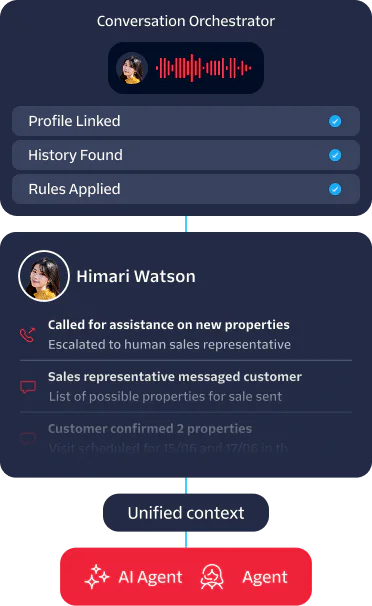
What you can build with Conversation Orchestrator
- AI-to-human escalation with full context: Transition from AI to a live agent without restarting the interaction
- Cross-channel continuity: Move between Messaging and Voice as part of the same conversation
- Persistent conversations across return visits: Pick up where the customer left off, even days or weeks later
- Unified interaction history across systems: Access one complete thread instead of separate channel sessions
Example: A connected customer journey
- Calls the dealership: A customer initiates a voice interaction to schedule an appointment for a specific vehicle.
- Sets up a test drive: The system identifies an open slot and confirms a booking for Thursday at 3 PM with Brian.
- An AI agent handles the conversation: The AI transitions to SMS to provide a formal confirmation and answer follow-up technical questions about charging specs.
- The issue escalates with full history: All vehicle preferences and charging concerns are saved and attached to Jordan’s profile for the staff.
- The agent resolves the issue without restating: Brian receives the full context, allowing him to jump straight into the charging demonstration during the physical test drive.
The result: one continuous conversation across channels, systems, and handoffs.
What are the benefits of using Conversation Orchestrator?
- Eliminate repeated questions Customers don’t need to restate context across channels or handoffs
- Maintain continuity across every interaction Conversations persist over time, not just within a single session
- Improve AI and agent effectiveness Every response is based on full conversation history
- Reduce engineering overhead No need to stitch sessions or rebuild context across systems
- Deliver more consistent customer experiences Every interaction feels connected and informed
Why connected conversations matter
Conversation Orchestrator connects each interaction to the right conversation. Conversation Memory brings in full context, while Enterprise Knowledge grounds responses in business-specific information. Conversation Intelligence analyzes what’s happening across the interaction. Twilio Agent Connect provides a reliable, scalable bridge between your AI stack and rich, context-aware customer conversations, so AI agents and human teams can participate in the same continuous conversation.
Frequently Asked Questions
What is the difference between Conversations (classic) and Conversation Orchestrator?
Conversations (classic) powers two-way messaging across channels and will continue to be supported. Conversation Orchestrator unifies all interactions into a single conversation, enabling full context with Conversation Memory and Conversation Intelligence. No migration required, both work together out of the box.
Where does Conversation Orchestrator fit in my architecture?
It sits alongside your existing channels and AI systems as a shared conversation layer. It does not replace them.
How does Conversation Orchestrator work with Conversation Memory, Enterprise Knowledge, Conversation Intelligence and Twilio Agent Connect?
Conversation Orchestrator connects each interaction to the right conversation, Conversation Memory brings in full context, Enterprise Knowledge grounds responses in verified business-specific information from enterprise content and data sources, Conversation Intelligence analyzes what’s happening, and Twilio Agent Connect provides a reliable, scalable bridge between your AI stack and rich, context-aware customer conversations so AI agents, workflows, and human teams can operate together across channels.
What do I need to pass into Conversation Orchestrator?
You’ll work with a conversationId and a customer identifier like a profileId. For handoffs, you can include a short summary.
What do I no longer need to build?
You don’t need to manage per-channel sessions, stitch interactions together, or rebuild context during handoffs.
What parts of the system do I still own?
You continue to manage your AI logic, routing decisions, and message delivery. Conversation Orchestrator keeps every interaction connected in a single continuous conversation, so context carries across channels, workflows, AI agents, and human handoffs.
How do I access conversation history and context?
Use the conversationId to retrieve the full conversation, including history, participants, and state.
Does this require me to use a specific AI vendor?
No. Conversation Orchestrator is AI agent-agnostic, allowing you to connect the AI agents you already use through Twilio Agent Connect.
In short: What is the main problem Conversation Orchestrator solves?
It solves context loss. It prevents the 'reset' that happens when a customer switches channels or moves from an AI bot to a human agent, ensuring a seamless, one-thread experience.
Start building
So what does it actually take to deliver a continuous, intelligent customer experience?
It starts with bringing every interaction into one conversation, where continuity, context, actionability, and coordination all come together.
Conversation Orchestrator powers that foundation by connecting Voice and Messaging into a single, continuous thread, while working alongside:
- Conversation Memory to persist customer history and preferences over time
- Enterprise Knowledge to ground AI agents in your business-specific data and policies
- Conversation Intelligence for real-time context and insights
- Twilio Agent Connect to take action directly within the conversation
Together, this is how every interaction builds on the last. Conversation Orchestrator adds the engine that brings it all together so context carries forward, systems stay in sync, and every conversation feels connected. Learn more by reading the docs.

Related Resources
Twilio Docs
From APIs to SDKs to sample apps
API reference documentation, SDKs, helper libraries, quickstarts, and tutorials for your language and platform.
Resource Center
The latest ebooks, industry reports, and webinars
Learn from customer engagement experts to improve your own communication.
Ahoy
Twilio's developer community hub
Best practices, code samples, and inspiration to build communications and digital engagement experiences.