All-in-one builder toolbox for Voice
Whether you’re new to Voice or building advanced call features, you’ll find everything you need to design, develop, and optimize seamless experiences.

Liftoff with Twilio Voice
Our Liftoff series breaks down the basics of how to build with Voice products.
Docs
Tutorials
Guides
What we’ve been building lately
What’s new and coming next

ROI of branded calling
See the full story, not just surface stats — know who answers, when, and why. Spot patterns behind friction and trust. Prove every improvement with numbers that speak for themselves.
FAQs
The Twilio Voice API lets developers make, receive, and control phone calls via code. Build IVRs, voice assistants, and real-time call analytics using TwiML and REST APIs.
Twilio Voice SDKs support Node.js, Python, C#, Java, PHP, and Ruby, with detailed examples in each language.
TwiML (Twilio Markup Language) is XML that tells Twilio how to handle calls—like playing audio, recording, or routing.
Yes. Use TwiML < Record > for recording and Conversational Intelligence for real-time transcription and analytics.
Use Twilio Studio or code it with TwiML < Gather > to create interactive menus for routing calls.
Twilio supports SIP Interface and Elastic SIP Trunking to connect on-premise or cloud PBXs to the Twilio cloud.
Voice Insights provides real-time call metrics and post-call analytics to track performance and resolve issues.
Use the Voice Insights API or Event Streams to access call performance data and export to analytics tools.
Build now, buy later.
Start for free. Sign up for a free trial—no credit card required.

All-in-one builder toolbox for Voice
Whether you’re new to Voice or building advanced call features, you’ll find everything you need to design, develop, and optimize seamless experiences.
Get started fast
What will you build next? Here are some resources to get started on your first Voice project.
Liftoff with Twilio Voice
Our Liftoff series breaks down the basics of how to build with Voice products.
Get Building
Dig into our up-to-date docs, tutorials, and guides to get started with your Twilio project.
Docs
Tutorials
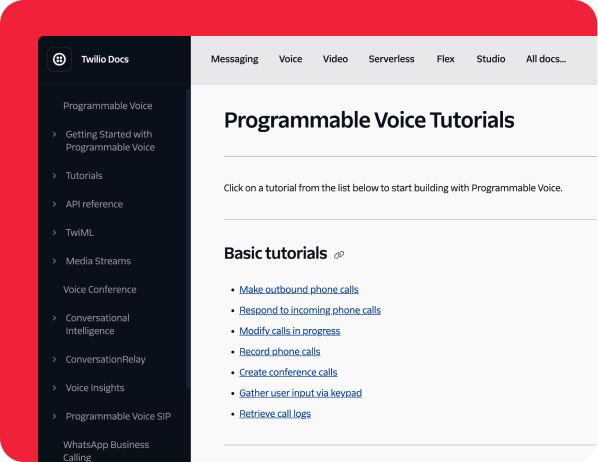
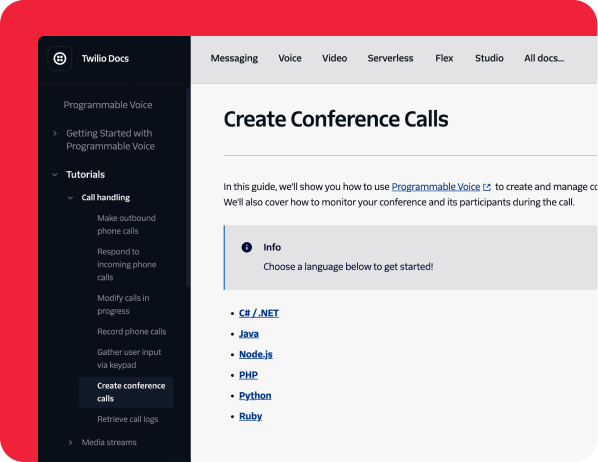
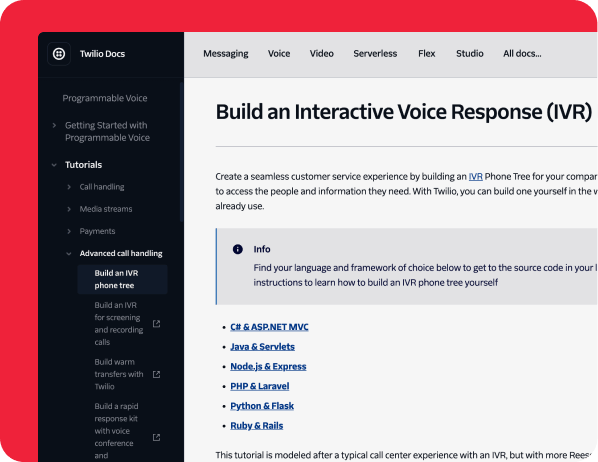
Everyone can be a builder
Twilio is for every kind of builder. Get started with our guides or explore partners for pre-built solutions.
Guides





Innovation & Trends
Stay ahead of the curve with the latest industry innovations and insights.
What we’ve been building lately



What’s new and coming next



ROI of branded calling
See the full story, not just surface stats — know who answers, when, and why. Spot patterns behind friction and trust. Prove every improvement with numbers that speak for themselves.
Best practices & continued learning
We’ve already done the exploration, prototyping, testing, and troubleshooting so you don’t have to.






Product Mastery
Become an expert Twilio builder with advanced tutorials and guides.





Community & collaboration
Connect, share, and grow with other developers who build with Twilio tools.




FAQs
The Twilio Voice API lets developers make, receive, and control phone calls via code. Build IVRs, voice assistants, and real-time call analytics using TwiML and REST APIs.
Twilio Voice SDKs support Node.js, Python, C#, Java, PHP, and Ruby, with detailed examples in each language.
TwiML (Twilio Markup Language) is XML that tells Twilio how to handle calls—like playing audio, recording, or routing.
Yes. Use TwiML < Record > for recording and Conversational Intelligence for real-time transcription and analytics.
Use Twilio Studio or code it with TwiML < Gather > to create interactive menus for routing calls.
Twilio supports SIP Interface and Elastic SIP Trunking to connect on-premise or cloud PBXs to the Twilio cloud.
Voice Insights provides real-time call metrics and post-call analytics to track performance and resolve issues.
Use the Voice Insights API or Event Streams to access call performance data and export to analytics tools.
Build now, buy later.
Start for free. Sign up for a free trial—no credit card required.
Let's find the right products for you
Generating your product picks...
See your product picks
For the best recommendations, tell me your use case, goals, requirements, etc.
Generating...
Complete
Thinking...
Finding the best products for your use case
R.I.P.
Something went wrong.
Generating Toolkit... See your toolkit
Ready, set, build! Resources to get started
Put the toolkit to use
Not quite what you're looking for? You can .
This product recommendation tool is powered by a hybrid AI system (Twilio and OpenAI) and may generate information that is inaccurate or incomplete. Recommendations are algorithmic, not professional advice. You should independently verify this information before use. By using this tool, you agree that your input is processed by both Twilio's internal systems and external OpenAI models to generate a response. You are responsible for any information you share. Twilio is not responsible for your use of this generated information, and this use does not modify your Twilio agreement if one is in place. Review our Privacy Notice for additional details on how we use data.